5MTD | pdb_00005mtd

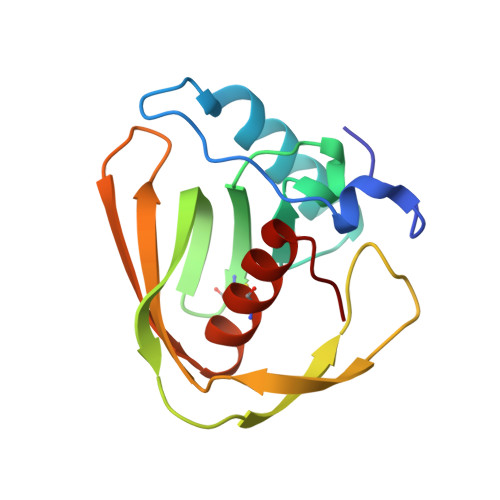
Crystal structure of PDF from the Vibrio parahaemolyticus bacteriophage VP16T - crystal form II


Experimental Data Snapshot

  • Method: X-RAY DIFFRACTION
  • Resolution: 1.50 Å
  • R-Value Free: 
    0.210 (Depositor), 0.206 (DCC) 
  • R-Value Work: 
    0.187 (Depositor), 0.184 (DCC) 
  • R-Value Observed: 
    0.188 (Depositor) 

Starting Model: experimental
View more details

wwPDB Validation 3D Report Full Report

Validation slider image for 5MTD

This is version 1.2 of the entry. See complete history

Literature

The C-terminal residue of phage Vp16 PDF, the smallest peptide deformylase, acts as an offset element locking the active conformation.

Grzela, R.Nusbaum, J.Fieulaine, S.Lavecchia, F.Bienvenut, W.V.Dian, C.Meinnel, T.Giglione, C.

(2017) Sci Rep 7: 11041-11041

  • DOI: https://doi.org/10.1038/s41598-017-11329-3
  • Primary Citation Related Structures: 
    5MTC, 5MTD

  • PubMed Abstract: 

    Prokaryotic proteins must be deformylated before the removal of their first methionine. Peptide deformylase (PDF) is indispensable and guarantees this mechanism. Recent metagenomics studies revealed new idiosyncratic PDF forms as the most abundant family of viral sequences. Little is known regarding these viral PDFs, including the capacity of the corresponding encoded proteins to ensure deformylase activity. We provide here the first evidence that viral PDFs, including the shortest PDF identified to date, Vp16 PDF, display deformylase activity in vivo, despite the absence of the key ribosome-interacting C-terminal region. Moreover, characterization of phage Vp16 PDF underscores unexpected structural and molecular features with the C-terminal Isoleucine residue significantly contributing to deformylase activity both in vitro and in vivo. This residue fully compensates for the absence of the usual long C-domain. Taken together, these data elucidate an unexpected mechanism of enzyme natural evolution and adaptation within viral sequences.


  • Organizational Affiliation
    • Institute for Integrative Biology of the Cell (I2BC), CEA, CNRS, Univ. Paris-Sud, Université Paris-Saclay, 91198, Gif-sur-Yvette Cedex, Paris, France.

Macromolecule Content 

  • Total Structure Weight: 30.22 kDa 
  • Atom Count: 2,405 
  • Modeled Residue Count: 274 
  • Deposited Residue Count: 274 
  • Unique protein chains: 1

Macromolecules

Find similar proteins by:|  3D Structure
Entity ID: 1
MoleculeChains  Sequence LengthOrganismDetailsImage
Putative uncharacterized protein orf60T
A, B
137Vibrio phage VP16TMutation(s): 0 
Gene Names: orf60T
UniProt
Find proteins for A0ACD6B856 (Vibrio phage VP16T)
Explore A0ACD6B856 
Go to UniProtKB:  A0ACD6B856
Entity Groups
Sequence Clusters30% Identity50% Identity70% Identity90% Identity95% Identity100% Identity
UniProt GroupA0ACD6B856
Sequence Annotations
Expand
Reference Sequence

Small Molecules

Ligands 3 Unique
IDChains Name / Formula / InChI Key2D Diagram3D Interactions
PGE

Query on PGE


Download:Ideal Coordinates CCD File
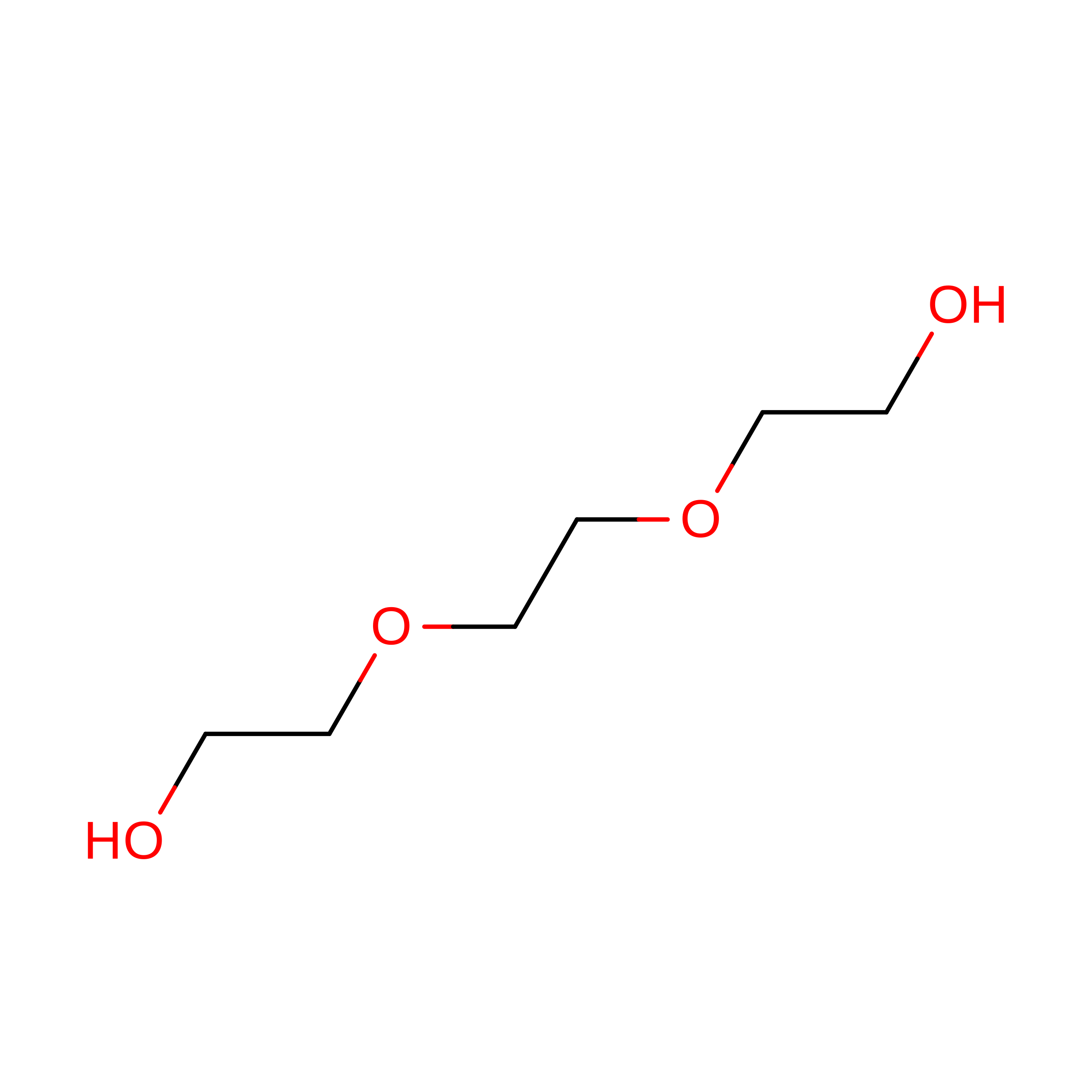
C [auth A],
H [auth B]
TRIETHYLENE GLYCOL
C6 H14 O4
ZIBGPFATKBEMQZ-UHFFFAOYSA-N
ZN

Query on ZN


Download:Ideal Coordinates CCD File
D [auth A],
I [auth B]
ZINC ION
Zn
PTFCDOFLOPIGGS-UHFFFAOYSA-N
NI

Query on NI


Download:Ideal Coordinates CCD File
E [auth A],
F [auth A],
G [auth A]
NICKEL (II) ION
Ni
VEQPNABPJHWNSG-UHFFFAOYSA-N

Experimental Data & Validation

Experimental Data

  • Method: X-RAY DIFFRACTION
  • Resolution: 1.50 Å
  • R-Value Free:  0.210 (Depositor), 0.206 (DCC) 
  • R-Value Work:  0.187 (Depositor), 0.184 (DCC) 
  • R-Value Observed: 0.188 (Depositor) 
Space Group: P 32 2 1
Unit Cell:
Length ( Å )Angle ( ˚ )
a = 64.26α = 90
b = 64.26β = 90
c = 125.69γ = 120
Software Package:
Software NamePurpose
REFMACrefinement
XDSdata reduction
XDSdata scaling
PHASERphasing

Structure Validation

View Full Validation Report


Entry History 

& Funding Information

Deposition Data


Funding OrganizationLocationGrant Number
French National Research AgencyFranceANR-10-Blanc-1510

Revision History  (Full details and data files)

  • Version 1.0: 2017-09-20
    Type: Initial release
  • Version 1.1: 2024-01-17
    Changes: Data collection, Database references, Derived calculations, Refinement description
  • Version 1.2: 2024-11-20
    Changes: Structure summary