5MIL | pdb_00005mil

Pirating conserved phage mechanisms promotes promiscuous staphylococcal pathogenicity islands transfer.


Experimental Data Snapshot

  • Method: X-RAY DIFFRACTION
  • Resolution: 2.10 Å
  • R-Value Free: 
    0.244 (Depositor), 0.246 (DCC) 
  • R-Value Work: 
    0.186 (Depositor), 0.188 (DCC) 
  • R-Value Observed: 
    0.189 (Depositor) 

wwPDB Validation 3D Report Full Report

Validation slider image for 5MIL

Ligand Structure Quality Assessment 


This is version 1.2 of the entry. See complete history

Literature

Pirating conserved phage mechanisms promotes promiscuous staphylococcal pathogenicity island transfer.

Bowring, J.Neamah, M.M.Donderis, J.Mir-Sanchis, I.Alite, C.Ciges-Tomas, J.R.Maiques, E.Medmedov, I.Marina, A.Penades, J.R.

(2017) Elife 6

  • DOI: https://doi.org/10.7554/eLife.26487
  • Primary Citation Related Structures: 
    5MIL

  • PubMed Abstract: 

    Targeting conserved and essential processes is a successful strategy to combat enemies. Remarkably, the clinically important Staphylococcus aureus pathogenicity islands (SaPIs) use this tactic to spread in nature. SaPIs reside passively in the host chromosome, under the control of the SaPI-encoded master repressor, Stl. It has been assumed that SaPI de-repression is effected by specific phage proteins that bind to Stl, initiating the SaPI cycle. Different SaPIs encode different Stl repressors, so each targets a specific phage protein for its de-repression. Broadening this narrow vision, we report here that SaPIs ensure their promiscuous transfer by targeting conserved phage mechanisms. This is accomplished because the SaPI Stl repressors have acquired different domains to interact with unrelated proteins, encoded by different phages, but in all cases performing the same conserved function. This elegant strategy allows intra- and inter-generic SaPI transfer, highlighting these elements as one of nature's most fascinating subcellular parasites.


  • Organizational Affiliation
    • Institute of Infection, Immunity and Inflammation, College of Medical, Veterinary and Life Sciences, University of Glasgow, Glasgow, United Kingdom.

Macromolecule Content 

  • Total Structure Weight: 46.82 kDa 
  • Atom Count: 2,506 
  • Modeled Residue Count: 313 
  • Deposited Residue Count: 404 
  • Unique protein chains: 1

Macromolecules

Find similar proteins by:|  3D Structure
Entity ID: 1
MoleculeChains  Sequence LengthOrganismDetailsImage
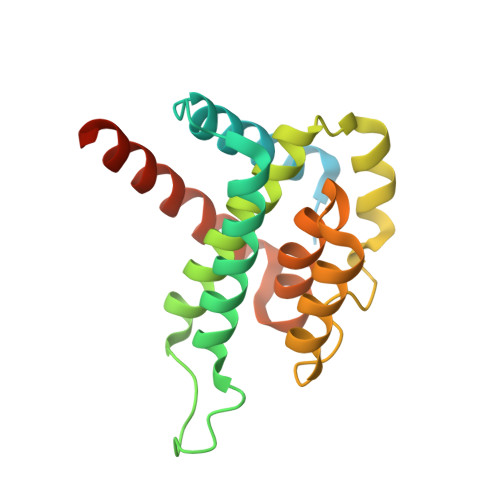
DUTPase family protein
A, B
202Staphylococcus aureusMutation(s): 0 
Gene Names: SAMEA2445607_02743
UniProt
Find proteins for Q4ZDP4 (Staphylococcus phage 69)
Explore Q4ZDP4 
Go to UniProtKB:  Q4ZDP4
Entity Groups
Sequence Clusters30% Identity50% Identity70% Identity90% Identity95% Identity100% Identity
UniProt GroupQ4ZDP4
Sequence Annotations
Expand
Reference Sequence

Experimental Data & Validation

Experimental Data

  • Method: X-RAY DIFFRACTION
  • Resolution: 2.10 Å
  • R-Value Free:  0.244 (Depositor), 0.246 (DCC) 
  • R-Value Work:  0.186 (Depositor), 0.188 (DCC) 
  • R-Value Observed: 0.189 (Depositor) 
Space Group: P 1 21 1
Unit Cell:
Length ( Å )Angle ( ˚ )
a = 33.47α = 90
b = 88.84β = 91.68
c = 54.15γ = 90
Software Package:
Software NamePurpose
PHENIXrefinement
XDSdata reduction
Aimlessdata scaling
PHASERphasing

Structure Validation

View Full Validation Report


Ligand Structure Quality Assessment 


Entry History 

Deposition Data

Revision History  (Full details and data files)

  • Version 1.0: 2017-09-06
    Type: Initial release
  • Version 1.1: 2017-09-13
    Changes: Database references
  • Version 1.2: 2024-05-08
    Changes: Data collection, Database references, Derived calculations