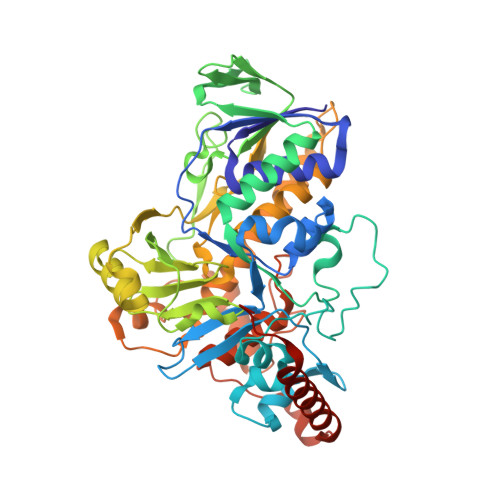
5LV9 | pdb_00005lv9

Crystal structure of thermophilic tryptophan halogenase (Th-Hal) enzyme from Streptomycin violaceusniger.


Experimental Data Snapshot

  • Method: X-RAY DIFFRACTION
  • Resolution: 2.33 Å
  • R-Value Free: 
    0.224 (Depositor), 0.227 (DCC) 
  • R-Value Work: 
    0.179 (Depositor), 0.185 (DCC) 
  • R-Value Observed: 
    0.181 (Depositor) 

wwPDB Validation 3D Report Full Report

Validation slider image for 5LV9

This is version 1.3 of the entry. See complete history

Literature

Structure and biocatalytic scope of thermophilic flavin-dependent halogenase and flavin reductase enzymes.

Menon, B.R.Latham, J.Dunstan, M.S.Brandenburger, E.Klemstein, U.Leys, D.Karthikeyan, C.Greaney, M.F.Shepherd, S.A.Micklefield, J.

(2016) Org Biomol Chem 14: 9354-9361

  • DOI: https://doi.org/10.1039/c6ob01861k
  • Primary Citation Related Structures: 
    5LV9, 5LVA

  • PubMed Abstract: 

    Flavin-dependent halogenase (Fl-Hal) enzymes have been shown to halogenate a range of synthetic as well as natural aromatic compounds. The exquisite regioselectively of Fl-Hal enzymes can provide halogenated building blocks which are inaccessible using standard halogenation chemistries. Consequently, Fl-Hal are potentially useful biocatalysts for the chemoenzymatic synthesis of pharmaceuticals and other valuable products, which are derived from haloaromatic precursors. However, the application of Fl-Hal enzymes, in vitro, has been hampered by their poor catalytic activity and lack of stability. To overcome these issues, we identified a thermophilic tryptophan halogenase (Th-Hal), which has significantly improved catalytic activity and stability, compared with other Fl-Hal characterised to date. When used in combination with a thermostable flavin reductase, Th-Hal can efficiently halogenate a number of aromatic substrates. X-ray crystal structures of Th-Hal, and the reductase partner (Th-Fre), provide insights into the factors that contribute to enzyme stability, which could guide the discovery and engineering of more robust and productive halogenase biocatalysts.


  • Organizational Affiliation
    • School of Chemistry and Manchester Institute of Biotechnology, The University of Manchester, 131 Princess Street, Manchester, M1 7DN, UK. jason.micklefield@manchester.ac.uk.

Macromolecule Content 

  • Total Structure Weight: 115.94 kDa 
  • Atom Count: 8,510 
  • Modeled Residue Count: 1,022 
  • Deposited Residue Count: 1,026 
  • Unique protein chains: 1

Macromolecules

Find similar proteins by:|  3D Structure
Entity ID: 1
MoleculeChains  Sequence LengthOrganismDetailsImage
thermophilic tryptophan halogenase
A, B
513Streptomyces violaceusnigerMutation(s): 0 
UniProt
Find proteins for A0A1L1QK36 (Streptomyces violaceusniger)
Explore A0A1L1QK36 
Go to UniProtKB:  A0A1L1QK36
Entity Groups
Sequence Clusters30% Identity50% Identity70% Identity90% Identity95% Identity100% Identity
UniProt GroupA0A1L1QK36
Sequence Annotations
Expand
Reference Sequence

Experimental Data & Validation

Experimental Data

  • Method: X-RAY DIFFRACTION
  • Resolution: 2.33 Å
  • R-Value Free:  0.224 (Depositor), 0.227 (DCC) 
  • R-Value Work:  0.179 (Depositor), 0.185 (DCC) 
  • R-Value Observed: 0.181 (Depositor) 
Space Group: P 65
Unit Cell:
Length ( Å )Angle ( ˚ )
a = 67.14α = 90
b = 67.14β = 90
c = 477.37γ = 120
Software Package:
Software NamePurpose
PHENIXrefinement
PDB_EXTRACTdata extraction
XDSdata reduction
XDSdata scaling
PHASERphasing

Structure Validation

View Full Validation Report


Entry History 

& Funding Information

Deposition Data


Funding OrganizationLocationGrant Number
Biotechnology and Biological Sciences Research CouncilUnited Kingdom--

Revision History  (Full details and data files)

  • Version 1.0: 2016-10-19
    Type: Initial release
  • Version 1.1: 2017-08-30
    Changes: Author supporting evidence
  • Version 1.2: 2019-10-16
    Changes: Data collection
  • Version 1.3: 2024-05-08
    Changes: Data collection, Database references