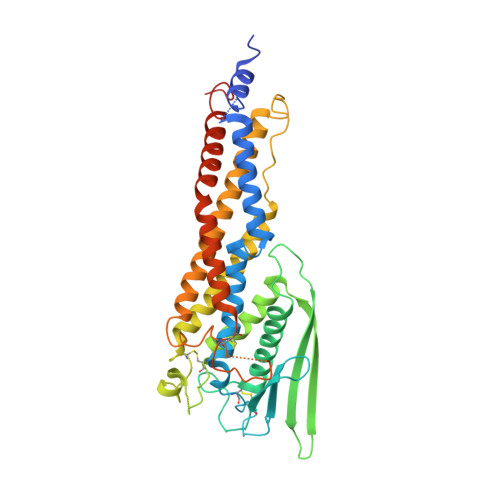
5LP2 | pdb_00005lp2

Adhesin domain of the type 1 HopQ of Helicobacter pylori strain G27


Experimental Data Snapshot

  • Method: X-RAY DIFFRACTION
  • Resolution: 2.60 Å
  • R-Value Free: 
    0.236 (Depositor), 0.239 (DCC) 
  • R-Value Work: 
    0.208 (Depositor), 0.215 (DCC) 
  • R-Value Observed: 
    0.209 (Depositor) 

Starting Model: experimental
View more details

wwPDB Validation 3D Report Full Report

Validation slider image for 5LP2

This is version 1.3 of the entry. See complete history

Literature

Helicobacter pylori adhesin HopQ engages in a virulence-enhancing interaction with human CEACAMs.

Javaheri, A.Kruse, T.Moonens, K.Mejias-Luque, R.Debraekeleer, A.Asche, C.I.Tegtmeyer, N.Kalali, B.Bach, N.C.Sieber, S.A.Hill, D.J.Koniger, V.Hauck, C.R.Moskalenko, R.Haas, R.Busch, D.H.Klaile, E.Slevogt, H.Schmidt, A.Backert, S.Remaut, H.Singer, B.B.Gerhard, M.

(2016) Nat Microbiol 2: 16189-16189

  • DOI: https://doi.org/10.1038/nmicrobiol.2016.189
  • Primary Citation Related Structures: 
    5LP2

  • PubMed Abstract: 

    Helicobacter pylori specifically colonizes the human gastric epithelium and is the major causative agent for ulcer disease and gastric cancer development. Here, we identify members of the carcinoembryonic antigen-related cell adhesion molecule (CEACAM) family as receptors of H. pylori and show that HopQ is the surface-exposed adhesin that specifically binds human CEACAM1, CEACAM3, CEACAM5 and CEACAM6. HopQ-CEACAM binding is glycan-independent and targeted to the N-domain. H. pylori binding induces CEACAM1-mediated signalling, and the HopQ-CEACAM1 interaction enables translocation of the virulence factor CagA into host cells and enhances the release of pro-inflammatory mediators such as interleukin-8. Based on the crystal structure of HopQ, we found that a β-hairpin insertion (HopQ-ID) in HopQ's extracellular 3+4 helix bundle domain is important for CEACAM binding. A peptide derived from this domain competitively inhibits HopQ-mediated activation of the Cag virulence pathway, as genetic or antibody-mediated abrogation of the HopQ function shows. Together, our data suggest the HopQ-CEACAM1 interaction to be a potentially promising novel therapeutic target to combat H. pylori-associated diseases.


  • Organizational Affiliation
    • Institute for Medical Microbiology, Immunology and Hygiene, Technische Universität München, 81675 Munich, Germany.

Macromolecule Content 

  • Total Structure Weight: 186.52 kDa 
  • Atom Count: 10,987 
  • Modeled Residue Count: 1,440 
  • Deposited Residue Count: 1,736 
  • Unique protein chains: 1

Macromolecules

Find similar proteins by:|  3D Structure
Entity ID: 1
MoleculeChains  Sequence LengthOrganismDetailsImage
HopQA [auth B],
B [auth A],
C,
D
434Helicobacter pylori G27Mutation(s): 0 
Gene Names: hopQHPG27_1120
UniProt
Find proteins for B5Z8H1 (Helicobacter pylori (strain G27))
Explore B5Z8H1 
Go to UniProtKB:  B5Z8H1
Entity Groups
Sequence Clusters30% Identity50% Identity70% Identity90% Identity95% Identity100% Identity
UniProt GroupB5Z8H1
Sequence Annotations
Expand
Reference Sequence

Experimental Data & Validation

Experimental Data

  • Method: X-RAY DIFFRACTION
  • Resolution: 2.60 Å
  • R-Value Free:  0.236 (Depositor), 0.239 (DCC) 
  • R-Value Work:  0.208 (Depositor), 0.215 (DCC) 
  • R-Value Observed: 0.209 (Depositor) 
Space Group: P 1 21 1
Unit Cell:
Length ( Å )Angle ( ˚ )
a = 57.7α = 90
b = 57.7β = 90.1
c = 285.6γ = 90
Software Package:
Software NamePurpose
REFMACrefinement
XDSdata reduction
XSCALEdata scaling
PHASERphasing

Structure Validation

View Full Validation Report


Entry History 

& Funding Information

Deposition Data


Funding OrganizationLocationGrant Number
FWOBelgiumG.0902.09

Revision History  (Full details and data files)

  • Version 1.0: 2016-10-12
    Type: Initial release
  • Version 1.1: 2016-10-26
    Changes: Database references
  • Version 1.2: 2024-01-10
    Changes: Data collection, Database references, Refinement description
  • Version 1.3: 2024-11-06
    Changes: Structure summary