5LE0 | pdb_00005le0

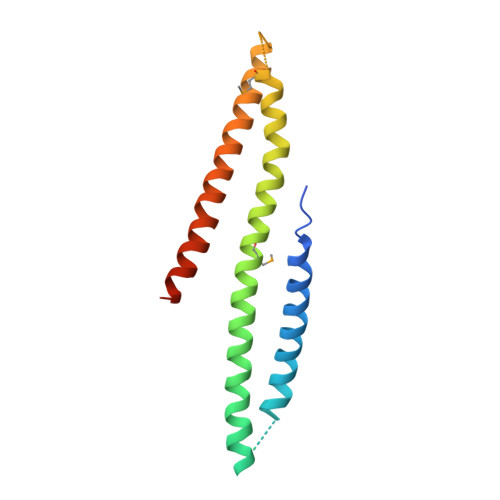
MICAL1 Cterminal domain


Experimental Data Snapshot

  • Method: X-RAY DIFFRACTION
  • Resolution: 3.30 Å
  • R-Value Free: 
    0.306 (Depositor), 0.311 (DCC) 
  • R-Value Work: 
    0.271 (Depositor), 0.274 (DCC) 
  • R-Value Observed: 
    0.273 (Depositor) 

wwPDB Validation 3D Report Full Report

Validation slider image for 5LE0

This is version 1.2 of the entry. See complete history

Literature

Oxidation of F-actin controls the terminal steps of cytokinesis.

Fremont, S.Hammich, H.Bai, J.Wioland, H.Klinkert, K.Rocancourt, M.Kikuti, C.Stroebel, D.Romet-Lemonne, G.Pylypenko, O.Houdusse, A.Echard, A.

(2017) Nat Commun 8: 14528-14528

  • DOI: https://doi.org/10.1038/ncomms14528
  • Primary Citation Related Structures: 
    5LE0

  • PubMed Abstract: 

    Cytokinetic abscission, the terminal step of cell division, crucially depends on the local constriction of ESCRT-III helices after cytoskeleton disassembly. While the microtubules of the intercellular bridge are cut by the ESCRT-associated enzyme Spastin, the mechanism that clears F-actin at the abscission site is unknown. Here we show that oxidation-mediated depolymerization of actin by the redox enzyme MICAL1 is key for ESCRT-III recruitment and successful abscission. MICAL1 is recruited to the abscission site by the Rab35 GTPase through a direct interaction with a flat three-helix domain found in MICAL1 C terminus. Mechanistically, in vitro assays on single actin filaments demonstrate that MICAL1 is activated by Rab35. Moreover, in our experimental conditions, MICAL1 does not act as a severing enzyme, as initially thought, but instead induces F-actin depolymerization from both ends. Our work reveals an unexpected role for oxidoreduction in triggering local actin depolymerization to control a fundamental step of cell division.


  • Organizational Affiliation
    • Membrane Traffic and Cell Division Lab, Cell Biology and Infection Department Institut Pasteur, 25-28 rue du Dr Roux, 75724 Paris Cedex 15, France.

Macromolecule Content 

  • Total Structure Weight: 17.67 kDa 
  • Atom Count: 956 
  • Modeled Residue Count: 123 
  • Deposited Residue Count: 150 
  • Unique protein chains: 1

Macromolecules

Find similar proteins by:|  3D Structure
Entity ID: 1
MoleculeChains  Sequence LengthOrganismDetailsImage
Protein-methionine sulfoxide oxidase MICAL1A [auth B]150Homo sapiensMutation(s): 0 
Gene Names: MICAL1MICALNICAL
EC: 1.14.13 (PDB Primary Data), 1.6.3.1 (UniProt), 1.14.13.225 (UniProt)
UniProt & NIH Common Fund Data Resources
Find proteins for Q8TDZ2 (Homo sapiens)
Explore Q8TDZ2 
Go to UniProtKB:  Q8TDZ2
PHAROS:  Q8TDZ2
GTEx:  ENSG00000135596 
Entity Groups
Sequence Clusters30% Identity50% Identity70% Identity90% Identity95% Identity100% Identity
UniProt GroupQ8TDZ2
Sequence Annotations
Expand
Reference Sequence

Small Molecules

Modified Residues  1 Unique
IDChains TypeFormula2D DiagramParent
MSE
Query on MSE
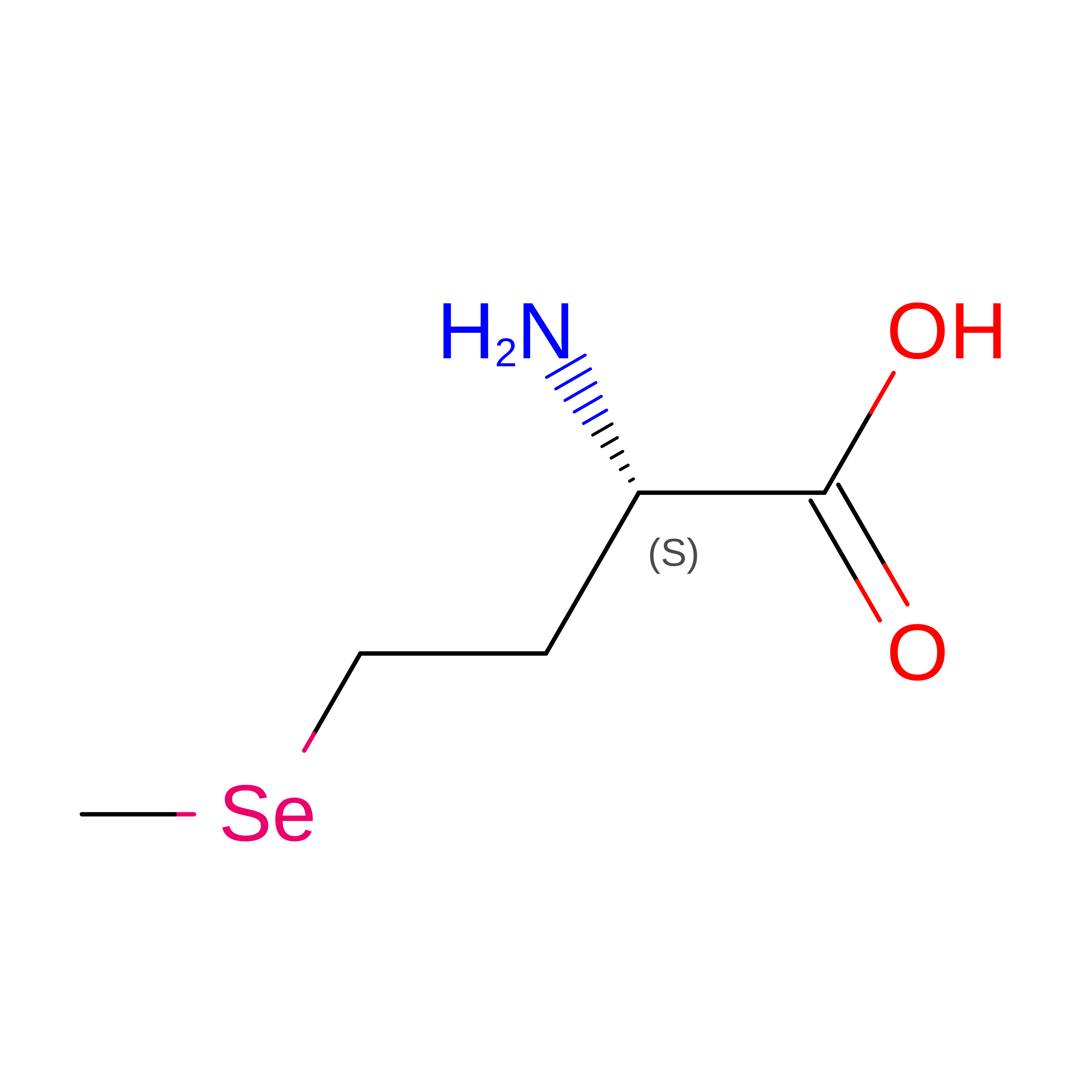
A [auth B]L-PEPTIDE LINKINGC5 H11 N O2 SeMET

Experimental Data & Validation

Experimental Data

  • Method: X-RAY DIFFRACTION
  • Resolution: 3.30 Å
  • R-Value Free:  0.306 (Depositor), 0.311 (DCC) 
  • R-Value Work:  0.271 (Depositor), 0.274 (DCC) 
  • R-Value Observed: 0.273 (Depositor) 
Space Group: P 43 2 2
Unit Cell:
Length ( Å )Angle ( ˚ )
a = 52.78α = 90
b = 52.78β = 90
c = 157γ = 90
Software Package:
Software NamePurpose
PHENIXrefinement
XDSdata reduction
PHENIXphasing

Structure Validation

View Full Validation Report


Entry History 

Deposition Data

Revision History  (Full details and data files)

  • Version 1.0: 2017-03-01
    Type: Initial release
  • Version 1.1: 2017-03-08
    Changes: Database references
  • Version 1.2: 2024-11-13
    Changes: Data collection, Database references, Structure summary