5L8Z | pdb_00005l8z

Structure of thermostable DNA-binding HU protein from micoplasma Spiroplasma melliferum


Experimental Data Snapshot

  • Method: X-RAY DIFFRACTION
  • Resolution: 1.40 Å
  • R-Value Free: 
    0.211 (Depositor), 0.212 (DCC) 
  • R-Value Work: 
    0.180 (Depositor), 0.183 (DCC) 
  • R-Value Observed: 
    0.181 (Depositor) 

Starting Model: experimental
View more details

wwPDB Validation 3D Report Full Report

Validation slider image for 5L8Z

This is version 1.2 of the entry. See complete history

Literature

Structural basis of the high thermal stability of the histone-like HU protein from the mollicute Spiroplasma melliferum KC3.

Boyko, K.M.Rakitina, T.V.Korzhenevskiy, D.A.Vlaskina, A.V.Agapova, Y.K.Kamashev, D.E.Kleymenov, S.Y.Popov, V.O.

(2016) Sci Rep 6: 36366-36366

  • DOI: https://doi.org/10.1038/srep36366
  • Primary Citation Related Structures: 
    5L8Z

  • PubMed Abstract: 

    The three-dimensional structure of the histone-like HU protein from the mycoplasma Spiroplasma melliferum KC3 (HUSpm) was determined at 1.4 Å resolution, and the thermal stability of the protein was evaluated by differential scanning calorimetry. A detailed analysis revealed that the three-dimensional structure of the HUSpm dimer is similar to that of its bacterial homologues but is characterized by stronger hydrophobic interactions at the dimer interface. This HUSpm dimer interface lacks salt bridges but is stabilized by a larger number of hydrogen bonds. According to the DSC data, HUSpm has a high denaturation temperature, comparable to that of HU proteins from thermophilic bacteria. To elucidate the structural basis of HUSpm thermal stability, we identified amino acid residues potentially responsible for this property and modified them by site-directed mutagenesis. A comparative analysis of the melting curves of mutant and wild-type HUSpm revealed the motifs that play a key role in protein thermal stability: non-conserved phenylalanine residues in the hydrophobic core, an additional hydrophobic loop at the N-terminal region of the protein, the absence of the internal cavity present at the dimer interface of some HU proteins, and the presence of additional hydrogen bonds between the monomers that are missing in homologous proteins.


  • Organizational Affiliation
    • Kurchatov Complex of NBICS-Technologies, National Research Center "Kurchatov Institute", Akad. Kurchatova pl., 1, Moscow, 123182, Russian Federation.

Macromolecule Content 

  • Total Structure Weight: 10.43 kDa 
  • Atom Count: 868 
  • Modeled Residue Count: 95 
  • Deposited Residue Count: 96 
  • Unique protein chains: 1

Macromolecules

Find similar proteins by:|  3D Structure
Entity ID: 1
MoleculeChains  Sequence LengthOrganismDetailsImage
DNA-binding protein96Spiroplasma melliferum KC3Mutation(s): 0 
Gene Names: SPM_000560

Small Molecules

Ligands 1 Unique
IDChains Name / Formula / InChI Key2D Diagram3D Interactions
NA

Query on NA


Download:Ideal Coordinates CCD File
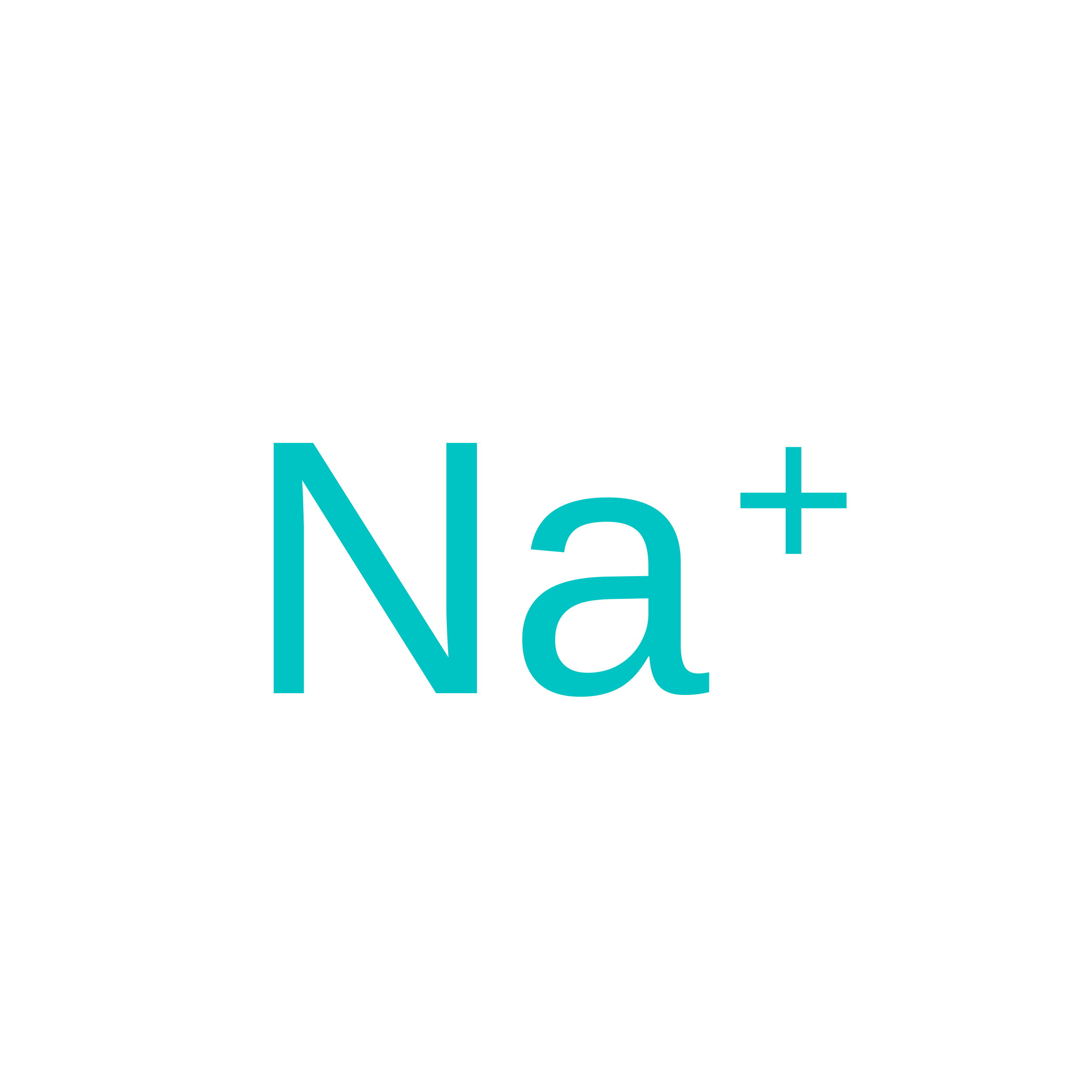
B [auth A]SODIUM ION
Na
FKNQFGJONOIPTF-UHFFFAOYSA-N

Experimental Data & Validation

Experimental Data

  • Method: X-RAY DIFFRACTION
  • Resolution: 1.40 Å
  • R-Value Free:  0.211 (Depositor), 0.212 (DCC) 
  • R-Value Work:  0.180 (Depositor), 0.183 (DCC) 
  • R-Value Observed: 0.181 (Depositor) 
Space Group: C 1 2 1
Unit Cell:
Length ( Å )Angle ( ˚ )
a = 57α = 90
b = 39.01β = 108.36
c = 38.78γ = 90
Software Package:
Software NamePurpose
Aimlessdata scaling
REFMACrefinement
PDB_EXTRACTdata extraction
iMOSFLMdata reduction
BALBESphasing

Structure Validation

View Full Validation Report


Entry History 

& Funding Information

Deposition Data


Funding OrganizationLocationGrant Number
Russian Science FoundationRussian Federation15-14-00063

Revision History  (Full details and data files)

  • Version 1.0: 2016-06-22
    Type: Initial release
  • Version 1.1: 2017-04-12
    Changes: Database references
  • Version 1.2: 2024-01-10
    Changes: Data collection, Database references, Derived calculations, Refinement description