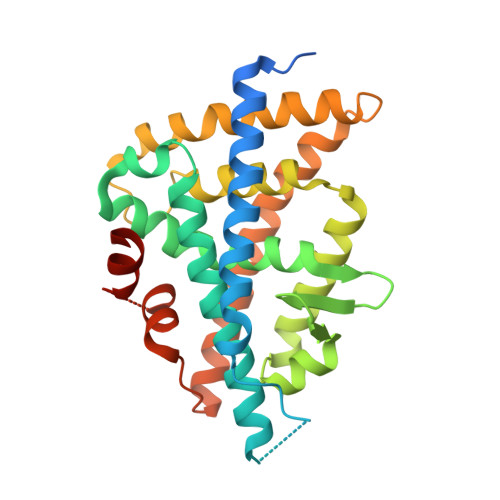
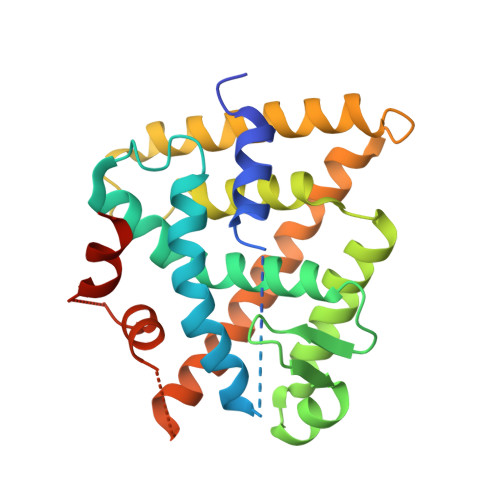
5KYA | pdb_00005kya

Brain penetrant liver X receptor (LXR) modulators based on a 2,4,5,6-tetrahydropyrrolo[3,4-c]pyrazole core


Experimental Data Snapshot

  • Method: X-RAY DIFFRACTION
  • Resolution: 2.60 Å
  • R-Value Free: 
    0.249 (Depositor), 0.246 (DCC) 
  • R-Value Work: 
    0.197 (Depositor), 0.200 (DCC) 
  • R-Value Observed: 
    0.199 (Depositor) 

wwPDB Validation 3D Report Full Report

Validation slider image for 5KYA

Ligand Structure Quality Assessment 


This is version 1.3 of the entry. See complete history

Literature

Brain penetrant liver X receptor (LXR) modulators based on a 2,4,5,6-tetrahydropyrrolo[3,4-c]pyrazole core.

Tice, C.M.Noto, P.B.Fan, K.Y.Zhao, W.Lotesta, S.D.Dong, C.Marcus, A.P.Zheng, Y.J.Chen, G.Wu, Z.Van Orden, R.Zhou, J.Bukhtiyarov, Y.Zhao, Y.Lipinski, K.Howard, L.Guo, J.Kandpal, G.Meng, S.Hardy, A.Krosky, P.Gregg, R.E.Leftheris, K.McKeever, B.M.Singh, S.B.Lala, D.McGeehan, G.M.Zhuang, L.Claremon, D.A.

(2016) Bioorg Med Chem Lett 26: 5044-5050

  • DOI: https://doi.org/10.1016/j.bmcl.2016.08.089
  • Primary Citation Related Structures: 
    5KYA, 5KYJ

  • PubMed Abstract: 

    Liver X receptor (LXR) agonists have been reported to lower brain amyloid beta (Aβ) and thus to have potential for the treatment of Alzheimer's disease. Structure and property based design led to the discovery of a series of orally bioavailable, brain penetrant LXR agonists. Oral administration of compound 18 to rats resulted in significant upregulation of the expression of the LXR target gene ABCA1 in brain tissue, but no significant effect on Aβ levels was detected.


  • Organizational Affiliation
    • Vitae Pharmaceuticals, 502 West Office Center Drive, Fort Washington, PA 19034, USA.

Macromolecule Content 

  • Total Structure Weight: 122.38 kDa 
  • Atom Count: 7,550 
  • Modeled Residue Count: 928 
  • Deposited Residue Count: 1,086 
  • Unique protein chains: 2

Macromolecules

Find similar proteins by:|  3D Structure
Entity ID: 1
MoleculeChains  Sequence LengthOrganismDetailsImage
Oxysterols receptor LXR-betaA,
C [auth E]
287Homo sapiensMutation(s): 6 
Gene Names: NR1H2LXRBNERUNR
UniProt & NIH Common Fund Data Resources
Find proteins for P55055 (Homo sapiens)
Explore P55055 
Go to UniProtKB:  P55055
PHAROS:  P55055
GTEx:  ENSG00000131408 
Entity Groups
Sequence Clusters30% Identity50% Identity70% Identity90% Identity95% Identity100% Identity
UniProt GroupP55055
Sequence Annotations
Expand
Reference Sequence
Find similar proteins by:|  3D Structure
Entity ID: 2
MoleculeChains  Sequence LengthOrganismDetailsImage
Retinoic acid receptor RXR-betaB,
D [auth F]
256Homo sapiensMutation(s): 1 
Gene Names: RXRBNR2B2
UniProt & NIH Common Fund Data Resources
Find proteins for P28702 (Homo sapiens)
Explore P28702 
Go to UniProtKB:  P28702
PHAROS:  P28702
GTEx:  ENSG00000204231 
Entity Groups
Sequence Clusters30% Identity50% Identity70% Identity90% Identity95% Identity100% Identity
UniProt GroupP28702
Sequence Annotations
Expand
Reference Sequence

Small Molecules

Ligands 1 Unique
IDChains Name / Formula / InChI Key2D Diagram3D Interactions
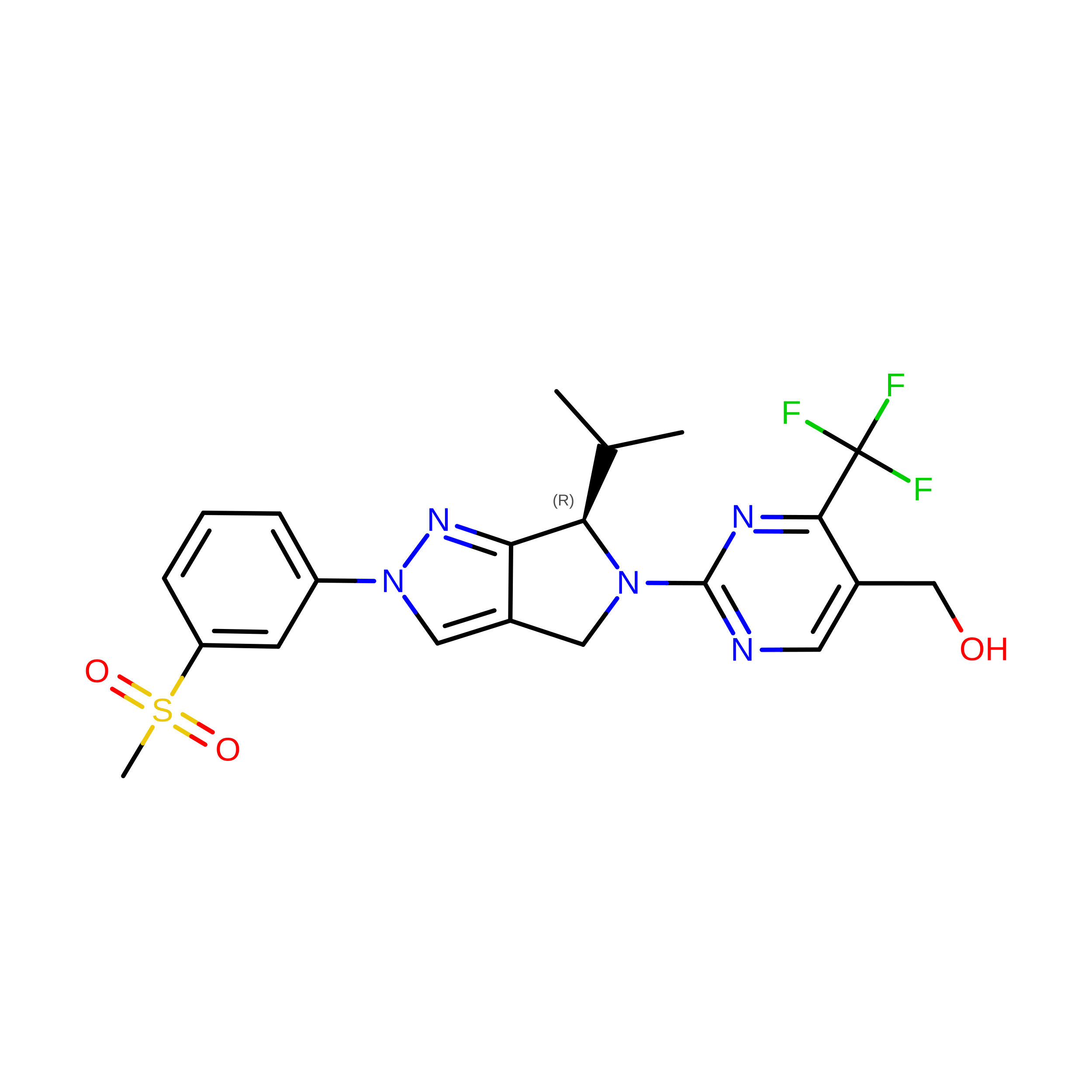
6Y4

Query on 6Y4


Download:Ideal Coordinates CCD File
E [auth A],
F [auth E]
[2-[(6~{R})-2-(3-methylsulfonylphenyl)-6-propan-2-yl-4,6-dihydropyrrolo[3,4-c]pyrazol-5-yl]-4-(trifluoromethyl)pyrimidin-5-yl]methanol
C21 H22 F3 N5 O3 S
NCZXBZJVJRJUSC-GOSISDBHSA-N

Experimental Data & Validation

Experimental Data

  • Method: X-RAY DIFFRACTION
  • Resolution: 2.60 Å
  • R-Value Free:  0.249 (Depositor), 0.246 (DCC) 
  • R-Value Work:  0.197 (Depositor), 0.200 (DCC) 
  • R-Value Observed: 0.199 (Depositor) 
Space Group: P 21 21 21
Unit Cell:
Length ( Å )Angle ( ˚ )
a = 68.439α = 90
b = 101.089β = 90
c = 143.58γ = 90
Software Package:
Software NamePurpose
REFMACrefinement
HKL-2000data reduction
HKL-2000data scaling
MOLREPphasing

Structure Validation

View Full Validation Report


Ligand Structure Quality Assessment 


Entry History 

Deposition Data

Revision History  (Full details and data files)

  • Version 1.0: 2016-09-21
    Type: Initial release
  • Version 1.1: 2016-10-19
    Changes: Database references
  • Version 1.2: 2017-11-01
    Changes: Author supporting evidence, Database references, Derived calculations
  • Version 1.3: 2024-03-06
    Changes: Data collection, Database references, Refinement description