5KX9 | pdb_00005kx9

Selective Small Molecule Inhibition of the FMN Riboswitch


Experimental Data Snapshot

  • Method: X-RAY DIFFRACTION
  • Resolution: 2.90 Å
  • R-Value Free: 
    0.251 (Depositor), 0.259 (DCC) 
  • R-Value Work: 
    0.216 (Depositor), 0.224 (DCC) 
  • R-Value Observed: 
    0.218 (Depositor) 

Starting Model: experimental
View more details

wwPDB Validation 3D Report Full Report

Validation slider image for 5KX9

Ligand Structure Quality Assessment 


This is version 1.4 of the entry. See complete history

Literature

Atomic resolution mechanistic studies of ribocil: A highly selective unnatural ligand mimic of the E. coli FMN riboswitch.

Howe, J.A.Xiao, L.Fischmann, T.O.Wang, H.Tang, H.Villafania, A.Zhang, R.Barbieri, C.M.Roemer, T.

(2016) RNA Biol 13: 946-954

  • DOI: https://doi.org/10.1080/15476286.2016.1216304
  • Primary Citation Related Structures: 
    5KX9

  • PubMed Abstract: 

    Bacterial riboswitches are non-coding RNA structural elements that direct gene expression in numerous metabolic pathways. The key regulatory roles of riboswitches, and the urgent need for new classes of antibiotics to treat multi-drug resistant bacteria, has led to efforts to develop small-molecules that mimic natural riboswitch ligands to inhibit metabolic pathways and bacterial growth. Recently, we reported the results of a phenotypic screen targeting the riboflavin biosynthesis pathway in the Gram-negative bacteria Escherichia coli that led to the identification of ribocil, a small molecule inhibitor of the flavin mononucleotide (FMN) riboswitch controlling expression of this biosynthetic pathway. Although ribocil is structurally distinct from FMN, ribocil functions as a potent and highly selective synthetic mimic of the natural ligand to repress riboswitch-mediated ribB gene expression and inhibit bacterial growth both in vitro and in vivo. Herein, we expand our analysis of ribocil; including mode of binding in the FMN binding pocket of the riboswitch, mechanisms of resistance and structure-activity relationship guided efforts to generate more potent analogs.


  • Organizational Affiliation
    • a Merck Research Laboratories , Kenilworth , NJ , USA.

Macromolecule Content 

  • Total Structure Weight: 36.3 kDa 
  • Atom Count: 2,359 
  • Modeled Residue Count: 109 
  • Deposited Residue Count: 110 
  • Unique nucleic acid chains: 2

Macromolecules

Find similar nucleic acids by:  (by identity cutoff) 
Entity ID: 1
MoleculeChains LengthOrganismImage
FMN RiboswitchA [auth X]54Fusobacterium nucleatum
Sequence Annotations
Expand
Reference Sequence
Find similar nucleic acids by:  (by identity cutoff) 
Entity ID: 2
MoleculeChains LengthOrganismImage
FMN RiboswitchB [auth Y]56Fusobacterium nucleatum
Sequence Annotations
Expand
Reference Sequence

Small Molecules

Ligands 3 Unique
IDChains Name / Formula / InChI Key2D Diagram3D Interactions
6YG

Query on 6YG


Download:Ideal Coordinates CCD File
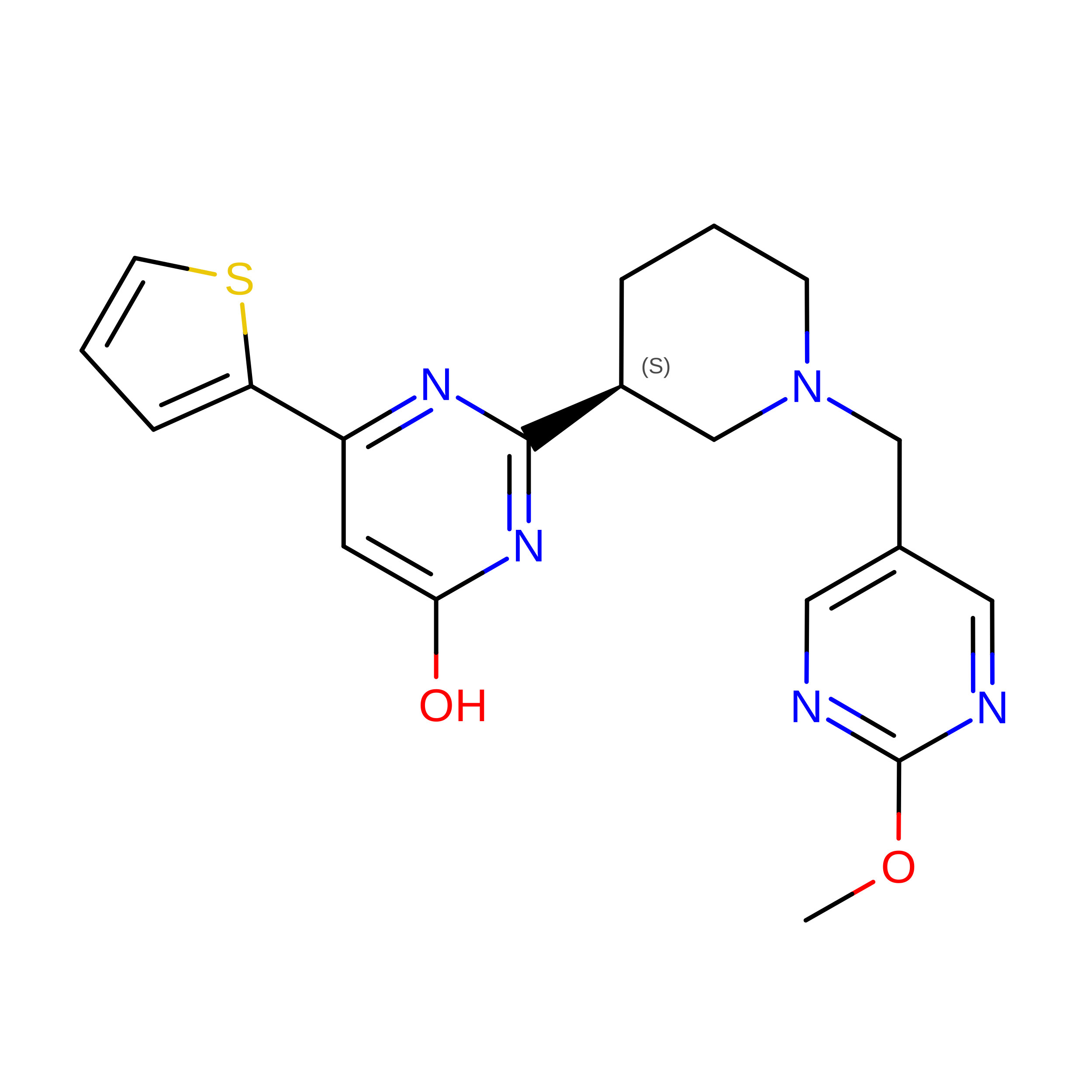
J [auth X](6P)-2-{(3S)-1-[(2-methoxypyrimidin-5-yl)methyl]piperidin-3-yl}-6-(thiophen-2-yl)pyrimidin-4-ol
C19 H21 N5 O2 S
NVEPPHORIAFPBH-AWEZNQCLSA-N
K

Query on K


Download:Ideal Coordinates CCD File
C [auth X]
D [auth X]
E [auth X]
F [auth X]
G [auth X]
C [auth X],
D [auth X],
E [auth X],
F [auth X],
G [auth X],
H [auth X],
M [auth Y]
POTASSIUM ION
K
NPYPAHLBTDXSSS-UHFFFAOYSA-N
MG

Query on MG


Download:Ideal Coordinates CCD File
I [auth X],
K [auth Y],
L [auth Y],
N [auth Y]
MAGNESIUM ION
Mg
JLVVSXFLKOJNIY-UHFFFAOYSA-N

Experimental Data & Validation

Experimental Data

  • Method: X-RAY DIFFRACTION
  • Resolution: 2.90 Å
  • R-Value Free:  0.251 (Depositor), 0.259 (DCC) 
  • R-Value Work:  0.216 (Depositor), 0.224 (DCC) 
  • R-Value Observed: 0.218 (Depositor) 
Space Group: P 31 2 1
Unit Cell:
Length ( Å )Angle ( ˚ )
a = 71.28α = 90
b = 71.28β = 90
c = 138.93γ = 120
Software Package:
Software NamePurpose
BUSTERrefinement
DENZOdata reduction
SCALEPACKdata scaling
BUSTERphasing

Structure Validation

View Full Validation Report


Ligand Structure Quality Assessment 


Entry History 

Deposition Data

Revision History  (Full details and data files)

  • Version 1.0: 2016-08-24
    Type: Initial release
  • Version 1.1: 2016-09-14
    Changes: Database references
  • Version 1.2: 2016-10-19
    Changes: Database references
  • Version 1.3: 2023-02-22
    Changes: Database references, Derived calculations, Structure summary
  • Version 1.4: 2023-10-25
    Changes: Data collection, Refinement description