5KGR | pdb_00005kgr

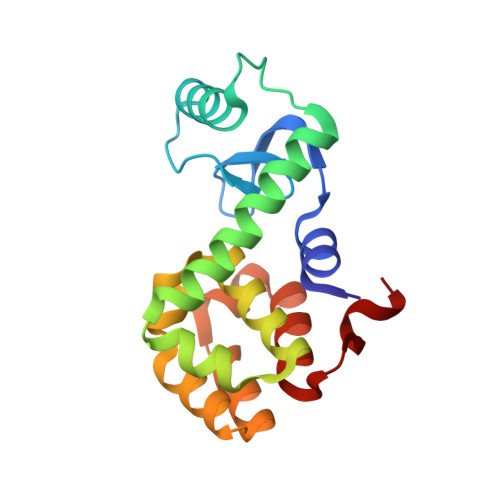
Spin-Labeled T4 Lysozyme Construct I9V1/V131V1 (30 days)


Experimental Data Snapshot

  • Method: X-RAY DIFFRACTION
  • Resolution: 1.47 Å
  • R-Value Free: 
    0.189 (Depositor), 0.190 (DCC) 
  • R-Value Work: 
    0.166 (Depositor), 0.167 (DCC) 
  • R-Value Observed: 
    0.167 (Depositor) 

Starting Model: experimental
View more details

wwPDB Validation 3D Report Full Report

Validation slider image for 5KGR

This is version 1.4 of the entry. See complete history

Literature

Toward Precise Interpretation of DEER-Based Distance Distributions: Insights from Structural Characterization of V1 Spin-Labeled Side Chains.

Balo, A.R.Feyrer, H.Ernst, O.P.

(2016) Biochemistry 55: 5256-5263

  • DOI: https://doi.org/10.1021/acs.biochem.6b00608
  • Primary Citation Related Structures: 
    5JGN, 5JGR, 5JGU, 5JGV, 5JGX, 5JGZ, 5KGR

  • PubMed Abstract: 

    Pulsed electron paramagnetic resonance experiments can measure individual distances between two spin-labeled side chains in proteins in the range of ∼1.5-8 nm. However, the flexibility of traditional spin-labeled side chains leads to diffuse spin density loci and thus distance distributions with relatively broad peaks, thereby complicating the interpretation of protein conformational states. Here we analyzed the spin-labeled V1 side chain, which is internally anchored and hence less flexible. Crystal structures of V1-labeled T4 lysozyme constructs carrying the V1 side chain on α-helical segments suggest that V1 side chains adopt only a few discrete rotamers. In most cases, only one rotamer is observed at a given site, explaining the frequently observed narrow distance distribution for doubly V1-labeled proteins. We used the present data to derive guidelines that may allow distance interpretation of other V1-labeled proteins for higher-precision structural modeling.


  • Organizational Affiliation
    • Department of Biochemistry and ‡Department of Molecular Genetics, University of Toronto , Toronto, Ontario M5S 1A8, Canada.

Macromolecule Content 

  • Total Structure Weight: 19.39 kDa 
  • Atom Count: 1,620 
  • Modeled Residue Count: 164 
  • Deposited Residue Count: 164 
  • Unique protein chains: 1

Macromolecules

Find similar proteins by:|  3D Structure
Entity ID: 1
MoleculeChains  Sequence LengthOrganismDetailsImage
Endolysin164Escherichia phage T4Mutation(s): 4 
EC: 3.2.1.17
UniProt
Find proteins for P00720 (Enterobacteria phage T4)
Explore P00720 
Go to UniProtKB:  P00720
Entity Groups
Sequence Clusters30% Identity50% Identity70% Identity90% Identity95% Identity100% Identity
UniProt GroupP00720
Sequence Annotations
Expand
Reference Sequence

Small Molecules

Ligands 4 Unique
IDChains Name / Formula / InChI Key2D Diagram3D Interactions
V1A

Query on V1A


Download:Ideal Coordinates CCD File
B [auth A],
C [auth A]
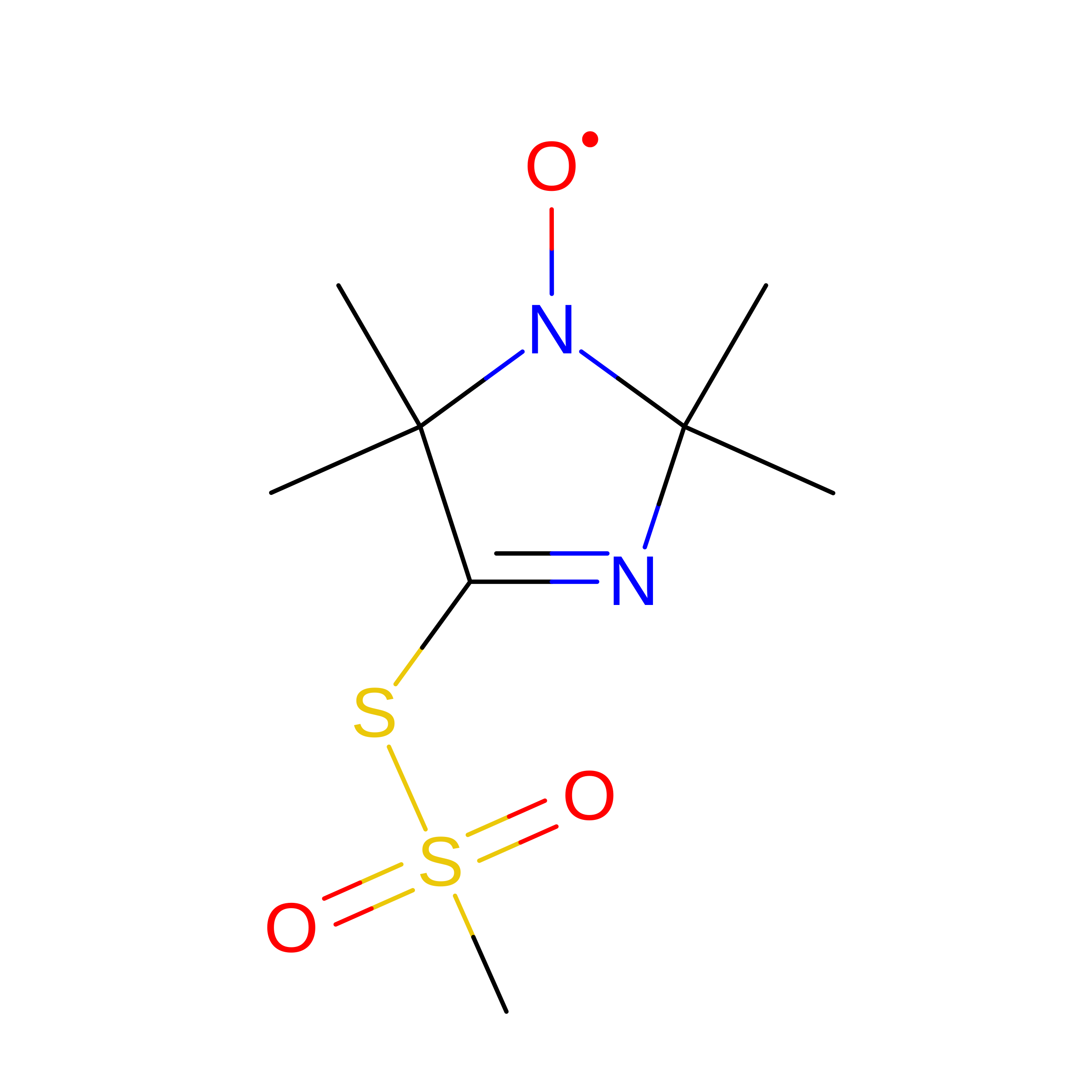
S-(1-oxyl-2,2,5,5-tetramethyl-2,5-dihydro-1H-imidazol-4-yl) methanesulfonothioate
C8 H15 N2 O3 S2
GGUBULNJTWFONN-UHFFFAOYSA-N
HEZ

Query on HEZ


Download:Ideal Coordinates CCD File
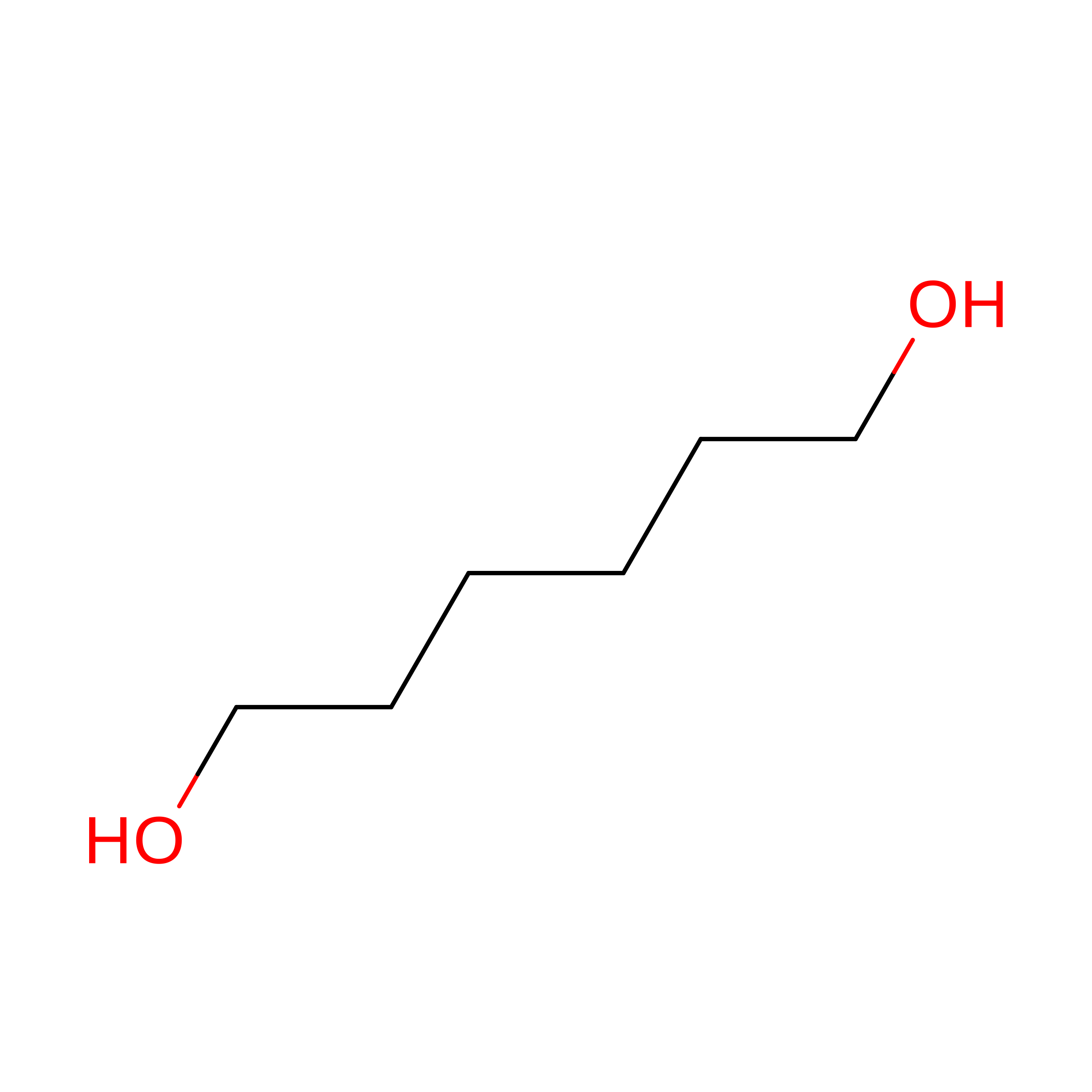
D [auth A]HEXANE-1,6-DIOL
C6 H14 O2
XXMIOPMDWAUFGU-UHFFFAOYSA-N
K

Query on K


Download:Ideal Coordinates CCD File
H [auth A]POTASSIUM ION
K
NPYPAHLBTDXSSS-UHFFFAOYSA-N
CL

Query on CL


Download:Ideal Coordinates CCD File
E [auth A],
F [auth A],
G [auth A]
CHLORIDE ION
Cl
VEXZGXHMUGYJMC-UHFFFAOYSA-M

Experimental Data & Validation

Experimental Data

  • Method: X-RAY DIFFRACTION
  • Resolution: 1.47 Å
  • R-Value Free:  0.189 (Depositor), 0.190 (DCC) 
  • R-Value Work:  0.166 (Depositor), 0.167 (DCC) 
  • R-Value Observed: 0.167 (Depositor) 
Space Group: P 32 2 1
Unit Cell:
Length ( Å )Angle ( ˚ )
a = 60.031α = 90
b = 60.031β = 90
c = 95.509γ = 120
Software Package:
Software NamePurpose
PHENIXrefinement
Aimlessdata scaling
PHASERphasing

Structure Validation

View Full Validation Report


Entry History 

Deposition Data

Revision History  (Full details and data files)

  • Version 1.0: 2017-02-15
    Type: Initial release
  • Version 1.1: 2017-10-25
    Changes: Database references
  • Version 1.2: 2023-09-27
    Changes: Data collection, Database references, Derived calculations, Refinement description
  • Version 1.3: 2024-05-01
    Changes: Advisory, Derived calculations
  • Version 1.4: 2024-10-30
    Changes: Structure summary