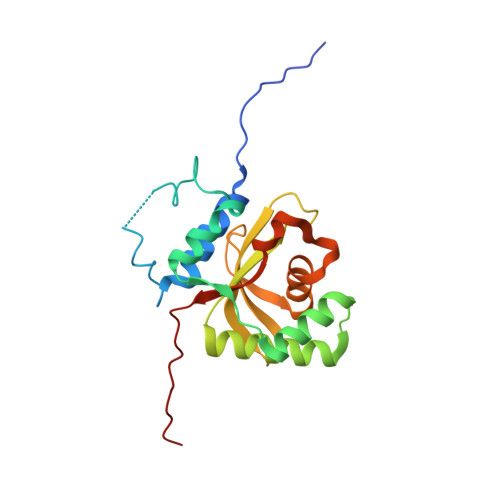
5KDG | pdb_00005kdg

Crystal Structure of Salmonella Typhimurium Effector GtgE


Experimental Data Snapshot

  • Method: X-RAY DIFFRACTION
  • Resolution: 1.73 Å
  • R-Value Free: 
    0.238 (Depositor), 0.242 (DCC) 
  • R-Value Work: 
    0.209 (Depositor), 0.210 (DCC) 
  • R-Value Observed: 
    0.211 (Depositor) 

Starting Model: experimental
View more details

wwPDB Validation 3D Report Full Report

Validation slider image for 5KDG

This is version 1.5 of the entry. See complete history

Literature

Crystal Structure of the Salmonella Typhimurium Effector GtgE.

Xu, C.Kozlov, G.Wong, K.Gehring, K.Cygler, M.

(2016) PLoS One 11: e0166643-e0166643

  • DOI: https://doi.org/10.1371/journal.pone.0166643
  • Primary Citation Related Structures: 
    5KDG

  • PubMed Abstract: 

    Salmonella Typhimurium GtgE is an effector protein contributing to the virulence of this pathogen. It was shown to possess highly selective proteolytic activity against a subset of Rab proteins that helps in evasion of Salmonella-containing vacuole (SCV) fusion with lysosomes. Cys45, His151 and Asp169 are essential for proteolytic activity. The structure of a C-terminal fragment GtgE(79-214) indicated the presence of a papain-like fold. Here, we present the structure of GtgE(17-214) containing the fully assembled active site. The design of a proteolytically active and crystallizable GtgE construct was aided by NMR spectroscopy. The protein indeed displays papain-like fold with an assembled Cys-His-Asp catalytic triad. Like the full-length GtgE, the crystallizable construct showed low activity in vitro for its known substrates, Rab32 and Rab29. NMR titration experiments showed at most very weak binding of GtgE to the peptide encompassing the Rab29 cleavage site. In view of the low in vitro activity and poor substrate binding, we postulate that the function of GtgE in vivo as a proteolytic enzyme is dependent on other factor(s), such as a protein partner or interactions with the SCV membrane, which stimulate(s) GtgE activity in vivo.


  • Organizational Affiliation
    • Department of Biochemistry, University of Saskatchewan, Saskatoon, Saskatchewan, Canada.

Macromolecule Content 

  • Total Structure Weight: 23.37 kDa 
  • Atom Count: 1,597 
  • Modeled Residue Count: 186 
  • Deposited Residue Count: 199 
  • Unique protein chains: 1

Macromolecules

Find similar proteins by:|  3D Structure
Entity ID: 1
MoleculeChains  Sequence LengthOrganismDetailsImage
Gifsy-2 prophage protein199Salmonella enterica subsp. enterica serovar TyphimuriumMutation(s): 2 
Gene Names: SBOV09681DD95_21385ERS450001_01848SEETMRM9437_5135TJ44_09000
EC: 3.4.22.2
UniProt
Find proteins for Q9XC73 (Salmonella typhimurium)
Explore Q9XC73 
Go to UniProtKB:  Q9XC73
Entity Groups
Sequence Clusters30% Identity50% Identity70% Identity90% Identity95% Identity100% Identity
UniProt GroupQ9XC73
Sequence Annotations
Expand
Reference Sequence

Experimental Data & Validation

Experimental Data

  • Method: X-RAY DIFFRACTION
  • Resolution: 1.73 Å
  • R-Value Free:  0.238 (Depositor), 0.242 (DCC) 
  • R-Value Work:  0.209 (Depositor), 0.210 (DCC) 
  • R-Value Observed: 0.211 (Depositor) 
Space Group: P 43 21 2
Unit Cell:
Length ( Å )Angle ( ˚ )
a = 64.302α = 90
b = 64.302β = 90
c = 124.206γ = 90
Software Package:
Software NamePurpose
REFMACrefinement
HKL-2000data reduction
HKL-2000data scaling
PHASERphasing

Structure Validation

View Full Validation Report


Entry History 

& Funding Information

Deposition Data


Funding OrganizationLocationGrant Number
Canadian Institutes of Health Research (CIHR)CanadaGSP-48370

Revision History  (Full details and data files)

  • Version 1.0: 2016-11-16
    Type: Initial release
  • Version 1.1: 2017-01-04
    Changes: Database references
  • Version 1.2: 2017-09-20
    Changes: Author supporting evidence
  • Version 1.3: 2017-11-01
    Changes: Author supporting evidence
  • Version 1.4: 2020-01-08
    Changes: Author supporting evidence
  • Version 1.5: 2023-09-27
    Changes: Data collection, Database references, Refinement description