5KD8 | pdb_00005kd8

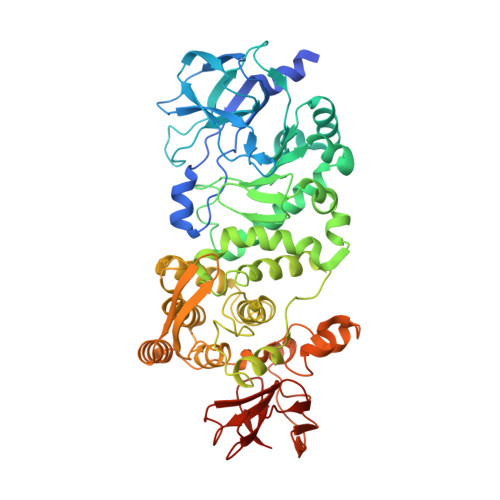
BT_4244 metallopeptidase in complex with Tn antigen.


Experimental Data Snapshot

  • Method: X-RAY DIFFRACTION
  • Resolution: 2.30 Å
  • R-Value Free: 
    0.242 (Depositor), 0.240 (DCC) 
  • R-Value Work: 
    0.200 (Depositor), 0.203 (DCC) 
  • R-Value Observed: 
    0.202 (Depositor) 

Starting Model: experimental
View more details

wwPDB Validation 3D Report Full Report

Validation slider image for 5KD8

Ligand Structure Quality Assessment 


This is version 2.1 of the entry. See complete history

Literature

Recognition of protein-linked glycans as a determinant of peptidase activity.

Noach, I.Ficko-Blean, E.Pluvinage, B.Stuart, C.Jenkins, M.L.Brochu, D.Buenbrazo, N.Wakarchuk, W.Burke, J.E.Gilbert, M.Boraston, A.B.

(2017) Proc Natl Acad Sci U S A 114: E679-E688

  • DOI: https://doi.org/10.1073/pnas.1615141114
  • Primary Citation Related Structures: 
    5KD2, 5KD5, 5KD8, 5KDJ, 5KDN, 5KDS, 5KDU, 5KDV, 5KDW, 5KDX

  • PubMed Abstract: 

    The vast majority of proteins are posttranslationally altered, with the addition of covalently linked sugars (glycosylation) being one of the most abundant modifications. However, despite the hydrolysis of protein peptide bonds by peptidases being a process essential to all life on Earth, the fundamental details of how peptidases accommodate posttranslational modifications, including glycosylation, has not been addressed. Through biochemical analyses and X-ray crystallographic structures we show that to hydrolyze their substrates, three structurally related metallopeptidases require the specific recognition of O-linked glycan modifications via carbohydrate-specific subsites immediately adjacent to their peptidase catalytic machinery. The three peptidases showed selectivity for different glycans, revealing protein-specific adaptations to particular glycan modifications, yet always cleaved the peptide bond immediately preceding the glycosylated residue. This insight builds upon the paradigm of how peptidases recognize substrates and provides a molecular understanding of glycoprotein degradation.


  • Organizational Affiliation
    • Department of Biochemistry and Microbiology, University of Victoria, Victoria, BC V8W 3P6, Canada.

Macromolecule Content 

  • Total Structure Weight: 64.83 kDa 
  • Atom Count: 4,524 
  • Modeled Residue Count: 537 
  • Deposited Residue Count: 559 
  • Unique protein chains: 1

Macromolecules

Find similar proteins by:|  3D Structure
Entity ID: 1
MoleculeChains  Sequence LengthOrganismDetailsImage
Metallopeptidase559Bacteroides thetaiotaomicron VPI-5482Mutation(s): 0 
Gene Names: BT_4244
UniProt
Find proteins for Q89ZX7 (Bacteroides thetaiotaomicron (strain ATCC 29148 / DSM 2079 / JCM 5827 / CCUG 10774 / NCTC 10582 / VPI-5482 / E50))
Explore Q89ZX7 
Go to UniProtKB:  Q89ZX7
Entity Groups
Sequence Clusters30% Identity50% Identity70% Identity90% Identity95% Identity100% Identity
UniProt GroupQ89ZX7
Sequence Annotations
Expand
Reference Sequence

Small Molecules

Ligands 5 Unique
IDChains Name / Formula / InChI Key2D Diagram3D Interactions
A2G

Query on A2G


Download:Ideal Coordinates CCD File
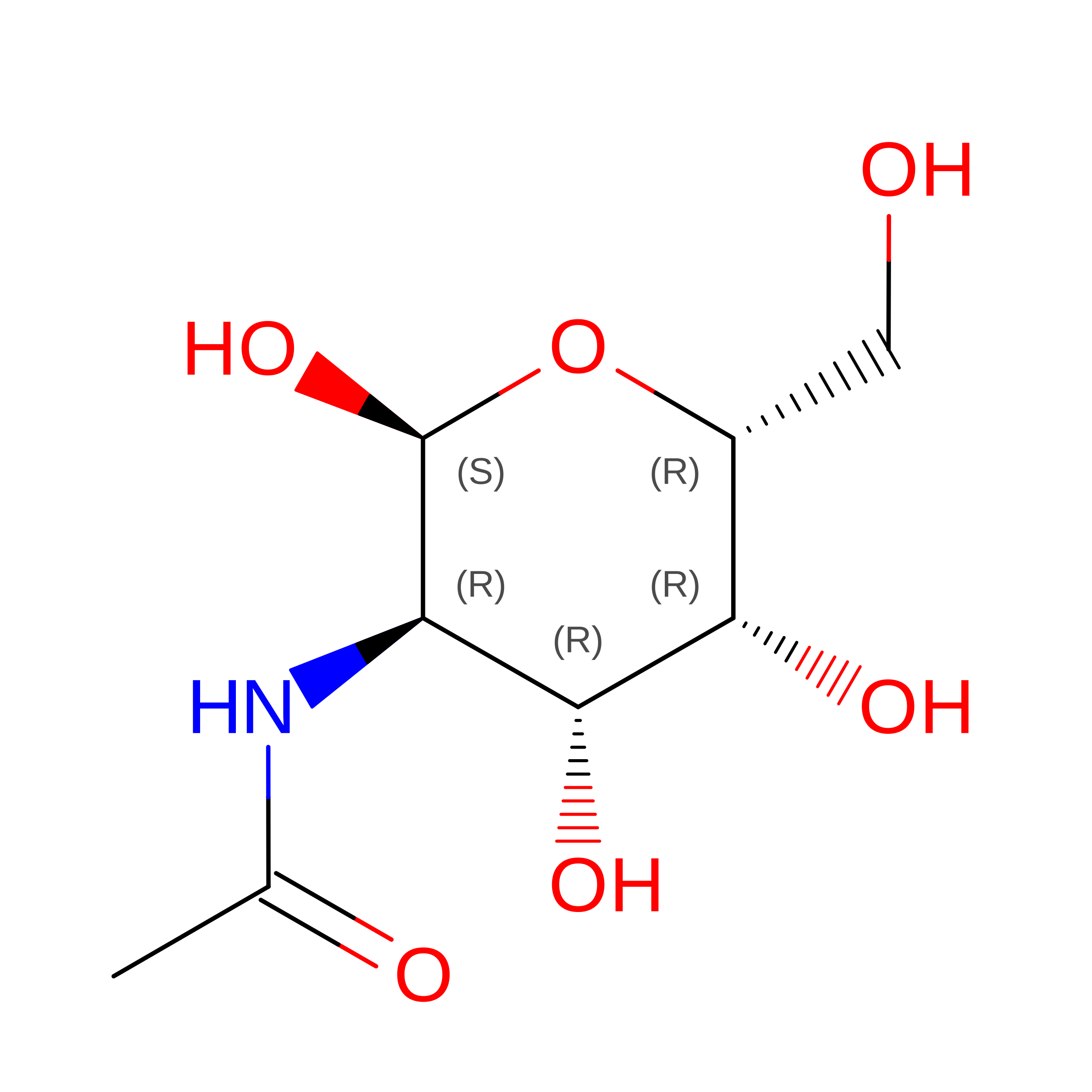
H [auth A]2-acetamido-2-deoxy-alpha-D-galactopyranose
C8 H15 N O6
OVRNDRQMDRJTHS-CBQIKETKSA-N
SER

Query on SER


Download:Ideal Coordinates CCD File
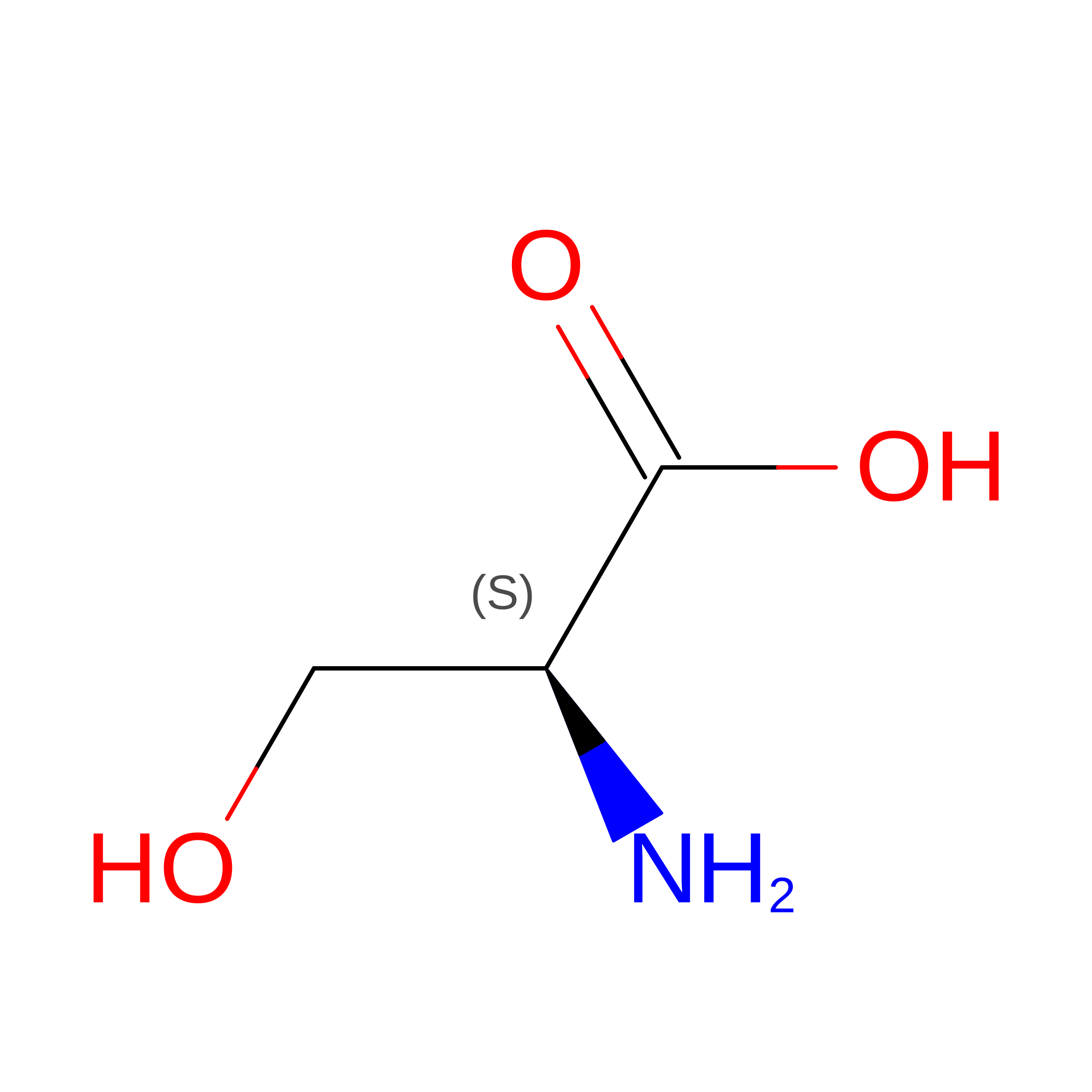
G [auth A]SERINE
C3 H7 N O3
MTCFGRXMJLQNBG-REOHCLBHSA-N
ZN

Query on ZN


Download:Ideal Coordinates CCD File
B [auth A]ZINC ION
Zn
PTFCDOFLOPIGGS-UHFFFAOYSA-N
NI

Query on NI


Download:Ideal Coordinates CCD File
C [auth A],
D [auth A]
NICKEL (II) ION
Ni
VEQPNABPJHWNSG-UHFFFAOYSA-N
NA

Query on NA


Download:Ideal Coordinates CCD File
E [auth A],
F [auth A]
SODIUM ION
Na
FKNQFGJONOIPTF-UHFFFAOYSA-N

Experimental Data & Validation

Experimental Data

  • Method: X-RAY DIFFRACTION
  • Resolution: 2.30 Å
  • R-Value Free:  0.242 (Depositor), 0.240 (DCC) 
  • R-Value Work:  0.200 (Depositor), 0.203 (DCC) 
  • R-Value Observed: 0.202 (Depositor) 
Space Group: P 21 21 21
Unit Cell:
Length ( Å )Angle ( ˚ )
a = 87.45α = 90
b = 88.23β = 90
c = 98.65γ = 90
Software Package:
Software NamePurpose
REFMACrefinement
XDSdata reduction
SCALAdata scaling
MOLREPphasing

Structure Validation

View Full Validation Report


Ligand Structure Quality Assessment 


Entry History 

Deposition Data

Revision History  (Full details and data files)

  • Version 1.0: 2017-01-11
    Type: Initial release
  • Version 1.1: 2017-02-01
    Changes: Database references
  • Version 1.2: 2017-02-08
    Changes: Database references
  • Version 2.0: 2020-07-29
    Type: Remediation
    Reason: Carbohydrate remediation
    Changes: Advisory, Atomic model, Data collection, Derived calculations, Non-polymer description, Structure summary
  • Version 2.1: 2023-09-27
    Changes: Data collection, Database references, Refinement description, Structure summary