5K48 | pdb_00005k48

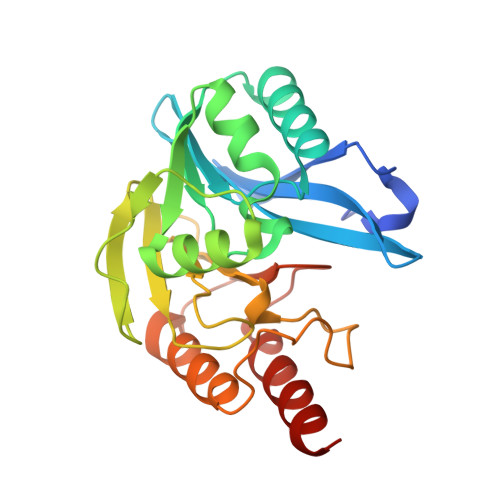
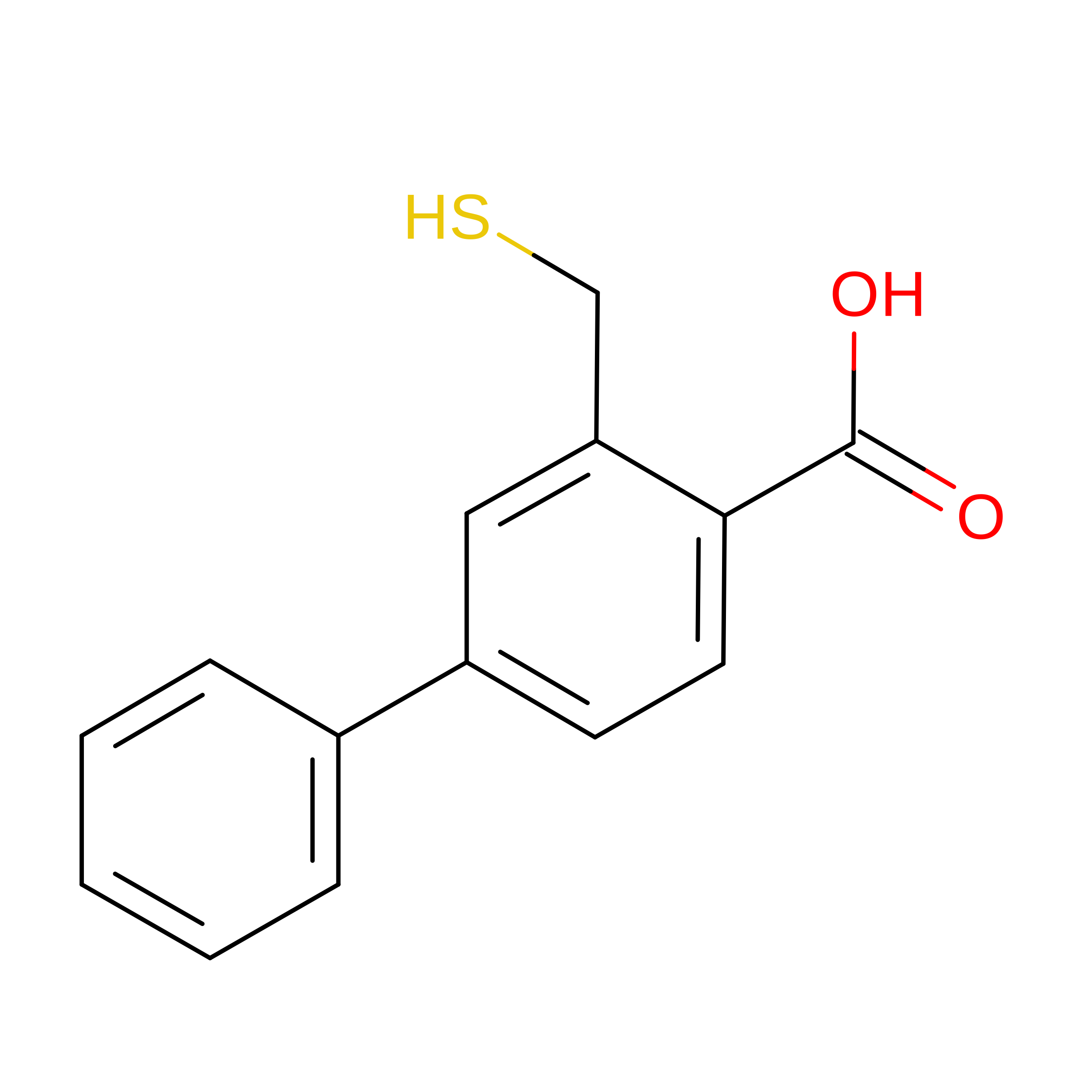
VIM-2 Metallo Beta Lactamase in complex with 3-(mercaptomethyl)-[1,1'-biphenyl]-4-carboxylic acid


Experimental Data Snapshot

  • Method: X-RAY DIFFRACTION
  • Resolution: 1.74 Å
  • R-Value Free: 
    0.194 (Depositor), 0.200 (DCC) 
  • R-Value Work: 
    0.166 (Depositor), 0.174 (DCC) 
  • R-Value Observed: 
    0.167 (Depositor) 

Starting Model: experimental
View more details

wwPDB Validation 3D Report Full Report

Validation slider image for 5K48

Ligand Structure Quality Assessment 


This is version 1.3 of the entry. See complete history

Literature

In Silico Fragment-Based Design Identifies Subfamily B1 Metallo-beta-lactamase Inhibitors.

Cain, R.Brem, J.Zollman, D.McDonough, M.A.Johnson, R.M.Spencer, J.Makena, A.Abboud, M.I.Cahill, S.Lee, S.Y.McHugh, P.J.Schofield, C.J.Fishwick, C.W.G.

(2018) J Med Chem 61: 1255-1260

  • DOI: https://doi.org/10.1021/acs.jmedchem.7b01728
  • Primary Citation Related Structures: 
    5K48

  • PubMed Abstract: 

    Zinc ion-dependent β-lactamases (MBLs) catalyze the hydrolysis of almost all β-lactam antibiotics and resist the action of clinically available β-lactamase inhibitors. We report how application of in silico fragment-based molecular design employing thiol-mediated metal anchorage leads to potent MBL inhibitors. The new inhibitors manifest potent inhibition of clinically important B1 subfamily MBLs, including the widespread NDM-1, IMP-1, and VIM-2 enzymes; with lower potency, some of them also inhibit clinically relevant Class A and D serine-β-lactamases. The inhibitors show selectivity for bacterial MBL enzymes compared to that for human MBL fold nucleases. Cocrystallization of one inhibitor, which shows potentiation of Meropenem activity against MBL-expressing Enterobacteriaceae, with VIM-2 reveals an unexpected binding mode, involving interactions with residues from conserved active site bordering loops.


  • Organizational Affiliation
    • School of Chemistry, University of Leeds , Leeds LS2 9JT, United Kingdom.

Macromolecule Content 

  • Total Structure Weight: 52.5 kDa 
  • Atom Count: 3,973 
  • Modeled Residue Count: 463 
  • Deposited Residue Count: 484 
  • Unique protein chains: 1

Macromolecules

Find similar proteins by:|  3D Structure
Entity ID: 1
MoleculeChains  Sequence LengthOrganismDetailsImage
Beta-lactamase VIM-2
A, B
242Pseudomonas aeruginosaMutation(s): 0 
Gene Names: blaVIM-2bla vim-2bla-VIM-2blasVIM-2blaVIM2blmVIM-2PAERUG_P32_London_17_VIM_2_10_11_06255
EC: 3.5.2.6
UniProt
Find proteins for Q9K2N0 (Pseudomonas aeruginosa)
Explore Q9K2N0 
Go to UniProtKB:  Q9K2N0
Entity Groups
Sequence Clusters30% Identity50% Identity70% Identity90% Identity95% Identity100% Identity
UniProt GroupQ9K2N0
Sequence Annotations
Expand
Reference Sequence

Small Molecules

Ligands 3 Unique
IDChains Name / Formula / InChI Key2D Diagram3D Interactions
S5Z

Query on S5Z


Download:Ideal Coordinates CCD File
C [auth A],
J [auth B]
4-phenyl-2-(sulfanylmethyl)benzoic acid
C14 H12 O2 S
OJGNJYVRHUYKQS-UHFFFAOYSA-N
ZN

Query on ZN


Download:Ideal Coordinates CCD File
G [auth A]
H [auth A]
I [auth A]
M [auth B]
N [auth B]
G [auth A],
H [auth A],
I [auth A],
M [auth B],
N [auth B],
O [auth B]
ZINC ION
Zn
PTFCDOFLOPIGGS-UHFFFAOYSA-N
FMT

Query on FMT


Download:Ideal Coordinates CCD File
D [auth A],
E [auth A],
F [auth A],
K [auth B],
L [auth B]
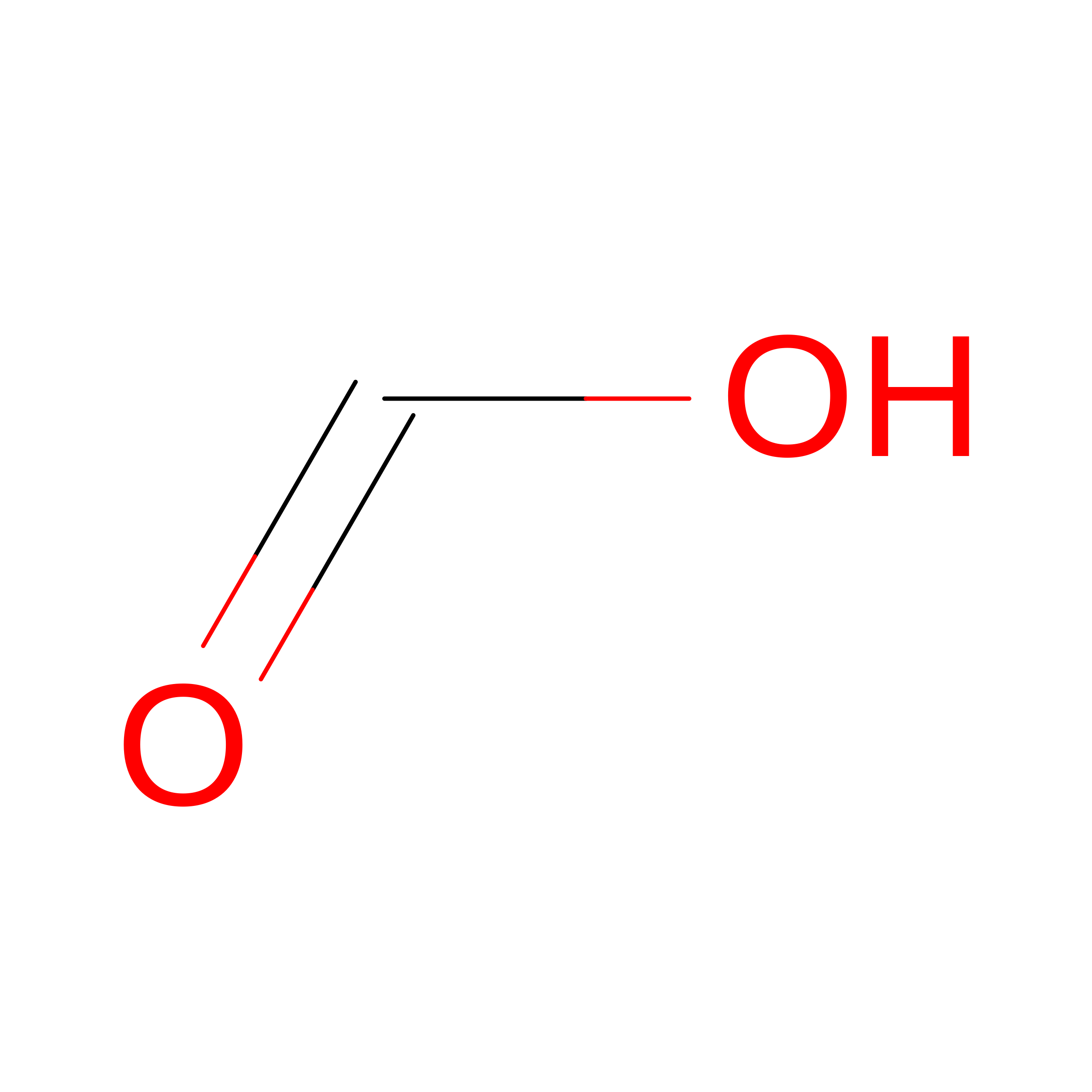
FORMIC ACID
C H2 O2
BDAGIHXWWSANSR-UHFFFAOYSA-N

Experimental Data & Validation

Experimental Data

  • Method: X-RAY DIFFRACTION
  • Resolution: 1.74 Å
  • R-Value Free:  0.194 (Depositor), 0.200 (DCC) 
  • R-Value Work:  0.166 (Depositor), 0.174 (DCC) 
  • R-Value Observed: 0.167 (Depositor) 
Space Group: C 1 2 1
Unit Cell:
Length ( Å )Angle ( ˚ )
a = 102.888α = 90
b = 79.542β = 130.6
c = 67.892γ = 90
Software Package:
Software NamePurpose
PHENIXrefinement
HKL-2000data reduction
HKL-2000data scaling
PHASERphasing

Structure Validation

View Full Validation Report


Ligand Structure Quality Assessment 


Entry History 

Deposition Data

Revision History  (Full details and data files)

  • Version 1.0: 2017-06-07
    Type: Initial release
  • Version 1.1: 2018-01-17
    Changes: Database references
  • Version 1.2: 2018-02-21
    Changes: Database references
  • Version 1.3: 2024-01-10
    Changes: Data collection, Database references, Derived calculations, Refinement description