5JSJ | pdb_00005jsj

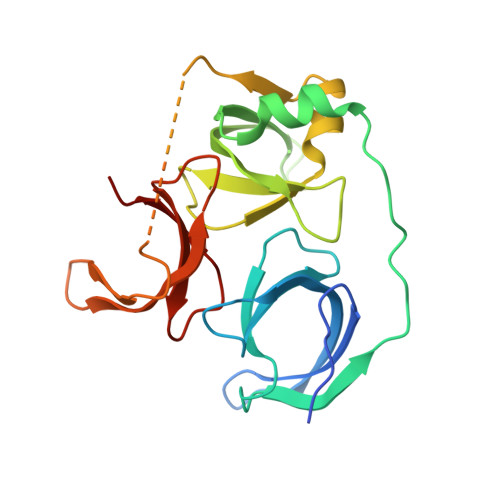
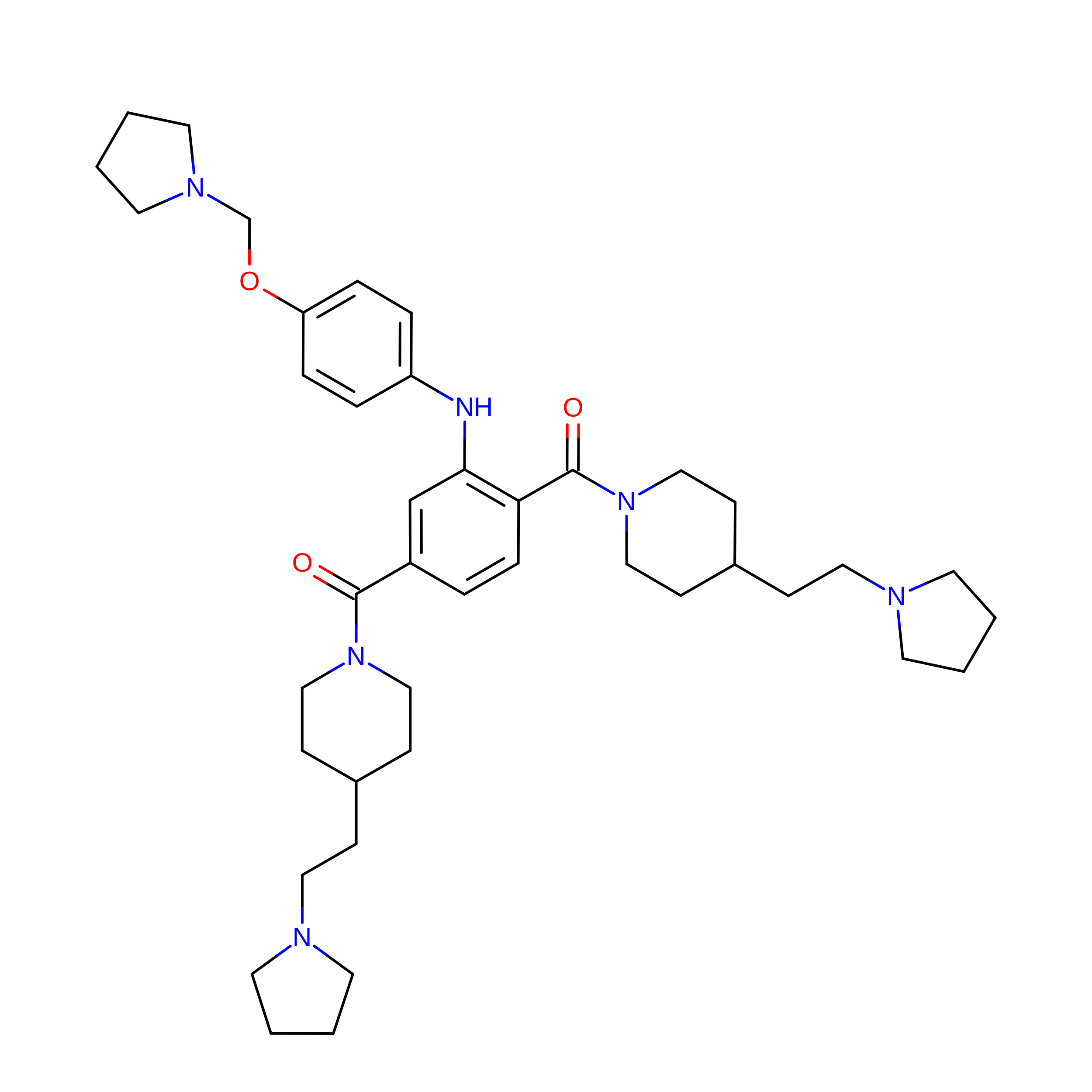
Crystal structure of Spindlin1 bound to compound EML631


Experimental Data Snapshot

  • Method: X-RAY DIFFRACTION
  • Resolution: 2.35 Å
  • R-Value Free: 
    0.249 (Depositor), 0.252 (DCC) 
  • R-Value Work: 
    0.199 (Depositor), 0.201 (DCC) 
  • R-Value Observed: 
    0.201 (Depositor) 

wwPDB Validation 3D Report Full Report

Validation slider image for 5JSJ

Ligand Structure Quality Assessment 


This is version 1.2 of the entry. See complete history

Literature

Developing Spindlin1 small-molecule inhibitors by using protein microarrays

Bae, N.Viviano, M.Su, X.Lv, J.Cheng, D.Sagum, C.Castellano, S.Bai, X.Johnson, C.Khalil, M.I.Shen, J.Chen, K.Li, H.Sbardella, G.Bedford, M.T.

(2017) Nat Chem Biol 13: 750-756

  • DOI: https://doi.org/10.1038/nchembio.2377
  • Primary Citation Related Structures: 
    5JSG, 5JSJ

  • PubMed Abstract: 

    The discovery of inhibitors of methyl- and acetyl-binding domains has provided evidence for the 'druggability' of epigenetic effector molecules. The small-molecule probe UNC1215 prevents methyl-dependent protein-protein interactions by engaging the aromatic cage of MBT domains and, with lower affinity, Tudor domains. Using a library of tagged UNC1215 analogs, we screened a protein-domain microarray of human methyllysine effector molecules to rapidly detect compounds with new binding profiles with either increased or decreased specificity. Using this approach, we identified a compound (EML405) that acquired a novel interaction with the Tudor-domain-containing protein Spindlin1 (SPIN1). Structural studies facilitated the rational synthesis of SPIN1 inhibitors with increased selectivity (EML631-633), which engage SPIN1 in cells, block its ability to 'read' H3K4me3 marks and inhibit its transcriptional-coactivator activity. Protein microarrays can thus be used as a platform to 'target-hop' and identify small molecules that bind and compete with domain-motif interactions.


  • Organizational Affiliation
    • Department of Epigenetics and Molecular Carcinogenesis, University of Texas MD Anderson Cancer Center, Smithville, Texas, USA.

Macromolecule Content 

  • Total Structure Weight: 52.48 kDa 
  • Atom Count: 3,353 
  • Modeled Residue Count: 391 
  • Deposited Residue Count: 444 
  • Unique protein chains: 1

Macromolecules

Find similar proteins by:|  3D Structure
Entity ID: 1
MoleculeChains  Sequence LengthOrganismDetailsImage
Spindlin-1
A, B
222Homo sapiensMutation(s): 0 
Gene Names: SPIN1OCRSPIN
UniProt & NIH Common Fund Data Resources
Find proteins for Q9Y657 (Homo sapiens)
Explore Q9Y657 
Go to UniProtKB:  Q9Y657
PHAROS:  Q9Y657
GTEx:  ENSG00000106723 
Entity Groups
Sequence Clusters30% Identity50% Identity70% Identity90% Identity95% Identity100% Identity
UniProt GroupQ9Y657
Sequence Annotations
Expand
Reference Sequence

Small Molecules

Binding Affinity Annotations 
IDSourceBinding Affinity
6PD BindingDB:  5JSJ Kd: min: 3000, max: 4000 (nM) from 2 assay(s)

Experimental Data & Validation

Experimental Data

  • Method: X-RAY DIFFRACTION
  • Resolution: 2.35 Å
  • R-Value Free:  0.249 (Depositor), 0.252 (DCC) 
  • R-Value Work:  0.199 (Depositor), 0.201 (DCC) 
  • R-Value Observed: 0.201 (Depositor) 
Space Group: P 1 21 1
Unit Cell:
Length ( Å )Angle ( ˚ )
a = 42.79α = 90
b = 123.827β = 92.22
c = 49.663γ = 90
Software Package:
Software NamePurpose
PHENIXrefinement
HKL-2000data scaling
PDB_EXTRACTdata extraction
HKL-2000data reduction
MOLREPphasing

Structure Validation

View Full Validation Report


Ligand Structure Quality Assessment 


Entry History 

Deposition Data

  • Released Date: 2017-05-24 
  • Deposition Author(s): Su, X., Li, H.

Revision History  (Full details and data files)

  • Version 1.0: 2017-05-24
    Type: Initial release
  • Version 1.1: 2017-07-26
    Changes: Database references
  • Version 1.2: 2024-03-20
    Changes: Data collection, Database references, Derived calculations