5J74 | pdb_00005j74

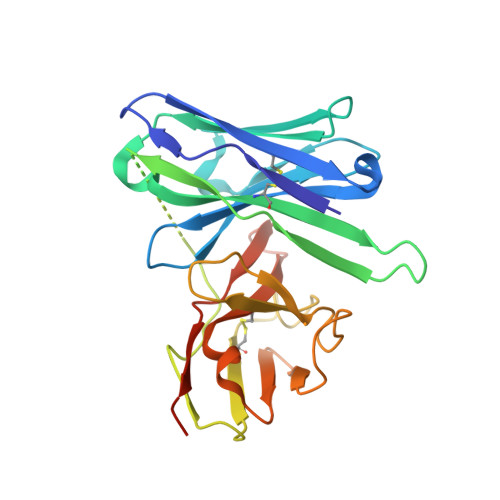
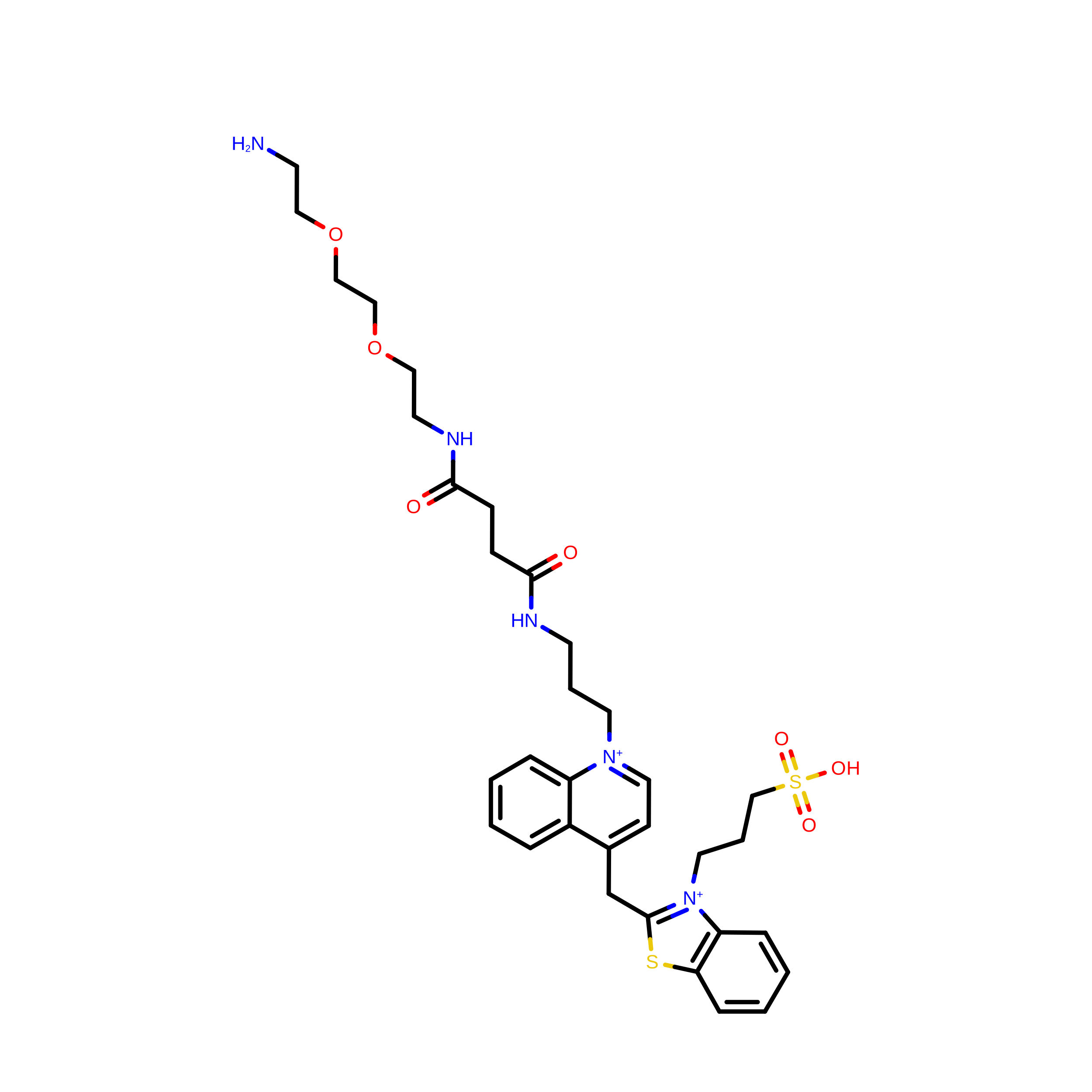
Fluorogen activating protein AM2.2 in complex with TO1-2p

  • Classification: IMMUNE SYSTEM
  • Organism(s): Homo sapiens
  • Expression System: Pichia
  • Mutation(s): No 

  • Deposited: 2016-04-05 Released: 2016-05-25 
  • Deposition Author(s): Stanfield, R.L., Wilson, I.A., Wu, Y.
  • Funding Organization(s): National Institutes of Health/National Institute of Mental Health (NIH/NIMH), National Institutes of Health/National Center for Research Resources (NIH/NCRR)

Experimental Data Snapshot

  • Method: X-RAY DIFFRACTION
  • Resolution: 2.70 Å
  • R-Value Free: 
    0.250 (Depositor), 0.253 (DCC) 
  • R-Value Work: 
    0.197 (Depositor), 0.207 (DCC) 
  • R-Value Observed: 
    0.200 (Depositor) 

Starting Model: experimental
View more details

wwPDB Validation 3D Report Full Report

Validation slider image for 5J74

Ligand Structure Quality Assessment 


This is version 1.4 of the entry. See complete history

Literature

Discovery of Small-Molecule Nonfluorescent Inhibitors of Fluorogen-Fluorogen Activating Protein Binding Pair.

Wu, Y.Stauffer, S.R.Stanfield, R.L.Tapia, P.H.Ursu, O.Fisher, G.W.Szent-Gyorgyi, C.Evangelisti, A.Waller, A.Strouse, J.J.Carter, M.B.Bologa, C.Gouveia, K.Poslusney, M.Waggoner, A.S.Lindsley, C.W.Jarvik, J.W.Sklar, L.A.

(2016) J Biomol Screen 21: 74-87

  • DOI: https://doi.org/10.1177/1087057115609145
  • Primary Citation Related Structures: 
    5J74, 5J75

  • PubMed Abstract: 

    A new class of biosensors, fluorogen activating proteins (FAPs), has been successfully used to track receptor trafficking in live cells. Unlike the traditional fluorescent proteins (FPs), FAPs do not fluoresce unless bound to their specific small-molecule fluorogens, and thus FAP-based assays are highly sensitive. Application of the FAP-based assay for protein trafficking in high-throughput flow cytometry resulted in the discovery of a new class of compounds that interferes with the binding between fluorogens and FAP, thus blocking the fluorescence signal. These compounds are high-affinity, nonfluorescent analogs of fluorogens with little or no toxicity to the tested cells and no apparent interference with the normal function of FAP-tagged receptors. The most potent compound among these, N,4-dimethyl-N-(2-oxo-2-(4-(pyridin-2-yl)piperazin-1-yl)ethyl)benzenesulfonamide (ML342), has been investigated in detail. X-ray crystallographic analysis revealed that ML342 competes with the fluorogen, sulfonated thiazole orange coupled to diethylene glycol diamine (TO1-2p), for the same binding site on a FAP, AM2.2. Kinetic analysis shows that the FAP-fluorogen interaction is more complex than a homogeneous one-site binding process, with multiple conformational states of the fluorogen and/or the FAP, and possible dimerization of the FAP moiety involved in the process.


  • Organizational Affiliation
    • Department of Pathology, University of New Mexico, Albuquerque, NM, USA Center for Molecular Discovery, University of New Mexico, Albuquerque, NM, USA.

Macromolecule Content 

  • Total Structure Weight: 56.08 kDa 
  • Atom Count: 3,547 
  • Modeled Residue Count: 464 
  • Deposited Residue Count: 528 
  • Unique protein chains: 1

Macromolecules

Find similar proteins by:|  3D Structure
Entity ID: 1
MoleculeChains  Sequence LengthOrganismDetailsImage
scFv AM2.2
A, B
264Homo sapiensMutation(s): 0 

Experimental Data & Validation

Experimental Data

  • Method: X-RAY DIFFRACTION
  • Resolution: 2.70 Å
  • R-Value Free:  0.250 (Depositor), 0.253 (DCC) 
  • R-Value Work:  0.197 (Depositor), 0.207 (DCC) 
  • R-Value Observed: 0.200 (Depositor) 
Space Group: I 2 2 2
Unit Cell:
Length ( Å )Angle ( ˚ )
a = 79.448α = 90
b = 114.83β = 90
c = 130.995γ = 90
Software Package:
Software NamePurpose
REFMACrefinement
DENZOdata reduction
SCALEPACKdata scaling
PHASERphasing

Structure Validation

View Full Validation Report


Ligand Structure Quality Assessment 


Entry History 

& Funding Information

Deposition Data


Funding OrganizationLocationGrant Number
National Institutes of Health/National Institute of Mental Health (NIH/NIMH)United States1U54MH084690-02
National Institutes of Health/National Institute of Mental Health (NIH/NIMH)United States5U54MH084690-03 CDP2
National Institutes of Health/National Institute of Mental Health (NIH/NIMH)United StatesU54MH084659
National Institutes of Health/National Center for Research Resources (NIH/NCRR)United States5U54RR022241

Revision History  (Full details and data files)

  • Version 1.0: 2016-05-25
    Type: Initial release
  • Version 1.1: 2017-09-13
    Changes: Author supporting evidence, Derived calculations
  • Version 1.2: 2019-11-27
    Changes: Author supporting evidence
  • Version 1.3: 2023-09-27
    Changes: Data collection, Database references, Refinement description
  • Version 1.4: 2024-11-13
    Changes: Structure summary