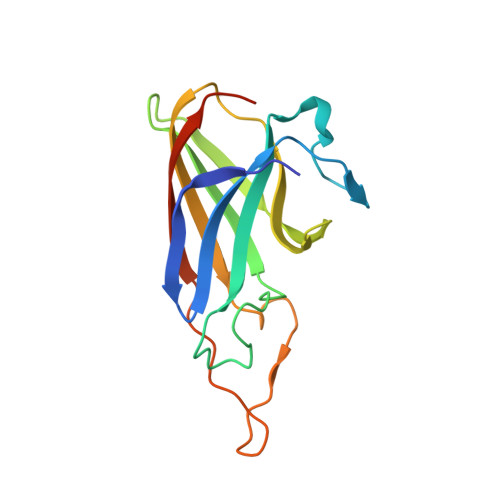
5I0Y | pdb_00005i0y

COPPER-BOUND E46Q VARIANT OF UROPATHOGENIC ESCHERICHIA COLI STRAIN F11 FETP


Experimental Data Snapshot

  • Method: X-RAY DIFFRACTION
  • Resolution: 1.40 Å
  • R-Value Free: 
    0.214 (Depositor), 0.215 (DCC) 
  • R-Value Work: 
    0.188 (Depositor), 0.188 (DCC) 
  • R-Value Observed: 
    0.190 (Depositor) 

Starting Model: experimental
View more details

wwPDB Validation 3D Report Full Report

Validation slider image for 5I0Y

This is version 1.2 of the entry. See complete history

Literature

A copper site is required for iron transport by the periplasmic proteins P19 and FetP.

Chan, A.C.K.Lin, H.Koch, D.Grass, G.Nies, D.H.Murphy, M.E.P.

(2020) Metallomics 12: 1530-1541

  • DOI: https://doi.org/10.1039/d0mt00130a
  • Primary Citation Related Structures: 
    5I0V, 5I0W, 5I0X, 5I0Y, 6WED, 6WEE, 6WEF

  • PubMed Abstract: 

    Campylobacter jejuni is a leading cause of food-borne gastrointestinal disease in humans and uropathogenic Escherichia coli is a leading cause of urinary tract infections. Both human pathogens harbour a homologous iron uptake system (termed cjFetM-P19 in C. jejuni and ecFetM-FetP in E. coli). Although these systems are important for growth under iron limitation, the mechanisms by which these systems function during iron transport remain undefined. The copper ions bound to P19 and FetP, the homologous periplasmic proteins, are coordinated in an uncommon penta-dentate manner involving a Met-Glu-His3 motif and exhibit positional plasticity. Here we demonstrate the function of the Met and Glu residues in modulating copper binding and controlling copper positioning through site-directed variants, binding assays, and crystal structures. Growth of C. jejuni strains with these p19 variants is impaired under iron limited conditions as compared to the wild-type strain. Additionally, an acidic residue-rich secondary site is required for binding iron and function in vivo. Finally, western blot analyses demonstrate direct and specific interactions between periplasmic P19 and FetP with the large periplasmic domain of their respective inner membrane transporters cjFetM and ecFetM.


  • Organizational Affiliation
    • Department of Microbiology and Immunology, Life Sciences Institute, University of British Columbia, Canada. michael.murphy@ubc.ca.

Macromolecule Content 

  • Total Structure Weight: 35.45 kDa 
  • Atom Count: 2,784 
  • Modeled Residue Count: 308 
  • Deposited Residue Count: 320 
  • Unique protein chains: 1

Macromolecules

Find similar proteins by:|  3D Structure
Entity ID: 1
MoleculeChains  Sequence LengthOrganismDetailsImage
Periplasmic protein-probably involved in high-affinity Fe2+ transport
A, B
160Escherichia coli F11Mutation(s): 1 
Gene Names: EcF11_1994
UniProt
Find proteins for A0A1S4NYE7 (Escherichia coli F11)
Explore A0A1S4NYE7 
Go to UniProtKB:  A0A1S4NYE7
Entity Groups
Sequence Clusters30% Identity50% Identity70% Identity90% Identity95% Identity100% Identity
UniProt GroupA0A1S4NYE7
Sequence Annotations
Expand
Reference Sequence

Experimental Data & Validation

Experimental Data

  • Method: X-RAY DIFFRACTION
  • Resolution: 1.40 Å
  • R-Value Free:  0.214 (Depositor), 0.215 (DCC) 
  • R-Value Work:  0.188 (Depositor), 0.188 (DCC) 
  • R-Value Observed: 0.190 (Depositor) 
Space Group: C 1 2 1
Unit Cell:
Length ( Å )Angle ( ˚ )
a = 83.16α = 90
b = 36.54β = 106.52
c = 101γ = 90
Software Package:
Software NamePurpose
MOSFLMdata reduction
SCALAdata scaling
MOLREPphasing
REFMACrefinement

Structure Validation

View Full Validation Report


Entry History 

Deposition Data

Revision History  (Full details and data files)

  • Version 1.0: 2017-02-08
    Type: Initial release
  • Version 1.1: 2021-02-10
    Changes: Database references, Derived calculations
  • Version 1.2: 2023-09-27
    Changes: Data collection, Database references, Refinement description