5I0E | pdb_00005i0e

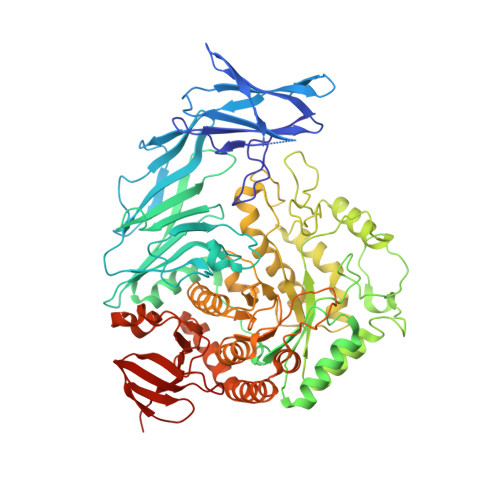
Cycloalternan-degrading enzyme from Trueperella pyogenes in complex with isomaltose


Experimental Data Snapshot

  • Method: X-RAY DIFFRACTION
  • Resolution: 2.30 Å
  • R-Value Free: 
    0.221 (Depositor), 0.220 (DCC) 
  • R-Value Work: 
    0.174 (Depositor), 0.178 (DCC) 
  • R-Value Observed: 
    0.177 (Depositor) 

Starting Model: experimental
View more details

wwPDB Validation 3D Report Full Report

Validation slider image for 5I0E

This is version 2.1 of the entry. See complete history

Literature

Transferase Versus Hydrolase: The Role of Conformational Flexibility in Reaction Specificity.

Light, S.H.Cahoon, L.A.Mahasenan, K.V.Lee, M.Boggess, B.Halavaty, A.S.Mobashery, S.Freitag, N.E.Anderson, W.F.

(2017) Structure 25: 295-304

  • DOI: https://doi.org/10.1016/j.str.2016.12.007
  • Primary Citation Related Structures: 
    5HOP, 5HPO, 5HXM, 5I0D, 5I0E, 5I0F, 5I0G

  • PubMed Abstract: 

    Active in the aqueous cellular environment where a massive excess of water is perpetually present, enzymes that catalyze the transfer of an electrophile to a non-water nucleophile (transferases) require specific strategies to inhibit mechanistically related hydrolysis reactions. To identify principles that confer transferase versus hydrolase reaction specificity, we exploited two enzymes that use highly similar catalytic apparatuses to catalyze the transglycosylation (a transferase reaction) or hydrolysis of α-1,3-glucan linkages in the cyclic tetrasaccharide cycloalternan (CA). We show that substrate binding to non-catalytic domains and a conformationally stable active site promote CA transglycosylation, whereas a distinct pattern of active site conformational change is associated with CA hydrolysis. These findings defy the classic view of induced-fit conformational change and illustrate a mechanism by which a stable hydrophobic binding site can favor transferase activity and disfavor hydrolysis. Application of these principles could facilitate the rational reengineering of transferases with desired catalytic properties.


  • Organizational Affiliation
    • Department of Biochemistry and Molecular Genetics, Center for Structural Genomics of Infectious Diseases, Feinberg School of Medicine, Northwestern University, Chicago, IL 60611, USA.

Macromolecule Content 

  • Total Structure Weight: 82.99 kDa 
  • Atom Count: 5,933 
  • Modeled Residue Count: 703 
  • Deposited Residue Count: 733 
  • Unique protein chains: 1

Macromolecules

Find similar proteins by:|  3D Structure
Entity ID: 1
MoleculeChains  Sequence LengthOrganismDetailsImage
Glycoside hydrolase family 31A [auth B]733Trueperella pyogenesMutation(s): 0 
Gene Names: CQ11_05330

Oligosaccharides

Help  
Entity ID: 2
MoleculeChains Length2D Diagram GlycosylationD Interactions
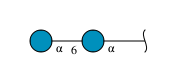
alpha-D-glucopyranose-(1-6)-alpha-D-glucopyranoseB [auth A]2N/A
Glycosylation Resources
GlyTouCan: G69864PN
GlyCosmos: G69864PN

Experimental Data & Validation

Experimental Data

  • Method: X-RAY DIFFRACTION
  • Resolution: 2.30 Å
  • R-Value Free:  0.221 (Depositor), 0.220 (DCC) 
  • R-Value Work:  0.174 (Depositor), 0.178 (DCC) 
  • R-Value Observed: 0.177 (Depositor) 
Space Group: C 1 2 1
Unit Cell:
Length ( Å )Angle ( ˚ )
a = 194.634α = 90
b = 103.382β = 91.32
c = 44.087γ = 90
Software Package:
Software NamePurpose
REFMACrefinement
HKL-2000data reduction
HKL-2000data scaling
PHASERphasing

Structure Validation

View Full Validation Report


Entry History 

Deposition Data

Revision History  (Full details and data files)

  • Version 1.0: 2016-12-14
    Type: Initial release
  • Version 1.1: 2017-01-25
    Changes: Database references
  • Version 1.2: 2017-02-22
    Changes: Database references
  • Version 2.0: 2020-07-29
    Type: Remediation
    Reason: Carbohydrate remediation
    Changes: Atomic model, Data collection, Derived calculations, Structure summary
  • Version 2.1: 2023-09-27
    Changes: Data collection, Database references, Derived calculations, Refinement description, Structure summary