5HI8 | pdb_00005hi8

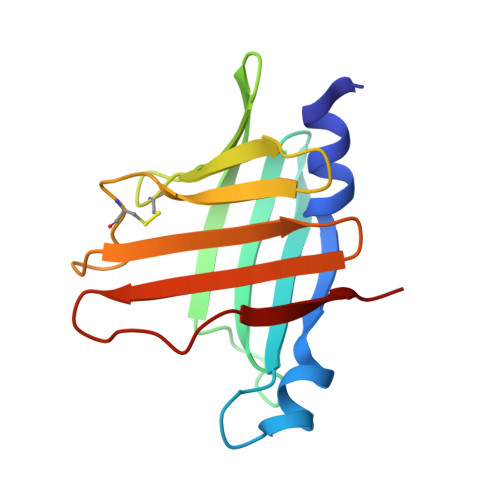
Structure of T-type Phycobiliprotein Lyase CpeT from Prochlorococcus phage P-HM1


Experimental Data Snapshot

  • Method: X-RAY DIFFRACTION
  • Resolution: 1.80 Å
  • R-Value Free: 
    0.228 (Depositor), 0.274 (DCC) 
  • R-Value Work: 
    0.207 (Depositor) 
  • R-Value Observed: 
    0.208 (Depositor) 

Starting Model: experimental
View more details

wwPDB Validation 3D Report Full Report

Validation slider image for 5HI8

This is version 1.3 of the entry. See complete history

Literature

Distinct Features of Cyanophage-encoded T-type Phycobiliprotein Lyase Phi CpeT: THE ROLE OF AUXILIARY METABOLIC GENES.

Gasper, R.Schwach, J.Hartmann, J.Holtkamp, A.Wiethaus, J.Riedel, N.Hofmann, E.Frankenberg-Dinkel, N.

(2017) J Biological Chem 292: 3089-3098

  • DOI: https://doi.org/10.1074/jbc.M116.769703
  • Primary Citation Related Structures: 
    5HI8

  • PubMed Abstract: 

    Auxiliary metabolic genes (AMG) are commonly found in the genomes of phages that infect cyanobacteria and increase the fitness of the cyanophage. AMGs are often homologs of host genes, and also typically related to photosynthesis. For example, the Φ cpeT gene in the cyanophage P-HM1 encodes a putative phycobiliprotein lyase related to cyanobacterial T-type lyases, which facilitate attachment of linear tetrapyrrole chromophores to Cys-155 of phycobiliprotein β-subunits, suggesting that ΦCpeT may also help assemble light-harvesting phycobiliproteins during infection. To investigate this possibility, we structurally and biochemically characterized recombinant ΦCpeT. The solved crystal structure of ΦCpeT at 1.8-Å resolution revealed that the protein adopts a similar fold as the cyanobacterial T-type lyase CpcT from Nostoc sp. PCC7120 but overall is more compact and smaller. ΦCpeT specifically binds phycoerythrobilin (PEB) in vitro leading to a tight complex that can also be formed in Escherichia coli when it is co-expressed with genes encoding PEB biosynthesis ( i.e. ho1 and pebS ). The formed ΦCpeT·PEB complex was very stable as the chromophore was not lost during chromatography and displayed a strong red fluorescence with a fluorescence quantum yield of Φ F = 0.3. This complex was not directly able to transfer PEB to the host phycobiliprotein β-subunit. However, it could assist the host lyase CpeS in its function by providing a pool of readily available PEB, a feature that might be important for fast phycobiliprotein assembly during phage infection.


  • Organizational Affiliation
    • Protein Crystallography Group.

Macromolecule Content 

  • Total Structure Weight: 32.69 kDa 
  • Atom Count: 2,389 
  • Modeled Residue Count: 272 
  • Deposited Residue Count: 272 
  • Unique protein chains: 1

Macromolecules

Find similar proteins by:|  3D Structure
Entity ID: 1
MoleculeChains  Sequence LengthOrganismDetailsImage
Antenna protein
A, B
136Prochlorococcus phage P-HM1Mutation(s): 0 
Gene Names: cpeTPHM1_028
UniProt
Find proteins for E3SMK9 (Prochlorococcus phage P-HM1)
Explore E3SMK9 
Go to UniProtKB:  E3SMK9
Entity Groups
Sequence Clusters30% Identity50% Identity70% Identity90% Identity95% Identity100% Identity
UniProt GroupE3SMK9
Sequence Annotations
Expand
Reference Sequence

Experimental Data & Validation

Experimental Data

  • Method: X-RAY DIFFRACTION
  • Resolution: 1.80 Å
  • R-Value Free:  0.228 (Depositor), 0.274 (DCC) 
  • R-Value Work:  0.207 (Depositor) 
  • R-Value Observed: 0.208 (Depositor) 
Space Group: C 1 2 1
Unit Cell:
Length ( Å )Angle ( ˚ )
a = 63.29α = 90
b = 61.68β = 109.77
c = 93.34γ = 90
Software Package:
Software NamePurpose
PHENIXrefinement
XSCALEdata scaling
PHASERphasing
PDB_EXTRACTdata extraction

Structure Validation

View Full Validation Report


Entry History 

& Funding Information

Deposition Data


Funding OrganizationLocationGrant Number
Funded by Transfer.NRW: Science-to-Business Pre SeedGermany300271002

Revision History  (Full details and data files)

  • Version 1.0: 2017-01-18
    Type: Initial release
  • Version 1.1: 2017-03-22
    Changes: Database references
  • Version 1.2: 2024-01-10
    Changes: Data collection, Database references, Derived calculations, Refinement description
  • Version 1.3: 2024-10-23
    Changes: Structure summary