5H4S | pdb_00005h4s

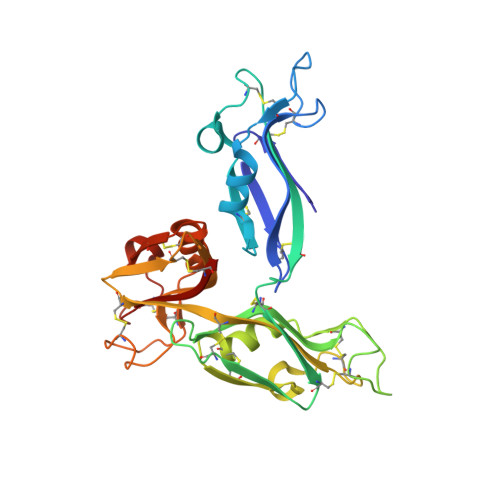
Crystal structure of a rhamnose-binding lectin SUL-I from the toxopneustid sea urchin Toxopneustes pileolus


Experimental Data Snapshot

  • Method: X-RAY DIFFRACTION
  • Resolution: 1.80 Å
  • R-Value Free: 
    0.205 (Depositor), 0.213 (DCC) 
  • R-Value Work: 
    0.157 (Depositor), 0.169 (DCC) 
  • R-Value Observed: 
    0.159 (Depositor) 

Starting Model: experimental
View more details

wwPDB Validation 3D Report Full Report

Validation slider image for 5H4S

Ligand Structure Quality Assessment 


This is version 1.4 of the entry. See complete history

Literature

Carbohydrate recognition by the rhamnose-binding lectin SUL-I with a novel three-domain structure isolated from the venom of globiferous pedicellariae of the flower sea urchin Toxopneustes pileolus

Hatakeyama, T.Ichise, A.Unno, H.Goda, S.Oda, T.Tateno, H.Hirabayashi, J.Sakai, H.Nakagawa, H.

(2017) Protein Sci 26: 1574-1583

  • DOI: https://doi.org/10.1002/pro.3185
  • Primary Citation Related Structures: 
    5H4S

  • PubMed Abstract: 

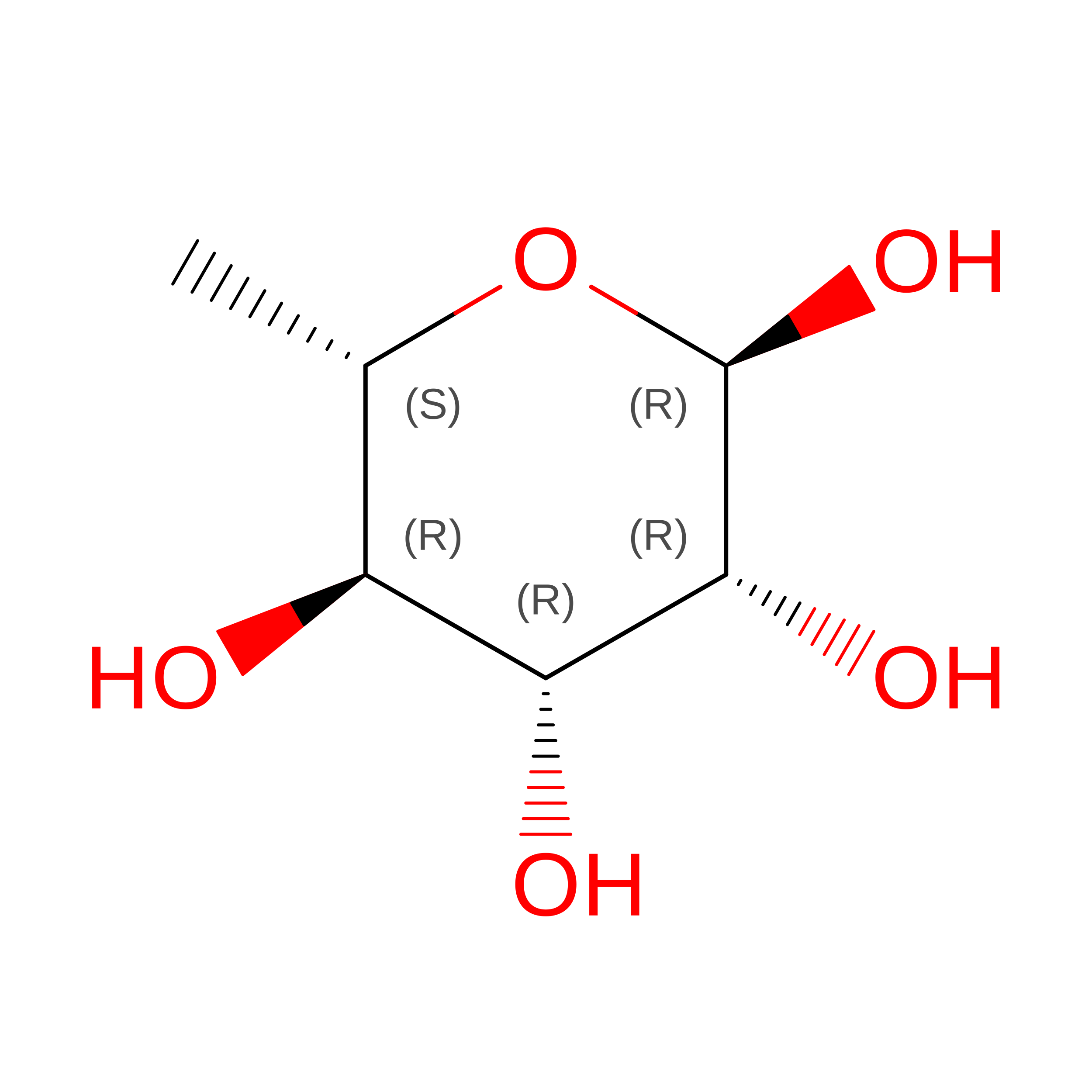
    The globiferous pedicellariae of the venomous sea urchin Toxopneustes pileolus contains several biologically active proteins. We have cloned the cDNA of one of the toxin components, SUL-I, which is a rhamnose-binding lectin (RBL) that acts as a mitogen through binding to carbohydrate chains on target cells. Recombinant SUL-I (rSUL-I) was produced in Escherichia coli cells, and its carbohydrate-binding specificity was examined with the glycoconjugate microarray analysis, which suggested that potential target carbohydrate structures are galactose-terminated N-glycans. rSUL-I exhibited mitogenic activity for murine splenocyte cells and toxicity against Vero cells. The three-dimensional structure of the rSUL-I/l-rhamnose complex was determined by X-ray crystallographic analysis at a 1.8 Å resolution. The overall structure of rSUL-I is composed of three distinctive domains with a folding structure similar to those of CSL3, a RBL from chum salmon (Oncorhynchus keta) eggs. The bound l-rhamnose molecules are mainly recognized by rSUL-I through hydrogen bonds between its 2-, 3-, and 4-hydroxy groups and Asp, Asn, and Glu residues in the binding sites, while Tyr and Ser residues participate in the recognition mechanism. It was also inferred that SUL-I may form a dimer in solution based on the molecular size estimated via dynamic light scattering as well as possible contact regions in its crystal structure.


  • Organizational Affiliation
    • Biomolecular Chemistry Laboratory, Graduate School of Engineering, Nagasaki University, 852-8521, Japan.

Macromolecule Content 

  • Total Structure Weight: 31.11 kDa 
  • Atom Count: 2,578 
  • Modeled Residue Count: 284 
  • Deposited Residue Count: 284 
  • Unique protein chains: 1

Macromolecules

Find similar proteins by:|  3D Structure
Entity ID: 1
MoleculeChains  Sequence LengthOrganismDetailsImage
L-rhamnose-binding lectin284Toxopneustes pileolusMutation(s): 0 
Gene Names: SUL-1
UniProt
Find proteins for A0A090BWT0 (Toxopneustes pileolus)
Explore A0A090BWT0 
Go to UniProtKB:  A0A090BWT0
Entity Groups
Sequence Clusters30% Identity50% Identity70% Identity90% Identity95% Identity100% Identity
UniProt GroupA0A090BWT0
Sequence Annotations
Expand
Reference Sequence

Experimental Data & Validation

Experimental Data

  • Method: X-RAY DIFFRACTION
  • Resolution: 1.80 Å
  • R-Value Free:  0.205 (Depositor), 0.213 (DCC) 
  • R-Value Work:  0.157 (Depositor), 0.169 (DCC) 
  • R-Value Observed: 0.159 (Depositor) 
Space Group: C 1 2 1
Unit Cell:
Length ( Å )Angle ( ˚ )
a = 101.76α = 90
b = 44.21β = 124.08
c = 71.84γ = 90
Software Package:
Software NamePurpose
REFMACrefinement
MOSFLMdata reduction
SCALAdata scaling
PHASERphasing

Structure Validation

View Full Validation Report


Ligand Structure Quality Assessment 


Entry History 

Deposition Data

Revision History  (Full details and data files)

  • Version 1.0: 2017-05-17
    Type: Initial release
  • Version 1.1: 2017-08-02
    Changes: Database references
  • Version 1.2: 2020-07-29
    Type: Remediation
    Reason: Carbohydrate remediation
    Changes: Data collection, Derived calculations, Structure summary
  • Version 1.3: 2023-11-08
    Changes: Data collection, Database references, Refinement description, Structure summary
  • Version 1.4: 2024-10-30
    Changes: Structure summary