5GWR | pdb_00005gwr

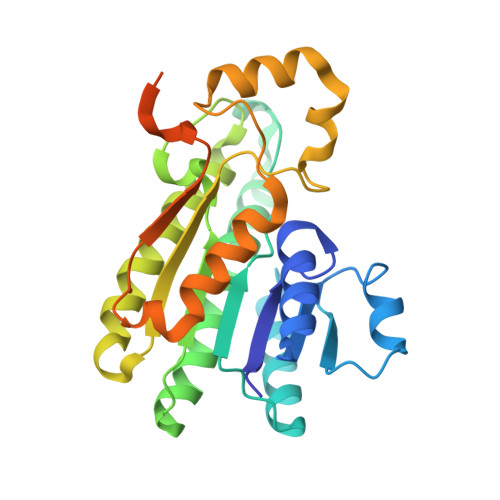
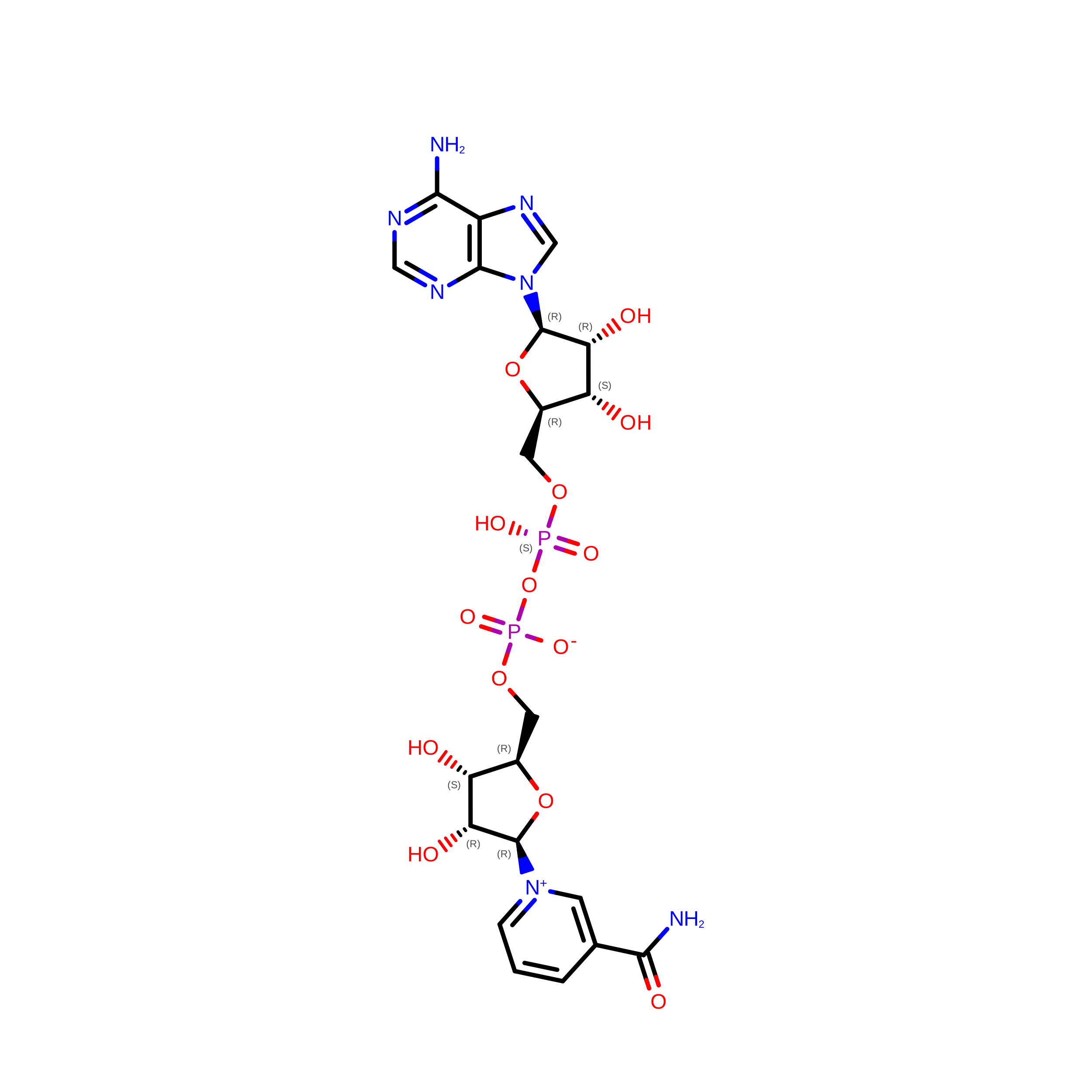
4-hydroxyisoleucine dehydrogenase complexed with NADH


Experimental Data Snapshot

  • Method: X-RAY DIFFRACTION
  • Resolution: 2.20 Å
  • R-Value Free: 
    0.205 (Depositor), 0.211 (DCC) 
  • R-Value Work: 
    0.166 (Depositor), 0.175 (DCC) 
  • R-Value Observed: 
    0.168 (Depositor) 

Starting Model: experimental
View more details

wwPDB Validation 3D Report Full Report

Validation slider image for 5GWR

Ligand Structure Quality Assessment 


This is version 1.2 of the entry. See complete history

Literature

Engineering a short-chain dehydrogenase/reductase for the stereoselective production of (2S,3R,4S)-4-hydroxyisoleucine with three asymmetric centers

Shi, X.Miyakawa, T.Nakamura, A.Hou, F.Hibi, M.Ogawa, J.Kwon, Y.Tanokura, M.

(2017) Sci Rep 7: 13703-13703

  • DOI: https://doi.org/10.1038/s41598-017-13978-w
  • Primary Citation Related Structures: 
    5GWR, 5GWS, 5GWT

  • PubMed Abstract: 

    Fenugreek is a dietary supplement for anti-aging and human health. (2S,3R,4S)-4-hydroxyisoleucine (4-HIL), which is extracted from fenugreek seeds, is expected to be a promising orally active drug for diabetes and diabetic nephropathy because of its insulinotropic effect. Although several chemical synthesis methods of 4-HIL have been proposed, these methods require multistep reactions to control the stereochemistry of 4-HIL. In this study, we modified the key enzyme 4-HIL dehydrogenase (HILDH) to overcome the biggest limitation in commercial-scale production of 4-HIL. As a result, an effective one-step carbonyl reduction to produce (2S,3R,4S)-4-HIL was successfully accomplished with strict stereoselectivity (>99% de). Mass production of (2S,3R,4S)-4-HIL by our synthetic method could have a significant contribution to the prevention of diabetes, dyslipidemia, and Alzheimer's disease. (120 words/200 words).


  • Organizational Affiliation
    • Laboratory of Basic Science on Healthy Longevity, Department of Applied Biological Chemistry, Graduate School of Agricultural and Life Sciences, The University of Tokyo, 1-1-1 Yayoi, Bunkyo-ku, Tokyo, 113-8657, Japan.

Macromolecule Content 

  • Total Structure Weight: 128.26 kDa 
  • Atom Count: 7,498 
  • Modeled Residue Count: 924 
  • Deposited Residue Count: 1,128 
  • Unique protein chains: 1

Macromolecules

Find similar proteins by:|  3D Structure
Entity ID: 1
MoleculeChains  Sequence LengthOrganismDetailsImage
4-hydroxyisolecuine dehydrogenase
A, B, C, D
282Bacillus thuringiensisMutation(s): 0 
Gene Names: AC241_05390

Experimental Data & Validation

Experimental Data

  • Method: X-RAY DIFFRACTION
  • Resolution: 2.20 Å
  • R-Value Free:  0.205 (Depositor), 0.211 (DCC) 
  • R-Value Work:  0.166 (Depositor), 0.175 (DCC) 
  • R-Value Observed: 0.168 (Depositor) 
Space Group: H 3
Unit Cell:
Length ( Å )Angle ( ˚ )
a = 231.474α = 90
b = 231.474β = 90
c = 78.675γ = 120
Software Package:
Software NamePurpose
REFMACrefinement
HKL-2000data reduction
HKL-2000data scaling
MOLREPphasing

Structure Validation

View Full Validation Report


Ligand Structure Quality Assessment 


Entry History 

Deposition Data

Revision History  (Full details and data files)

  • Version 1.0: 2017-10-25
    Type: Initial release
  • Version 1.1: 2017-11-08
    Changes: Database references
  • Version 1.2: 2023-11-08
    Changes: Data collection, Database references, Refinement description