5FLI | pdb_00005fli

enzyme-substrate complex of Ni-quercetinase


Experimental Data Snapshot

  • Method: X-RAY DIFFRACTION
  • Resolution: 2.15 Å
  • R-Value Free: 
    0.232 (Depositor), 0.233 (DCC) 
  • R-Value Work: 
    0.195 (Depositor), 0.197 (DCC) 
  • R-Value Observed: 
    0.197 (Depositor) 

Starting Model: experimental
View more details

wwPDB Validation 3D Report Full Report

Validation slider image for 5FLI

Ligand Structure Quality Assessment 


This is version 1.5 of the entry. See complete history

Literature

Quercetin 2,4-Dioxygenase Activates Dioxygen in a Side-On O2-Ni Complex.

Jeoung, J.H.Nianios, D.Fetzner, S.Dobbek, H.

(2016) Angew Chem Int Ed Engl 55: 3281-3284

  • DOI: https://doi.org/10.1002/anie.201510741
  • Primary Citation Related Structures: 
    5FLH, 5FLI, 5FLJ

  • PubMed Abstract: 

    Quercetin 2,4-dioxygenase (quercetinase) from Streptomyces uses nickel as the active-site cofactor to catalyze oxidative cleavage of the flavonol quercetin. How this unusual active-site metal supports catalysis and O2 activation is under debate. We present crystal structures of Ni-quercetinase in three different states, thus providing direct insight into how quercetin and O2 are activated at the Ni(2+) ion. The Ni(2+) ion is coordinated by three histidine residues and a glutamate residue (E(76)) in all three states. Upon binding, quercetin replaces one water ligand at Ni and is stabilized by a short hydrogen bond through E(76) , the carboxylate group of which rotates by 90°. This conformational change weakens the interaction between Ni and the remaining water ligand, thereby preparing a coordination site at Ni to bind O2. O2 binds side-on to the Ni(2+) ion and is perpendicular to the C2-C3 and C3-C4 bonds of quercetin, which are cleaved in the following reaction steps.


  • Organizational Affiliation
    • Institut für Biologie, Strukturbiologie/Biochemie, Humboldt-Universität zu Berlin, Unter den Linden 6, 10099, Berlin, Germany.

Macromolecule Content 

  • Total Structure Weight: 257.15 kDa 
  • Atom Count: 18,870 
  • Modeled Residue Count: 2,196 
  • Deposited Residue Count: 2,232 
  • Unique protein chains: 1

Macromolecules

Find similar proteins by:|  3D Structure
Entity ID: 1
MoleculeChains  Sequence LengthOrganismDetailsImage
QUERCETINASE QUED
A, B, C, D, E
A, B, C, D, E, F, G, H, I, J, K, L
186Streptomyces sp. FLAMutation(s): 0 
EC: 1.13.11.24
UniProt
Find proteins for A2VA43 (Streptomyces sp. FLA)
Explore A2VA43 
Go to UniProtKB:  A2VA43
Entity Groups
Sequence Clusters30% Identity50% Identity70% Identity90% Identity95% Identity100% Identity
UniProt GroupA2VA43
Sequence Annotations
Expand
Reference Sequence

Small Molecules

Ligands 2 Unique
IDChains Name / Formula / InChI Key2D Diagram3D Interactions
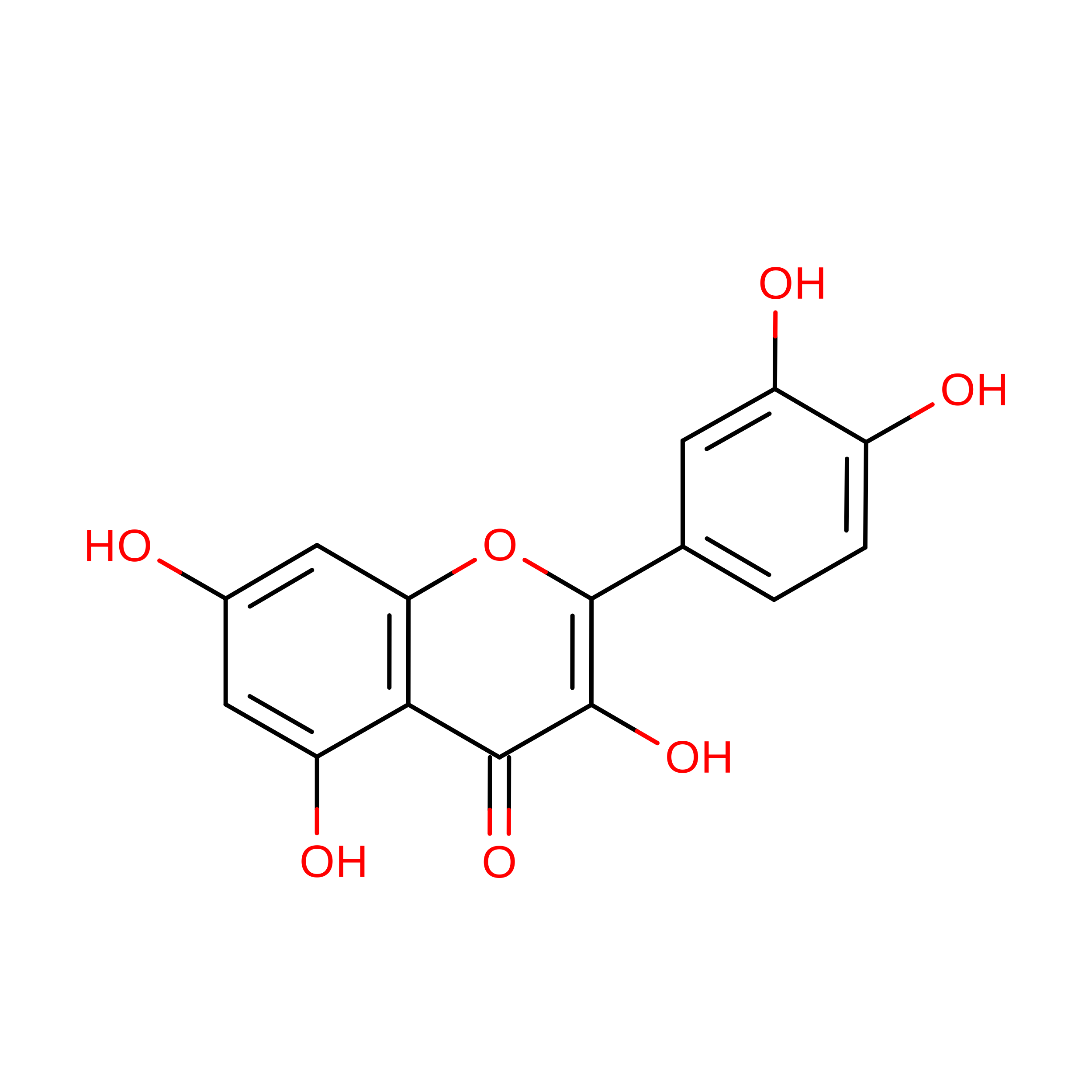
QUE

Query on QUE


Download:Ideal Coordinates CCD File
BA [auth H]
EA [auth J]
GA [auth K]
IA [auth L]
N [auth A]
BA [auth H],
EA [auth J],
GA [auth K],
IA [auth L],
N [auth A],
P [auth B],
R [auth C],
T [auth D],
V [auth E],
X [auth F],
Z [auth G]
3,5,7,3',4'-PENTAHYDROXYFLAVONE
C15 H10 O7
REFJWTPEDVJJIY-UHFFFAOYSA-N
NI

Query on NI


Download:Ideal Coordinates CCD File
AA [auth H]
CA [auth I]
DA [auth J]
FA [auth K]
HA [auth L]
AA [auth H],
CA [auth I],
DA [auth J],
FA [auth K],
HA [auth L],
M [auth A],
O [auth B],
Q [auth C],
S [auth D],
U [auth E],
W [auth F],
Y [auth G]
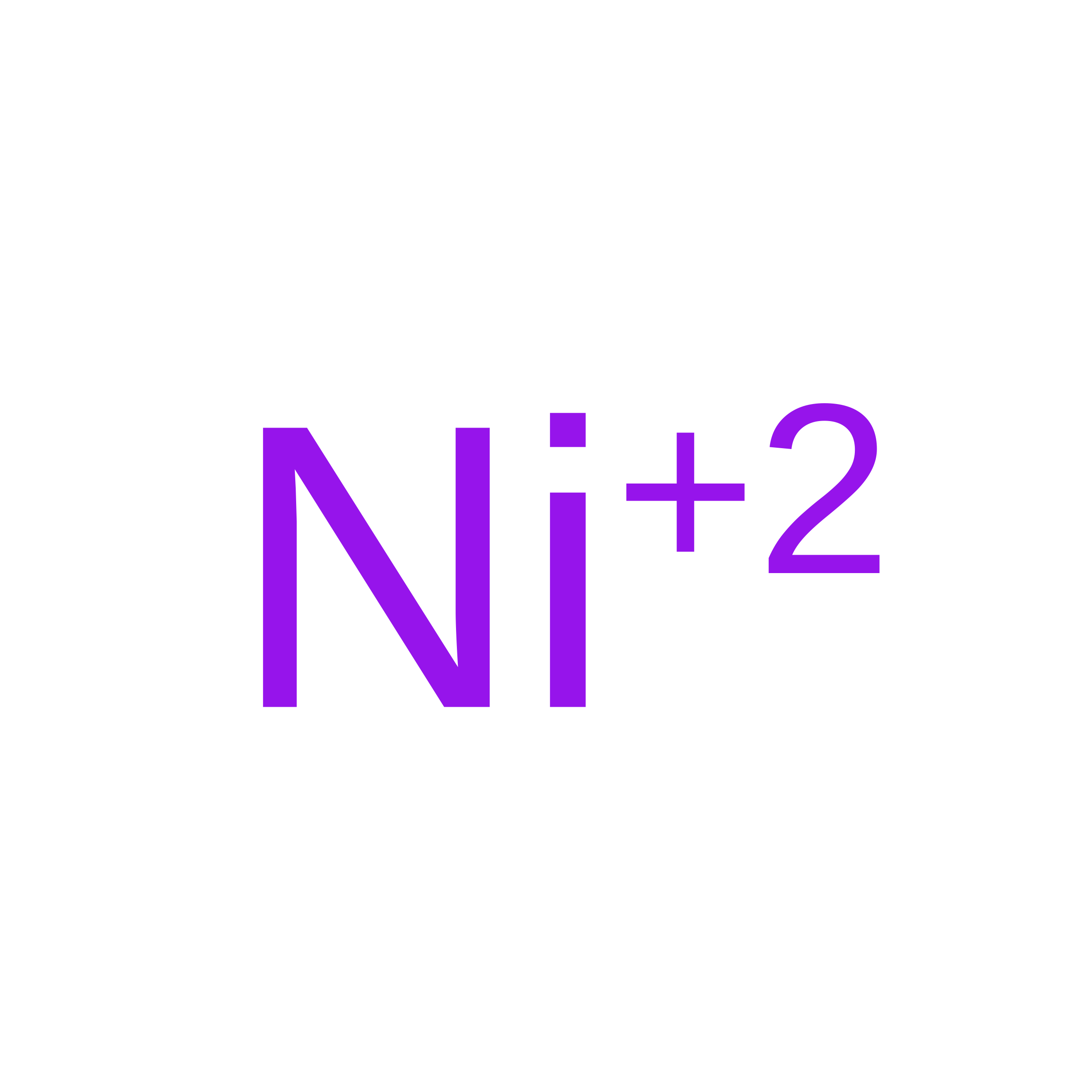
NICKEL (II) ION
Ni
VEQPNABPJHWNSG-UHFFFAOYSA-N

Experimental Data & Validation

Experimental Data

  • Method: X-RAY DIFFRACTION
  • Resolution: 2.15 Å
  • R-Value Free:  0.232 (Depositor), 0.233 (DCC) 
  • R-Value Work:  0.195 (Depositor), 0.197 (DCC) 
  • R-Value Observed: 0.197 (Depositor) 
Space Group: P 1 21 1
Unit Cell:
Length ( Å )Angle ( ˚ )
a = 101.396α = 90
b = 113.752β = 96.45
c = 105.003γ = 90
Software Package:
Software NamePurpose
PHENIXrefinement
XDSdata reduction
XSCALEdata scaling
PHASERphasing

Structure Validation

View Full Validation Report


Ligand Structure Quality Assessment 


Entry History 

Deposition Data

Revision History  (Full details and data files)

  • Version 1.0: 2016-06-01
    Type: Initial release
  • Version 1.1: 2017-04-12
    Changes: Database references
  • Version 1.2: 2017-04-26
    Changes: Database references
  • Version 1.3: 2017-05-24
    Changes: Database references
  • Version 1.4: 2019-02-27
    Changes: Data collection, Database references
  • Version 1.5: 2024-01-10
    Changes: Data collection, Database references, Derived calculations, Other, Refinement description