5F9Q | pdb_00005f9q

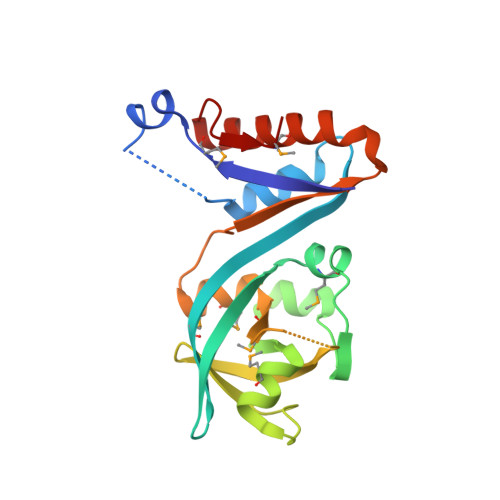
Crystal structure of the extracellular domain of noncanonic ABC-type transporter YknZ from Gram-positive bacteria


Experimental Data Snapshot

  • Method: X-RAY DIFFRACTION
  • Resolution: 2.04 Å
  • R-Value Free: 
    0.247 (Depositor), 0.248 (DCC) 
  • R-Value Work: 
    0.194 (Depositor), 0.196 (DCC) 
  • R-Value Observed: 
    0.200 (Depositor) 

wwPDB Validation 3D Report Full Report

Validation slider image for 5F9Q

This is version 1.2 of the entry. See complete history

Literature

The Crystal Structure of the YknZ Extracellular Domain of ABC Transporter YknWXYZ from Bacillus amyloliquefaciens.

Xu, Y.Guo, J.Wang, L.Jiang, R.Jin, X.Liu, J.Fan, S.Quan, C.S.Ha, N.C.

(2016) PLoS One 11: e0155846-e0155846

  • DOI: https://doi.org/10.1371/journal.pone.0155846
  • Primary Citation Related Structures: 
    5F9Q

  • PubMed Abstract: 

    Bacillus possesses the peptide toxin Sporulation-Delaying Protein (SDP), which can kill cells within a biofilm to support continued growth, thereby delaying the onset of biofilm sporulation. The four-component transporter YknWXYZ acts as a major SDP efflux pump to protect cells against the endogenous SDP toxin, for which YknYZ is a non-canonical ATP-binding cassette (ABC)-type transporter. YknYZ consists of the following two components: (1) an individual protein (YknY) and (2) a respective permease (YknZ). To date, the crystal structure, molecular function, and mechanism of action of the integral membrane protein YknZ remain to be elucidated. In this study, to characterize the structural and biochemical roles of YknZ in the functional assembly of YknWXYZ, we predicted and overexpressed the YknZ extracellular domain. We determined the crystal structure of B. amyloliquefaciens YknZ at a resolution of 2.0 Å. The structure revealed that the YknZ extracellular region exhibits significant structural similarity with the MacB periplasmic domain, which is a non-canonical ABC-type transporter in the tripartite macrolide-specific efflux pump in Gram-negative bacteria. We also found that the YknZ extracellular domain can directly bind to an extracellular component of YknX. This structural and biochemical study provides insights into the assembly of YknWXYZ, which may be relevant to understanding cannibalistic peptide toxin resistance in Bacillus and controlling bacterial growth.


  • Organizational Affiliation
    • Department of Bioengineering, College of Life Science, Dalian Nationalities University, Dalian 116600, Liaoning, China.

Macromolecule Content 

  • Total Structure Weight: 22.08 kDa 
  • Atom Count: 1,530 
  • Modeled Residue Count: 187 
  • Deposited Residue Count: 199 
  • Unique protein chains: 1

Macromolecules

Find similar proteins by:|  3D Structure
Entity ID: 1
MoleculeChains  Sequence LengthOrganismDetailsImage
Macrolide export ATP-binding/permease protein YknZ199Bacillus amyloliquefaciensMutation(s): 0 
Gene Names: ABH13_1432

Small Molecules

Modified Residues  1 Unique
IDChains TypeFormula2D DiagramParent
MSE
Query on MSE
A
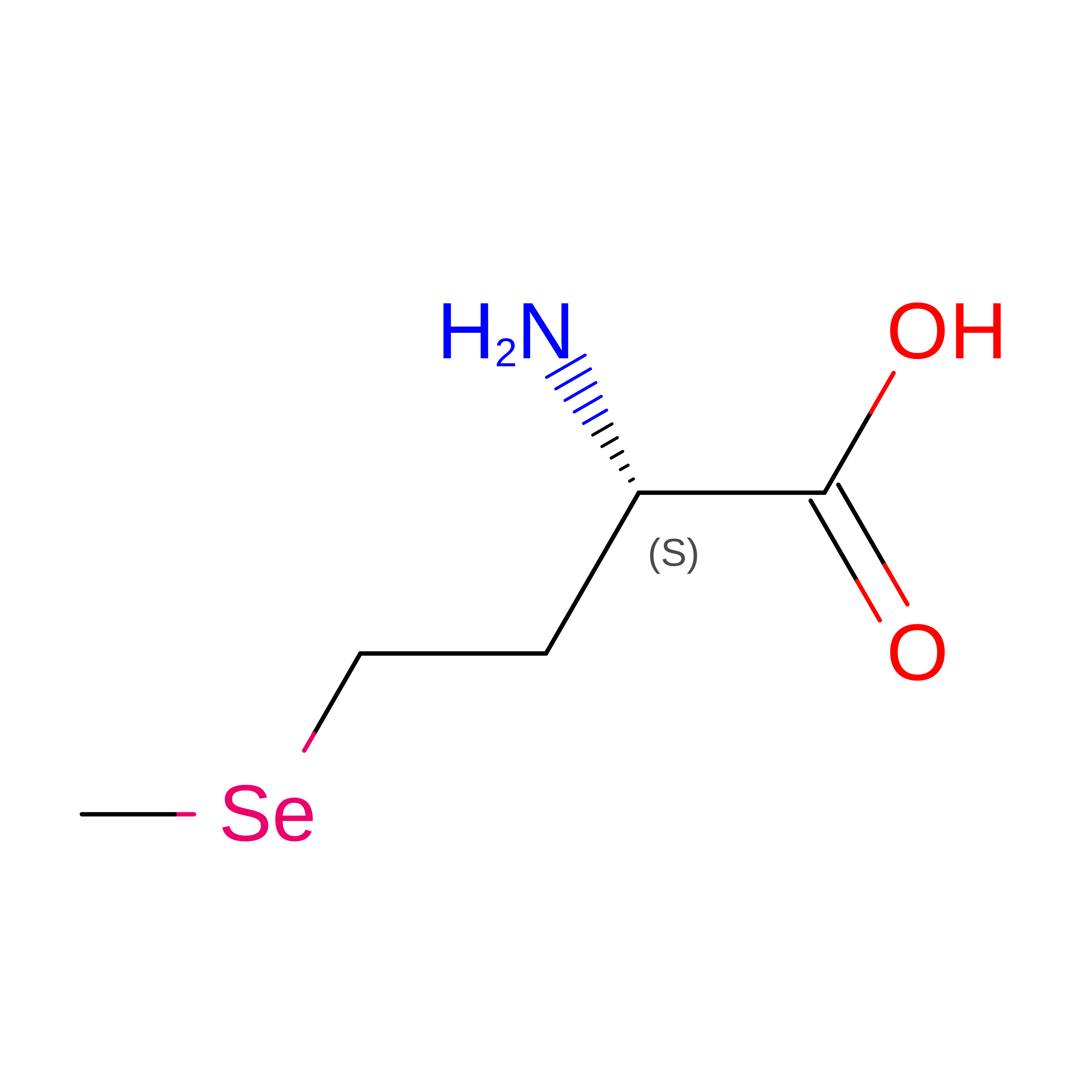
L-PEPTIDE LINKINGC5 H11 N O2 SeMET

Experimental Data & Validation

Experimental Data

  • Method: X-RAY DIFFRACTION
  • Resolution: 2.04 Å
  • R-Value Free:  0.247 (Depositor), 0.248 (DCC) 
  • R-Value Work:  0.194 (Depositor), 0.196 (DCC) 
  • R-Value Observed: 0.200 (Depositor) 
Space Group: P 21 21 21
Unit Cell:
Length ( Å )Angle ( ˚ )
a = 44.169α = 90
b = 46.147β = 90
c = 87.543γ = 90
Software Package:
Software NamePurpose
PHENIXrefinement
HKL-2000data processing
HKL-2000data scaling
AutoSolphasing

Structure Validation

View Full Validation Report


Entry History 

& Funding Information

Deposition Data


Funding OrganizationLocationGrant Number
the National Natural Science Foundation of ChinaChina31200556
the National Natural Science Foundation of ChinaChina21402024
the National Natural Science Foundation of ChinaChina21272031
China Postdoctoral Science FoundationChina2013M540229
the Fundamental Research Funds for the Central UniversitiesChinaDC201502020203

Revision History  (Full details and data files)

  • Version 1.0: 2016-02-03
    Type: Initial release
  • Version 1.1: 2016-09-14
    Changes: Database references
  • Version 1.2: 2024-10-23
    Changes: Data collection, Database references, Derived calculations, Structure summary