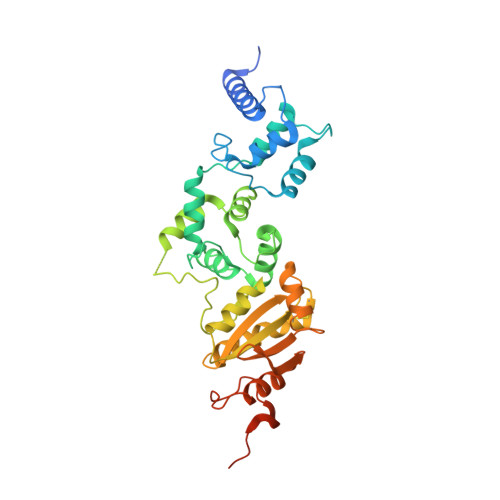
5E37 | pdb_00005e37

Redox protein from Chlamydomonas reinhardtii


Experimental Data Snapshot

  • Method: X-RAY DIFFRACTION
  • Resolution: 1.60 Å
  • R-Value Free: 
    0.233 (Depositor), 0.240 (DCC) 
  • R-Value Work: 
    0.199 (Depositor), 0.207 (DCC) 
  • R-Value Observed: 
    0.200 (Depositor) 

wwPDB Validation 3D Report Full Report

Validation slider image for 5E37

This is version 1.3 of the entry. See complete history. 

Literature

Calredoxin represents a novel type of calcium-dependent sensor-responder connected to redox regulation in the chloroplast

Hochmal, A.K., Zinzius, K., Charoenwattanasatien, R., Gabelein, P., Mutoh, R., Tanaka, H., Schulze, S., Liu, G., Scholz, M., Nordhues, A., Offenborn, J.N., Petroutsos, D., Finazzi, G., Fufezan, C., Huang, K., Kurisu, G., Hippler, M.

(2016) Nat Commun 7: 11847-11847

  • DOI: https://doi.org/10.1038/ncomms11847
  • Primary Citation Related Structures: 
    5E37

  • PubMed Abstract: 

    Calcium (Ca(2+)) and redox signalling play important roles in acclimation processes from archaea to eukaryotic organisms. Herein we characterized a unique protein from Chlamydomonas reinhardtii that has the competence to integrate Ca(2+)- and redox-related signalling. This protein, designated as calredoxin (CRX), combines four Ca(2+)-binding EF-hands and a thioredoxin (TRX) domain. A crystal structure of CRX, at 1.6 Å resolution, revealed an unusual calmodulin-fold of the Ca(2+)-binding EF-hands, which is functionally linked via an inter-domain communication path with the enzymatically active TRX domain. CRX is chloroplast-localized and interacted with a chloroplast 2-Cys peroxiredoxin (PRX1). Ca(2+)-binding to CRX is critical for its TRX activity and for efficient binding and reduction of PRX1. Thereby, CRX represents a new class of Ca(2+)-dependent 'sensor-responder' proteins. Genetically engineered Chlamydomonas strains with strongly diminished amounts of CRX revealed altered photosynthetic electron transfer and were affected in oxidative stress response underpinning a function of CRX in stress acclimation.


  • Organizational Affiliation: 
    • Institute of Plant Biology and Biotechnology, University of Münster, 48143 Münster, Germany.

Macromolecule Content 

  • Total Structure Weight: 80.22 kDa 
  • Atom Count: 5,719 
  • Modeled Residue Count: 623 
  • Deposited Residue Count: 712 
  • Unique protein chains: 1

Macromolecules

Find similar proteins by:|  3D Structure
Entity ID: 1
MoleculeChains  Sequence LengthOrganismDetailsImage
EF-Hand domain-containing thioredoxinA,
B [auth C]
356Chlamydomonas reinhardtiiMutation(s): 0 
Gene Names: CHLREDRAFT_205510
UniProt
Find proteins for A0A2K3DZB3 (Chlamydomonas reinhardtii)
Explore A0A2K3DZB3 
Go to UniProtKB:  A0A2K3DZB3
Entity Groups
Sequence Clusters30% Identity50% Identity70% Identity90% Identity95% Identity100% Identity
UniProt GroupA0A2K3DZB3
Sequence Annotations
Expand
Reference Sequence

Experimental Data & Validation

Experimental Data

  • Method: X-RAY DIFFRACTION
  • Resolution: 1.60 Å
  • R-Value Free:  0.233 (Depositor), 0.240 (DCC) 
  • R-Value Work:  0.199 (Depositor), 0.207 (DCC) 
  • R-Value Observed: 0.200 (Depositor) 
Space Group: P 1 21 1
Unit Cell:
Length ( Å )Angle ( ˚ )
a = 85.96α = 90
b = 55.19β = 101
c = 89.58γ = 90
Software Package:
Software NamePurpose
REFMACrefinement
HKL-2000data reduction
HKL-2000data scaling
PHENIXphasing

Structure Validation

View Full Validation Report


Entry History 

& Funding Information

Deposition Data


Funding OrganizationLocationGrant Number
Funding Program for Next Generation World-Leading Researchers from the Cabinet Office of JapanJapanGS016
International Joint Research Promotion Program and International Collaborative Research Program, Osaka UniversityJapan--

Revision History  (Full details and data files)

  • Version 1.0: 2016-06-22
    Type: Initial release
  • Version 1.1: 2016-06-29
    Changes: Database references
  • Version 1.2: 2020-02-19
    Changes: Data collection, Derived calculations
  • Version 1.3: 2024-10-23
    Changes: Data collection, Database references, Derived calculations, Structure summary