5DTL | pdb_00005dtl

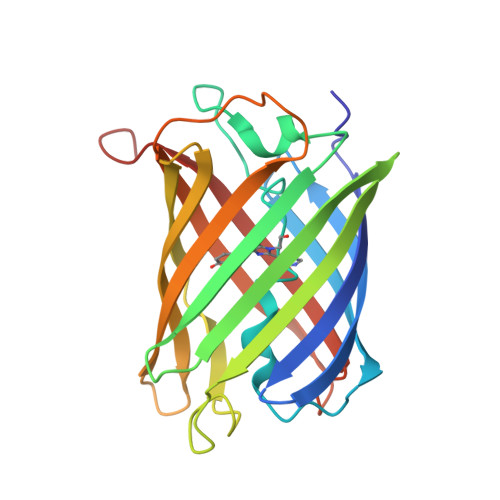
Crystal structure of mEos2-A69T fluorescent protein


Experimental Data Snapshot

  • Method: X-RAY DIFFRACTION
  • Resolution: 2.70 Å
  • R-Value Free: 
    0.232 (Depositor), 0.221 (DCC) 
  • R-Value Work: 
    0.211 (Depositor), 0.212 (DCC) 
  • R-Value Observed: 
    0.212 (Depositor) 

Starting Model: experimental
View more details

wwPDB Validation 3D Report Full Report

Validation slider image for 5DTL

This is version 4.0 of the entry. See complete history

Literature

Arginine 66 Controls Dark-State Formation in Green-to-Red Photoconvertible Fluorescent Proteins.

Berardozzi, R.Adam, V.Martins, A.Bourgeois, D.

(2016) J Am Chem Soc 138: 558-565

  • DOI: https://doi.org/10.1021/jacs.5b09923
  • Primary Citation Related Structures: 
    5DTL

  • PubMed Abstract: 

    Photoactivated localization microscopy (PALM) is a powerful technique to investigate cellular nanostructures quantitatively and dynamically. However, the use of PALM for molecular counting or single-particle tracking remains limited by the propensity of photoconvertible fluorescent protein markers (PCFPs) to repeatedly enter dark states. By designing the single mutants mEos2-A69T and Dendra2-T69A, we completely swapped the blinking behaviors of mEos2 and Dendra2, two popular PCFPs. We combined X-ray crystallography and single-molecule microscopy to show that blinking in mEos2 and Dendra2 is largely controlled by the orientation of arginine 66, a highly conserved residue in Anthozoan PCFPs. The Arg66 side-chain conformation affects the bleaching and the on-to-off transition quantum yields, as well as the fraction of molecules entering long-lived dark states, resulting in widely different apparent blinking behaviors that largely modulate the efficiency of current blinking correction procedures. The present work provides mechanistic insight into the complex photophysics of Anthozoan PCFPs and will facilitate future engineering of bright and low-blinking variants suitable for PALM.


  • Organizational Affiliation
    • Institut de Biologie Structurale, Université Grenoble Alpes , CEA, CNRS, 38044 Grenoble, France.

Macromolecule Content 

  • Total Structure Weight: 310.72 kDa 
  • Atom Count: 21,915 
  • Modeled Residue Count: 2,640 
  • Deposited Residue Count: 2,688 
  • Unique protein chains: 1

Macromolecules

Find similar proteins by:|  3D Structure
Entity ID: 1
MoleculeChains  Sequence LengthOrganismDetailsImage
Green to red photoconvertible GFP-like protein EosFP
A, B, C, D, E
A, B, C, D, E, F, G, H, I, J, K, L
224Lobophyllia hemprichiiMutation(s): 8 
UniProt
Find proteins for Q5S6Z9 (Lobophyllia hemprichii)
Explore Q5S6Z9 
Go to UniProtKB:  Q5S6Z9
Entity Groups
Sequence Clusters30% Identity50% Identity70% Identity90% Identity95% Identity100% Identity
UniProt GroupQ5S6Z9
Sequence Annotations
Expand
Reference Sequence

Small Molecules

Modified Residues  1 Unique
IDChains TypeFormula2D DiagramParent
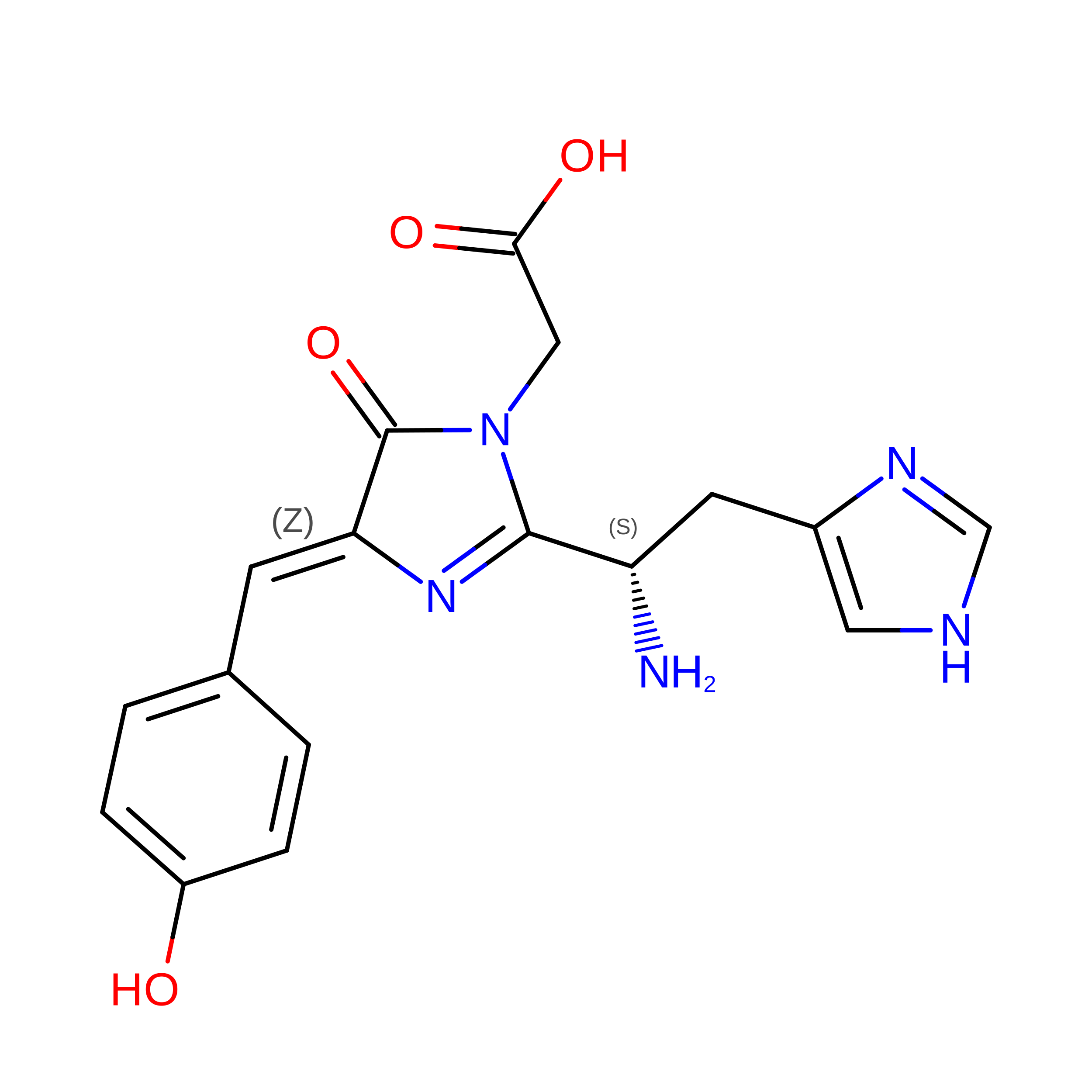
5SQ
Query on 5SQ
A, B, C, D, E
A, B, C, D, E, F, G, H, I, J, K, L
L-PEPTIDE LINKINGC17 H17 N5 O4HIS, TYR, GLY

Experimental Data & Validation

Experimental Data

  • Method: X-RAY DIFFRACTION
  • Resolution: 2.70 Å
  • R-Value Free:  0.232 (Depositor), 0.221 (DCC) 
  • R-Value Work:  0.211 (Depositor), 0.212 (DCC) 
  • R-Value Observed: 0.212 (Depositor) 
Space Group: P 1
Unit Cell:
Length ( Å )Angle ( ˚ )
a = 73.37α = 91.68
b = 96.5β = 107.83
c = 100.06γ = 97.38
Software Package:
Software NamePurpose
REFMACrefinement
XDSdata reduction
XSCALEdata scaling
PHASERphasing

Structure Validation

View Full Validation Report


Entry History 

Deposition Data

Revision History  (Full details and data files)

  • Version 1.0: 2015-12-30
    Type: Initial release
  • Version 1.1: 2016-01-13
    Changes: Database references
  • Version 1.2: 2016-01-27
    Changes: Database references
  • Version 2.0: 2021-09-01
    Changes: Advisory, Atomic model, Data collection, Database references, Derived calculations, Non-polymer description, Polymer sequence, Structure summary
  • Version 3.0: 2023-11-15
    Changes: Advisory, Atomic model, Data collection, Derived calculations, Refinement description
  • Version 3.1: 2024-01-10
    Changes: Refinement description
  • Version 3.2: 2024-10-23
    Changes: Structure summary
  • Version 4.0: 2026-03-18
    Changes: Polymer sequence