5DRX | pdb_00005drx

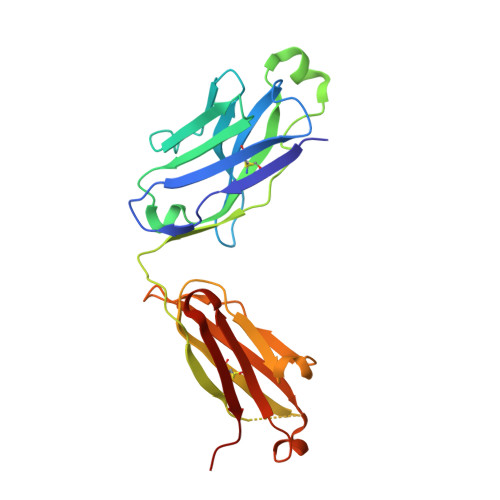
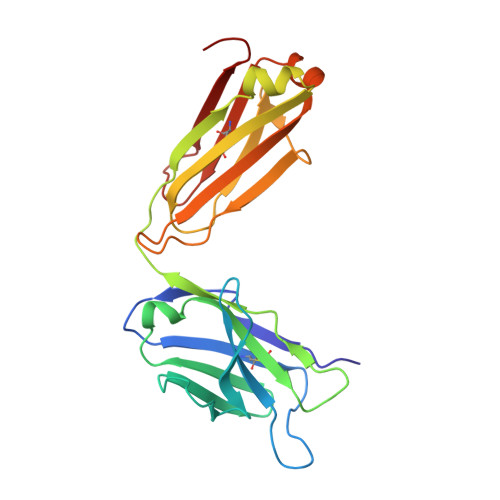
Crystal structure of the BCR Fab fragment from subset #4 case CLL240


Experimental Data Snapshot

  • Method: X-RAY DIFFRACTION
  • Resolution: 2.10 Å
  • R-Value Free: 
    0.222 (Depositor), 0.225 (DCC) 
  • R-Value Work: 
    0.194 (Depositor), 0.197 (DCC) 
  • R-Value Observed: 
    0.195 (Depositor) 

Starting Model: other
View more details

wwPDB Validation 3D Report Full Report

Validation slider image for 5DRX

This is version 1.3 of the entry. See complete history

Literature

Distinct homotypic B-cell receptor interactions shape the outcome of chronic lymphocytic leukaemia.

Minici, C.Gounari, M.Ubelhart, R.Scarfo, L.Duhren-von Minden, M.Schneider, D.Tasdogan, A.Alkhatib, A.Agathangelidis, A.Ntoufa, S.Chiorazzi, N.Jumaa, H.Stamatopoulos, K.Ghia, P.Degano, M.

(2017) Nat Commun 8: 15746-15746

  • DOI: https://doi.org/10.1038/ncomms15746
  • Primary Citation Related Structures: 
    5DRW, 5DRX, 5IFH

  • PubMed Abstract: 

    Cell-autonomous B-cell receptor (BcR)-mediated signalling is a hallmark feature of the neoplastic B lymphocytes in chronic lymphocytic leukaemia (CLL). Here we elucidate the structural basis of autonomous activation of CLL B cells, showing that BcR immunoglobulins initiate intracellular signalling through homotypic interactions between epitopes that are specific for each subgroup of patients with homogeneous clinicobiological profiles. The molecular details of the BcR-BcR interactions apparently dictate the clinical course of disease, with stronger affinities and longer half-lives in indolent cases, and weaker, short-lived contacts mediating the aggressive ones. The diversity of homotypic BcR contacts leading to cell-autonomous signalling reconciles the existence of a shared pathogenic mechanism with the biological and clinical heterogeneity of CLL and offers opportunities for innovative treatment strategies.


  • Organizational Affiliation
    • Biocrystallography Unit, Division of Immunology, Transplantation and Infectious Diseases, IRCCS San Raffaele Scientific Institute, via Olgettina 58, 20132 Milan, Italy.

Macromolecule Content 

  • Total Structure Weight: 98.37 kDa 
  • Atom Count: 7,500 
  • Modeled Residue Count: 877 
  • Deposited Residue Count: 898 
  • Unique protein chains: 2

Macromolecules

Find similar proteins by:|  3D Structure
Entity ID: 1
MoleculeChains  Sequence LengthOrganismDetailsImage
CLL240 heavy chain (VH and CH1 domains)A [auth H],
C [auth A]
228Homo sapiensMutation(s): 0 
Gene Names: IGHV4-34IGHJ6IGHG1*03
Find similar proteins by:|  3D Structure
Entity ID: 2
MoleculeChains  Sequence LengthOrganismDetailsImage
CLL240 BCR light chainB [auth L],
D [auth B]
221Homo sapiensMutation(s): 0 
Gene Names: IGKV2-30IGKJ2IGKC*01

Experimental Data & Validation

Experimental Data

  • Method: X-RAY DIFFRACTION
  • Resolution: 2.10 Å
  • R-Value Free:  0.222 (Depositor), 0.225 (DCC) 
  • R-Value Work:  0.194 (Depositor), 0.197 (DCC) 
  • R-Value Observed: 0.195 (Depositor) 
Space Group: P 21 21 21
Unit Cell:
Length ( Å )Angle ( ˚ )
a = 86.187α = 90
b = 92.327β = 90
c = 135.13γ = 90
Software Package:
Software NamePurpose
PHENIXrefinement
XDSdata reduction
XSCALEdata scaling
MOLREPphasing
Cootmodel building

Structure Validation

View Full Validation Report


Entry History 

& Funding Information

Deposition Data


Funding OrganizationLocationGrant Number
AIRCItaly5xMille
Fondazione Intesa San Paolo OnlusItaly--

Revision History  (Full details and data files)

  • Version 1.0: 2016-09-28
    Type: Initial release
  • Version 1.1: 2022-10-26
    Changes: Database references
  • Version 1.2: 2024-05-01
    Changes: Data collection, Refinement description
  • Version 1.3: 2024-10-23
    Changes: Structure summary