5DQP | pdb_00005dqp

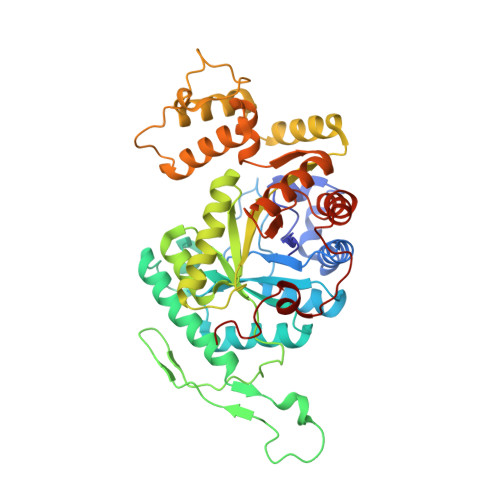
EDTA monooxygenase (EmoA) from Chelativorans sp. BNC1


Experimental Data Snapshot

  • Method: X-RAY DIFFRACTION
  • Resolution: 2.15 Å
  • R-Value Free: 
    0.235 (Depositor), 0.238 (DCC) 
  • R-Value Work: 
    0.190 (Depositor) 
  • R-Value Observed: 
    0.192 (Depositor) 

Starting Model: experimental
View more details

wwPDB Validation 3D Report Full Report

Validation slider image for 5DQP

This is version 1.2 of the entry. See complete history

Literature

Structural and biochemical characterization of EDTA monooxygenase and its physical interaction with a partner flavin reductase.

Jun, S.Y.Lewis, K.M.Youn, B.Xun, L.Kang, C.

(2016) Mol Microbiol 100: 989-1003

  • DOI: https://doi.org/10.1111/mmi.13363
  • Primary Citation Related Structures: 
    5DQP

  • PubMed Abstract: 

    Ethylenediaminetetraacetate (EDTA) is currently the most abundant organic pollutant due to its recalcitrance and extensive use. Only a few bacteria can degrade it, using EDTA monooxygenase (EmoA) to initiate the degradation. EmoA is an FMNH2 -dependent monooxygenase that requires an NADH:FMN oxidoreductase (EmoB) to provide FMNH2 as a cosubstrate. Although EmoA has been identified from Chelativorans (ex. Mesorhizobium) sp. BNC1, its catalytic mechanism is unknown. Crystal structures of EmoA revealed a domain-like insertion into a TIM-barrel, which might serve as a flexible lid for the active site. Docking of MgEDTA(2-) into EmoA identified an intricate hydrogen bond network connected to Tyr(71) , which should potentially lower its pKa. Tyr(71) , along with nearby Glu(70) and a peroxy flavin, facilitates a keto-enol transition of the leaving acetyl group of EDTA. Further, for the first time, the physical interaction between EmoA and EmoB was observed by ITC, molecular docking and enzyme kinetic assay, which enhanced both EmoA and EmoB activities probably through coupled channelling of FMNH2 .


  • Organizational Affiliation
    • Department of Chemistry, Washington State University, Pullman, WA, 99164-4630, USA.

Macromolecule Content 

  • Total Structure Weight: 95.22 kDa 
  • Atom Count: 7,119 
  • Modeled Residue Count: 838 
  • Deposited Residue Count: 860 
  • Unique protein chains: 1

Macromolecules

Find similar proteins by:|  3D Structure
Entity ID: 1
MoleculeChains  Sequence LengthOrganismDetailsImage
EDTA monooxygenase
A, B
430EDTA-degrading bacterium BNC1Mutation(s): 0 
Gene Names: emoA
UniProt
Find proteins for Q9F9T3 (EDTA-degrading bacterium BNC1)
Explore Q9F9T3 
Go to UniProtKB:  Q9F9T3
Entity Groups
Sequence Clusters30% Identity50% Identity70% Identity90% Identity95% Identity100% Identity
UniProt GroupQ9F9T3
Sequence Annotations
Expand
Reference Sequence

Small Molecules

Ligands 2 Unique
IDChains Name / Formula / InChI Key2D Diagram3D Interactions
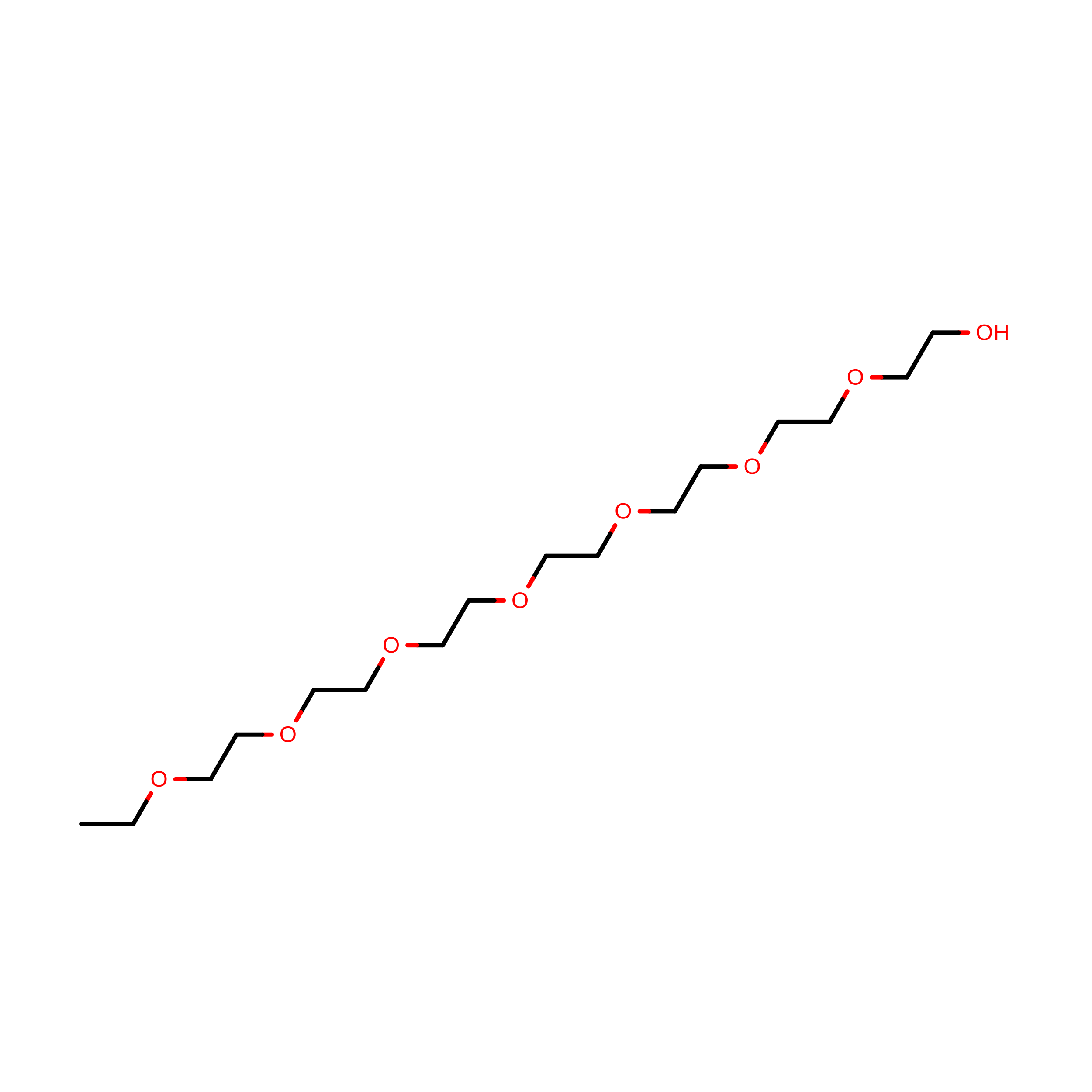
PE4

Query on PE4


Download:Ideal Coordinates CCD File
C [auth A]2-{2-[2-(2-{2-[2-(2-ETHOXY-ETHOXY)-ETHOXY]-ETHOXY}-ETHOXY)-ETHOXY]-ETHOXY}-ETHANOL
C16 H34 O8
PJWQOENWHPEPKI-UHFFFAOYSA-N
SO4

Query on SO4


Download:Ideal Coordinates CCD File
D [auth A]SULFATE ION
O4 S
QAOWNCQODCNURD-UHFFFAOYSA-L

Experimental Data & Validation

Experimental Data

  • Method: X-RAY DIFFRACTION
  • Resolution: 2.15 Å
  • R-Value Free:  0.235 (Depositor), 0.238 (DCC) 
  • R-Value Work:  0.190 (Depositor) 
  • R-Value Observed: 0.192 (Depositor) 
Space Group: P 43 2 2
Unit Cell:
Length ( Å )Angle ( ˚ )
a = 87.332α = 90
b = 87.332β = 90
c = 262.704γ = 90
Software Package:
Software NamePurpose
PHENIXrefinement
HKL-2000data reduction
HKL-2000data scaling
PHASERphasing

Structure Validation

View Full Validation Report


Entry History 

Deposition Data

Revision History  (Full details and data files)

  • Version 1.0: 2016-03-16
    Type: Initial release
  • Version 1.1: 2016-06-22
    Changes: Database references
  • Version 1.2: 2023-09-27
    Changes: Data collection, Database references, Derived calculations, Refinement description