5D9G | pdb_00005d9g

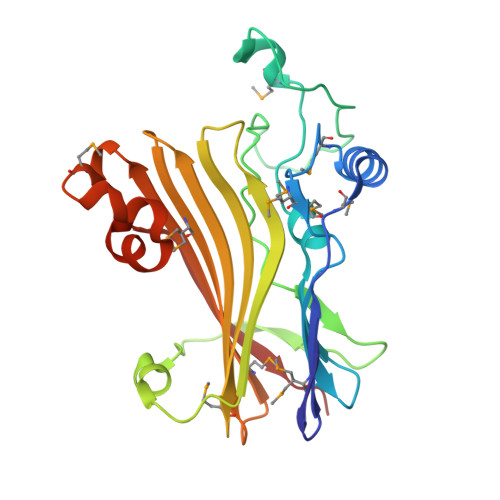
Crystal structure of TIPRL, TOR signaling pathway regulator-like, in complex with peptide


Experimental Data Snapshot

  • Method: X-RAY DIFFRACTION
  • Resolution: 2.15 Å
  • R-Value Free: 
    0.199 (Depositor), 0.202 (DCC) 
  • R-Value Work: 
    0.182 (Depositor), 0.189 (DCC) 
  • R-Value Observed: 
    0.183 (Depositor) 

wwPDB Validation 3D Report Full Report

Validation slider image for 5D9G

This is version 1.6 of the entry. See complete history

Literature

Crystal structure of the human Tip41 orthologue, TIPRL, reveals a novel fold and a binding site for the PP2Ac C-terminus.

Scorsato, V.Lima, T.B.Righetto, G.L.Zanchin, N.I.Brandao-Neto, J.Sandy, J.Pereira, H.D.Ferrari, A.J.Gozzo, F.C.Smetana, J.H.Aparicio, R.

(2016) Sci Rep 6: 30813-30813

  • DOI: https://doi.org/10.1038/srep30813
  • Primary Citation Related Structures: 
    5D9G

  • PubMed Abstract: 

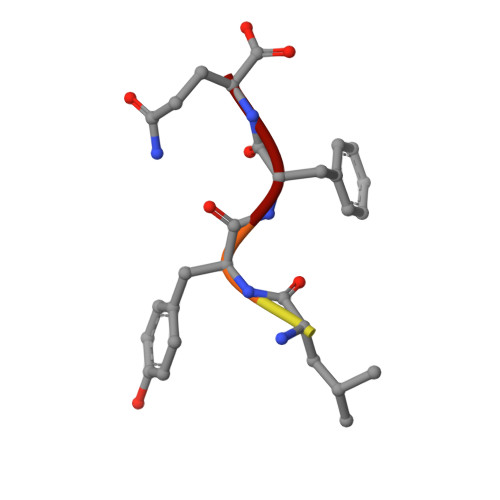
    TOR signaling pathway regulator-like (TIPRL) is a regulatory protein which inhibits the catalytic subunits of Type 2A phosphatases. Several cellular contexts have been proposed for TIPRL, such as regulation of mTOR signaling, inhibition of apoptosis and biogenesis and recycling of PP2A, however, the underlying molecular mechanism is still poorly understood. We have solved the crystal structure of human TIPRL at 2.15 Å resolution. The structure is a novel fold organized around a central core of antiparallel beta-sheet, showing an N-terminal α/β region at one of its surfaces and a conserved cleft at the opposite surface. Inside this cleft, we found a peptide derived from TEV-mediated cleavage of the affinity tag. We show by mutagenesis, pulldown and hydrogen/deuterium exchange mass spectrometry that this peptide is a mimic for the conserved C-terminal tail of PP2A, an important region of the phosphatase which regulates holoenzyme assembly, and TIPRL preferentially binds the unmodified version of the PP2A-tail mimetic peptide DYFL compared to its tyrosine-phosphorylated version. A docking model of the TIPRL-PP2Ac complex suggests that TIPRL blocks the phosphatase's active site, providing a structural framework for the function of TIPRL in PP2A inhibition.


  • Organizational Affiliation
    • Institute of Chemistry, University of Campinas, Campinas, São Paulo 13083-970, Brazil.

Macromolecule Content 

  • Total Structure Weight: 59.63 kDa 
  • Atom Count: 4,314 
  • Modeled Residue Count: 502 
  • Deposited Residue Count: 504 
  • Unique protein chains: 2

Macromolecules

Find similar proteins by:|  3D Structure
Entity ID: 1
MoleculeChains  Sequence LengthOrganismDetailsImage
TIP41-like protein
A, B
246Homo sapiensMutation(s): 0 
Gene Names: TIPRL
UniProt & NIH Common Fund Data Resources
Find proteins for O75663 (Homo sapiens)
Explore O75663 
Go to UniProtKB:  O75663
PHAROS:  O75663
GTEx:  ENSG00000143155 
Entity Groups
Sequence Clusters30% Identity50% Identity70% Identity90% Identity95% Identity100% Identity
UniProt GroupO75663
Sequence Annotations
Expand
Reference Sequence
Find similar proteins by:  Sequence   |   3D Structure  
Entity ID: 2
MoleculeChains  Sequence LengthOrganismDetailsImage
oligo peptide
C, D
6Homo sapiensMutation(s): 0 

Experimental Data & Validation

Experimental Data

  • Method: X-RAY DIFFRACTION
  • Resolution: 2.15 Å
  • R-Value Free:  0.199 (Depositor), 0.202 (DCC) 
  • R-Value Work:  0.182 (Depositor), 0.189 (DCC) 
  • R-Value Observed: 0.183 (Depositor) 
Space Group: P 65
Unit Cell:
Length ( Å )Angle ( ˚ )
a = 145.307α = 90
b = 145.307β = 90
c = 95.95γ = 120
Software Package:
Software NamePurpose
PHENIXrefinement
Aimlessdata scaling
SHELXphasing
PDB_EXTRACTdata extraction

Structure Validation

View Full Validation Report


Entry History 

& Funding Information

Deposition Data


Funding OrganizationLocationGrant Number
Sao Paulo Research Foundation (FAPESP)Brazil2011/03054-9
Sao Paulo Research Foundation (FAPESP)Brazil2014/12445-0
Brazilian National Council for Scientific and Technological Development (CNPq)Brazil474402/2013-4

Revision History  (Full details and data files)

  • Version 1.0: 2016-08-10
    Type: Initial release
  • Version 1.1: 2016-08-17
    Changes: Database references
  • Version 1.2: 2017-09-20
    Changes: Author supporting evidence, Data collection, Derived calculations
  • Version 1.3: 2017-11-01
    Changes: Author supporting evidence
  • Version 1.4: 2019-04-17
    Changes: Author supporting evidence, Data collection
  • Version 1.5: 2020-01-01
    Changes: Author supporting evidence
  • Version 1.6: 2024-11-06
    Changes: Data collection, Database references, Structure summary