5CI3 | pdb_00005ci3

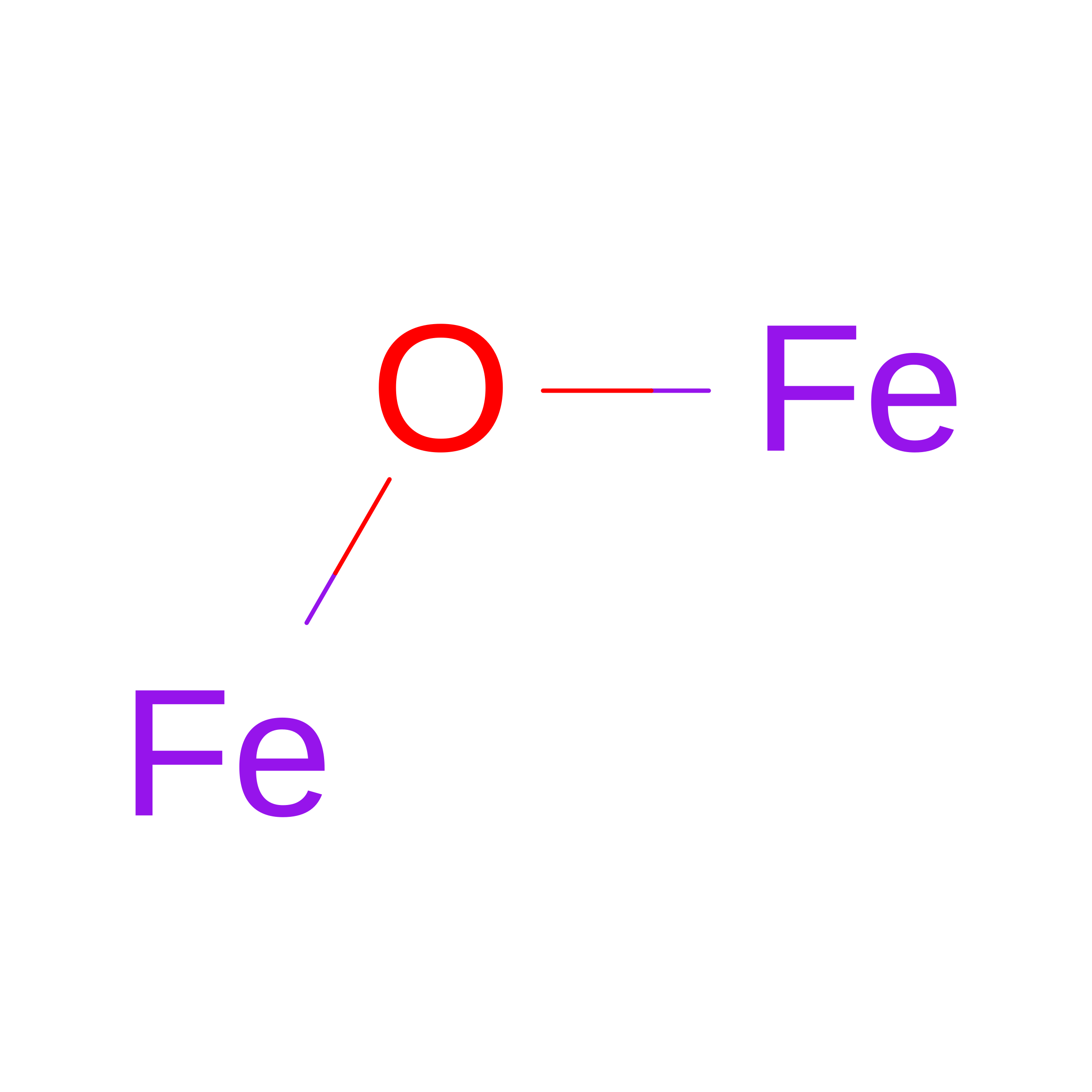
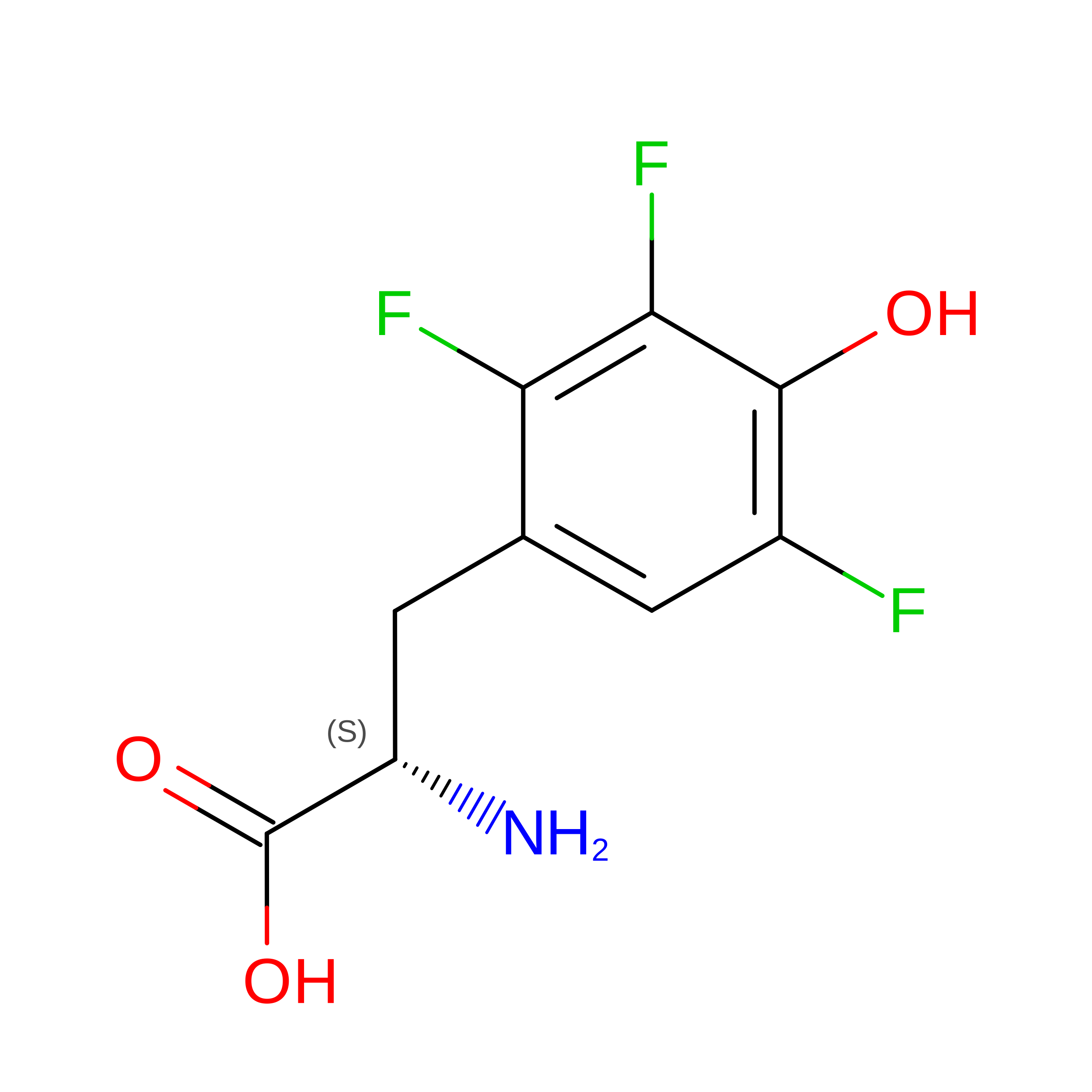
Ribonucleotide reductase Y122 2,3,5-F3Y variant


Experimental Data Snapshot

  • Method: X-RAY DIFFRACTION
  • Resolution: 2.40 Å
  • R-Value Free: 
    0.212 (Depositor), 0.214 (DCC) 
  • R-Value Work: 
    0.166 (Depositor), 0.168 (DCC) 
  • R-Value Observed: 
    0.168 (Depositor) 

Starting Model: experimental
View more details

wwPDB Validation 3D Report Full Report

Validation slider image for 5CI3

This is version 1.6 of the entry. See complete history

Literature

Biophysical Characterization of Fluorotyrosine Probes Site-Specifically Incorporated into Enzymes: E. coli Ribonucleotide Reductase As an Example.

Oyala, P.H.Ravichandran, K.R.Funk, M.A.Stucky, P.A.Stich, T.A.Drennan, C.L.Britt, R.D.Stubbe, J.

(2016) J Am Chem Soc 138: 7951-7964

  • DOI: https://doi.org/10.1021/jacs.6b03605
  • Primary Citation Related Structures: 
    5CI0, 5CI1, 5CI2, 5CI3, 5CI4

  • PubMed Abstract: 

    Fluorinated tyrosines (FnY's, n = 2 and 3) have been site-specifically incorporated into E. coli class Ia ribonucleotide reductase (RNR) using the recently evolved M. jannaschii Y-tRNA synthetase/tRNA pair. Class Ia RNRs require four redox active Y's, a stable Y radical (Y·) in the β subunit (position 122 in E. coli), and three transiently oxidized Y's (356 in β and 731 and 730 in α) to initiate the radical-dependent nucleotide reduction process. FnY (3,5; 2,3; 2,3,5; and 2,3,6) incorporation in place of Y122-β and the X-ray structures of each resulting β with a diferric cluster are reported and compared with wt-β2 crystallized under the same conditions. The essential diferric-FnY· cofactor is self-assembled from apo FnY-β2, Fe(2+), and O2 to produce ∼1 Y·/β2 and ∼3 Fe(3+)/β2. The FnY· are stable and active in nucleotide reduction with activities that vary from 5% to 85% that of wt-β2. Each FnY·-β2 has been characterized by 9 and 130 GHz electron paramagnetic resonance and high-field electron nuclear double resonance spectroscopies. The hyperfine interactions associated with the (19)F nucleus provide unique signatures of each FnY· that are readily distinguishable from unlabeled Y·'s. The variability of the abiotic FnY pKa's (6.4 to 7.8) and reduction potentials (-30 to +130 mV relative to Y at pH 7.5) provide probes of enzymatic reactions proposed to involve Y·'s in catalysis and to investigate the importance and identity of hopping Y·'s within redox active proteins proposed to protect them from uncoupled radical chemistry.


  • Organizational Affiliation
    • Department of Chemistry, University of California, Davis , One Shields Avenue, Davis, California 95616, United States.

Macromolecule Content 

  • Total Structure Weight: 43.99 kDa 
  • Atom Count: 3,161 
  • Modeled Residue Count: 349 
  • Deposited Residue Count: 375 
  • Unique protein chains: 1

Macromolecules

Find similar proteins by:|  3D Structure
Entity ID: 1
MoleculeChains  Sequence LengthOrganismDetailsImage
Ribonucleoside-diphosphate reductase 1 subunit beta375Escherichia coli O157:H7Mutation(s): 1 
Gene Names: nrdBftsBZ3491ECs3118
EC: 1.17.4.1
UniProt
Find proteins for P69925 (Escherichia coli O157:H7)
Explore P69925 
Go to UniProtKB:  P69925
Entity Groups
Sequence Clusters30% Identity50% Identity70% Identity90% Identity95% Identity100% Identity
UniProt GroupP69925
Sequence Annotations
Expand
Reference Sequence

Experimental Data & Validation

Experimental Data

  • Method: X-RAY DIFFRACTION
  • Resolution: 2.40 Å
  • R-Value Free:  0.212 (Depositor), 0.214 (DCC) 
  • R-Value Work:  0.166 (Depositor), 0.168 (DCC) 
  • R-Value Observed: 0.168 (Depositor) 
Space Group: P 61 2 2
Unit Cell:
Length ( Å )Angle ( ˚ )
a = 92.216α = 90
b = 92.216β = 90
c = 207.044γ = 120
Software Package:
Software NamePurpose
PHENIXrefinement
HKL-2000data scaling
PHASERphasing
HKL-2000data reduction

Structure Validation

View Full Validation Report


Entry History 

& Funding Information

Deposition Data


Funding OrganizationLocationGrant Number
National Science Foundation (NSF, United States)United States0645960

Revision History  (Full details and data files)

  • Version 1.0: 2016-07-13
    Type: Initial release
  • Version 1.1: 2016-07-20
    Changes: Database references
  • Version 1.2: 2017-09-20
    Changes: Author supporting evidence, Derived calculations
  • Version 1.3: 2018-03-21
    Changes: Data collection
  • Version 1.4: 2019-11-27
    Changes: Author supporting evidence
  • Version 1.5: 2023-09-27
    Changes: Data collection, Database references, Derived calculations, Refinement description
  • Version 1.6: 2023-11-15
    Changes: Data collection, Derived calculations