5C5J | pdb_00005c5j

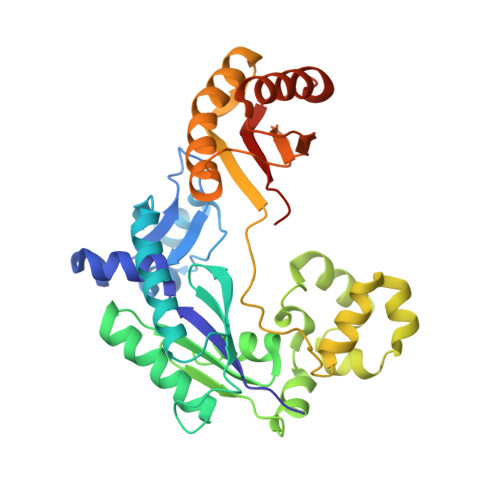
Poymerase Nucleotide complex


Experimental Data Snapshot

  • Method: X-RAY DIFFRACTION
  • Resolution: 2.10 Å
  • R-Value Free: 
    0.274 (Depositor), 0.276 (DCC) 
  • R-Value Work: 
    0.222 (Depositor), 0.224 (DCC) 
  • R-Value Observed: 
    0.225 (Depositor) 

Starting Model: experimental
View more details

wwPDB Validation 3D Report Full Report

Validation slider image for 5C5J

Ligand Structure Quality Assessment 


This is version 1.1 of the entry. See complete history

Literature

Reactive Oxygen Species Play an Important Role in the Bactericidal Activity of Quinolone Antibiotics

Kottur, J.Nair, D.T.

(2016) Angew Chem Int Ed Engl 55: 2397-2400

  • DOI: https://doi.org/10.1002/anie.201509340
  • Primary Citation Related Structures: 
    5C5J

  • PubMed Abstract: 

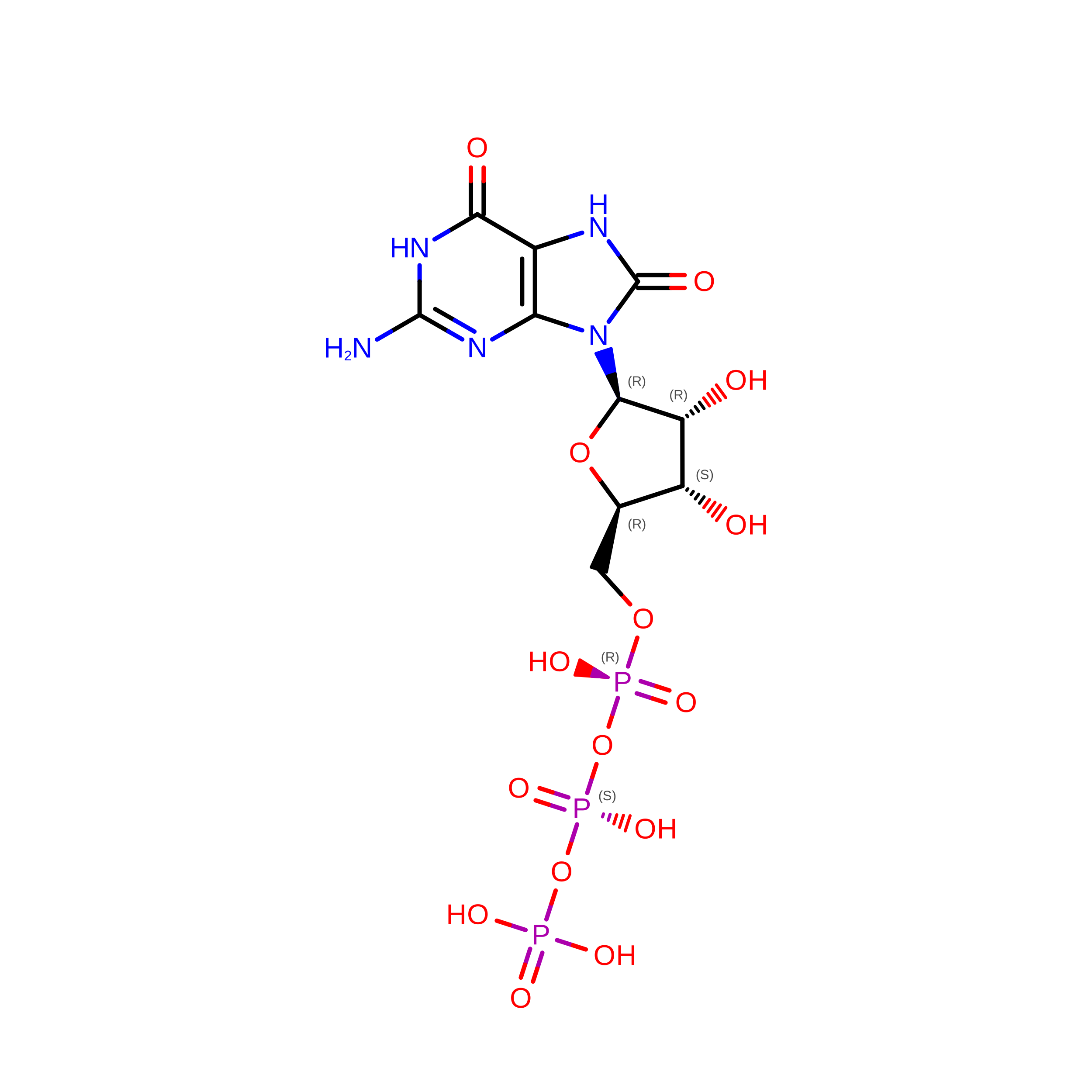
    Recent studies posit that reactive oxygen species (ROS) contribute to the cell lethality of bactericidal antibiotics. However, this conjecture has been challenged and remains controversial. To resolve this controversy, we adopted a strategy that involves DNA polymerase IV (PolIV). The nucleotide pool of the cell gets oxidized by ROS and PolIV incorporates the damaged nucleotides (especially 8oxodGTP) into the genome, which results in death of the bacteria. By using a combination of structural and biochemical tools coupled with growth assays, it was shown that selective perturbation of the 8oxodGTP incorporation activity of PolIV results in considerable enhancement of the survival of bacteria in the presence of the norfloxacin antibiotic. Our studies therefore indicate that ROS induced in bacteria by the presence of antibiotics in the environment contribute significantly to cell lethality.


  • Organizational Affiliation
    • Regional Centre for Biotechnology, NCR Biotech Science Cluster, 3rd Milestone, Faridabad-Gurgaon Expressway, Faridabad, 121001, India.

Macromolecule Content 

  • Total Structure Weight: 101.71 kDa 
  • Atom Count: 7,204 
  • Modeled Residue Count: 751 
  • Deposited Residue Count: 776 
  • Unique protein chains: 1
  • Unique nucleic acid chains: 1

Macromolecules


Find similar proteins by:|  3D Structure
Entity ID: 1
MoleculeChains  Sequence LengthOrganismDetailsImage
DNA polymerase IVA [auth F],
B [auth A]
352Escherichia coliMutation(s): 0 
Gene Names: dinB
EC: 2.7.7.7
UniProt
Find proteins for Q47155 (Escherichia coli (strain K12))
Explore Q47155 
Go to UniProtKB:  Q47155
Entity Groups
Sequence Clusters30% Identity50% Identity70% Identity90% Identity95% Identity100% Identity
UniProt GroupQ47155
Sequence Annotations
Expand
Reference Sequence
Find similar nucleic acids by:  Sequence
Entity ID: 2
MoleculeChains LengthOrganismImage
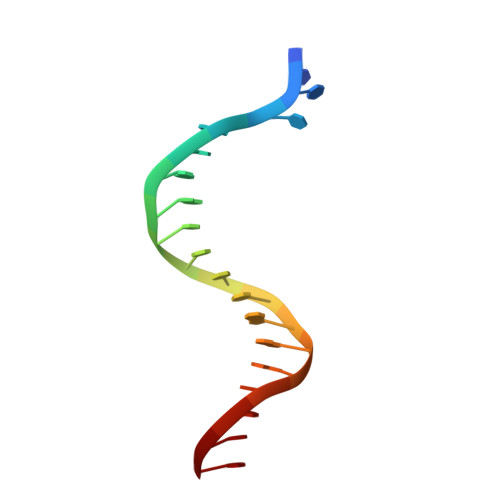
DNA (5'-D(*TP*CP*TP*AP*GP*GP*GP*TP*CP*CP*TP*AP*GP*GP*AP*CP*CP*C)-3')C [auth G],
D [auth H],
E [auth B],
F [auth C]
18Escherichia coli
Sequence Annotations
Expand
Reference Sequence

Small Molecules

Experimental Data & Validation

Experimental Data

  • Method: X-RAY DIFFRACTION
  • Resolution: 2.10 Å
  • R-Value Free:  0.274 (Depositor), 0.276 (DCC) 
  • R-Value Work:  0.222 (Depositor), 0.224 (DCC) 
  • R-Value Observed: 0.225 (Depositor) 
Space Group: P 1 21 1
Unit Cell:
Length ( Å )Angle ( ˚ )
a = 86.45α = 90
b = 57.38β = 94.51
c = 110.64γ = 90
Software Package:
Software NamePurpose
PHENIXrefinement
SCALAdata reduction
SCALAdata scaling
PHASERphasing

Structure Validation

View Full Validation Report


Ligand Structure Quality Assessment 


Entry History 

Deposition Data

Revision History  (Full details and data files)

  • Version 1.0: 2016-06-22
    Type: Initial release
  • Version 1.1: 2023-11-08
    Changes: Data collection, Database references, Derived calculations, Refinement description