5BNI | pdb_00005bni

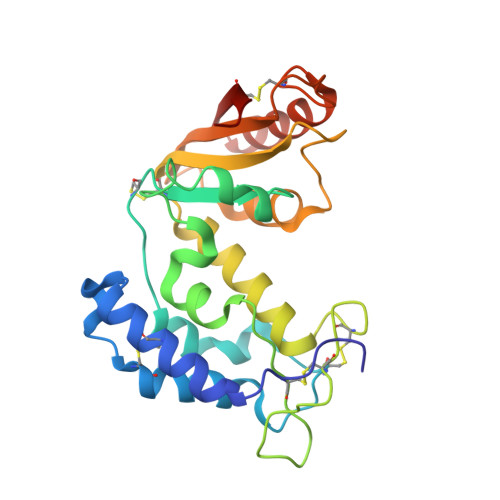
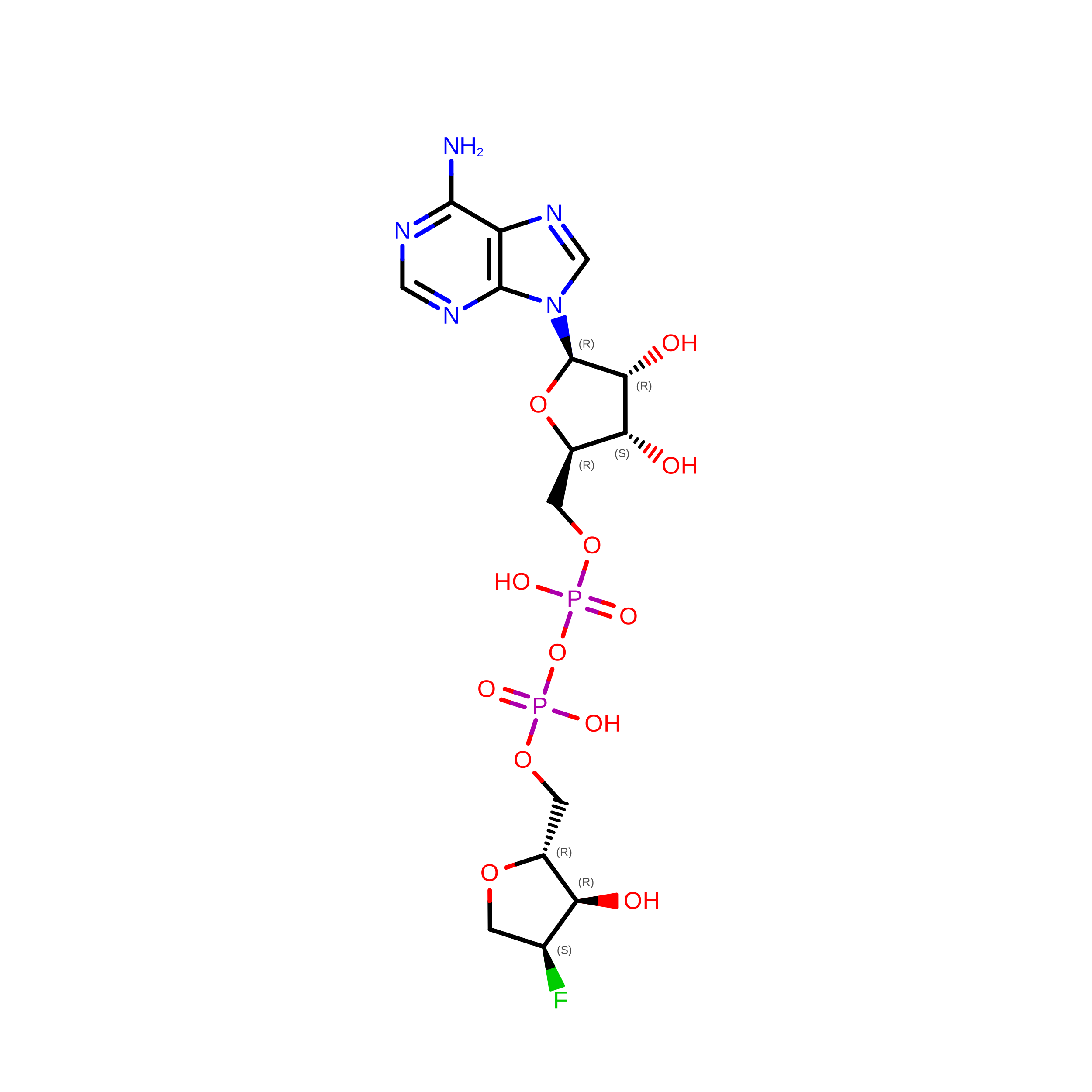
Porcine CD38 complexed with complexed with a covalent intermediate, ribo-F-ribose-5'-phosphate


Experimental Data Snapshot

  • Method: X-RAY DIFFRACTION
  • Resolution: 2.50 Å
  • R-Value Free: 
    0.278 (Depositor), 0.278 (DCC) 
  • R-Value Work: 
    0.187 (Depositor), 0.186 (DCC) 
  • R-Value Observed: 
    0.192 (Depositor) 

wwPDB Validation 3D Report Full Report

Validation slider image for 5BNI

Ligand Structure Quality Assessment 


This is version 1.2 of the entry. See complete history

Literature

Porcine CD38 exhibits prominent secondary NAD(+) cyclase activity.

Ting, K.Y.Leung, C.F.Graeff, R.M.Lee, H.C.Hao, Q.Kotaka, M.

(2016) Protein Sci 25: 650-661

  • DOI: https://doi.org/10.1002/pro.2859
  • Primary Citation Related Structures: 
    5BNF, 5BNI

  • PubMed Abstract: 

    Cyclic ADP-ribose (cADPR) mobilizes intracellular Ca(2+) stores and activates Ca(2+) influx to regulate a wide range of physiological processes. It is one of the products produced from the catalysis of NAD(+) by the multifunctional CD38/ADP-ribosyl cyclase superfamily. After elimination of the nicotinamide ring by the enzyme, the reaction intermediate of NAD(+) can either be hydrolyzed to form linear ADPR or cyclized to form cADPR. We have previously shown that human CD38 exhibits a higher preference towards the hydrolysis of NAD(+) to form linear ADPR while Aplysia ADP-ribosyl cyclase prefers cyclizing NAD(+) to form cADPR. In this study, we characterized the enzymatic properties of porcine CD38 and revealed that it has a prominent secondary NAD(+) cyclase activity producing cADPR. We also determined the X-ray crystallographic structures of porcine CD38 and were able to observe conformational flexibility at the base of the active site of the enzyme which allow the NAD(+) reaction intermediate to adopt conformations resulting in both hydrolysis and cyclization forming linear ADPR and cADPR respectively.


  • Organizational Affiliation
    • School of Life Sciences, the Chinese University of Hong Kong, Hong Kong.

Macromolecule Content 

  • Total Structure Weight: 53.41 kDa 
  • Atom Count: 3,875 
  • Modeled Residue Count: 463 
  • Deposited Residue Count: 464 
  • Unique protein chains: 1

Macromolecules

Find similar proteins by:|  3D Structure
Entity ID: 1
MoleculeChains  Sequence LengthOrganismDetailsImage
Uncharacterized protein
A, B
232Sus scrofaMutation(s): 0 
Gene Names: CD38

Small Molecules

Ligands 1 Unique
IDChains Name / Formula / InChI Key2D Diagram3D Interactions
AVW

Query on AVW


Download:Ideal Coordinates CCD File
C [auth B][(2R,3S,4R,5R)-5-(6-amino-9H-purin-9-yl)-3,4-dihydroxytetrahydrofuran-2-yl]methyl [(2R,3R,4S)-4-fluoro-3-hydroxytetrahydrofuran-2-yl]methyl dihydrogen diphosphate
C15 H22 F N5 O12 P2
GOCJJDZHXMDJEZ-AOOZFPJJSA-N

Experimental Data & Validation

Experimental Data

  • Method: X-RAY DIFFRACTION
  • Resolution: 2.50 Å
  • R-Value Free:  0.278 (Depositor), 0.278 (DCC) 
  • R-Value Work:  0.187 (Depositor), 0.186 (DCC) 
  • R-Value Observed: 0.192 (Depositor) 
Space Group: P 21 21 2
Unit Cell:
Length ( Å )Angle ( ˚ )
a = 69.507α = 90
b = 104.973β = 90
c = 63.785γ = 90
Software Package:
Software NamePurpose
SCALEPACKdata scaling
PHASERphasing
REFMACrefinement
PDB_EXTRACTdata extraction

Structure Validation

View Full Validation Report


Ligand Structure Quality Assessment 


Entry History 

Deposition Data

Revision History  (Full details and data files)

  • Version 1.0: 2016-05-25
    Type: Initial release
  • Version 1.1: 2025-04-09
    Changes: Data collection, Database references, Derived calculations, Structure summary
  • Version 1.2: 2025-09-17
    Changes: Advisory, Derived calculations, Structure summary