5BK0 | pdb_00005bk0

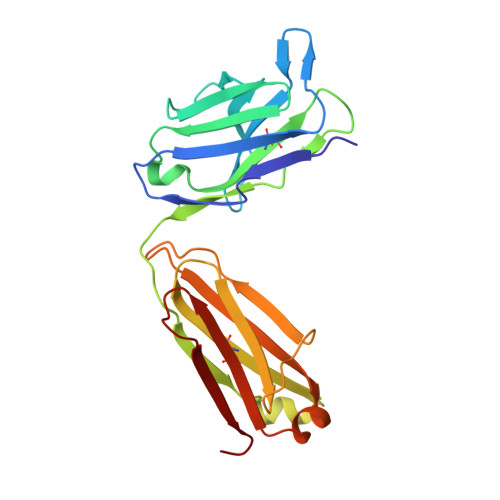
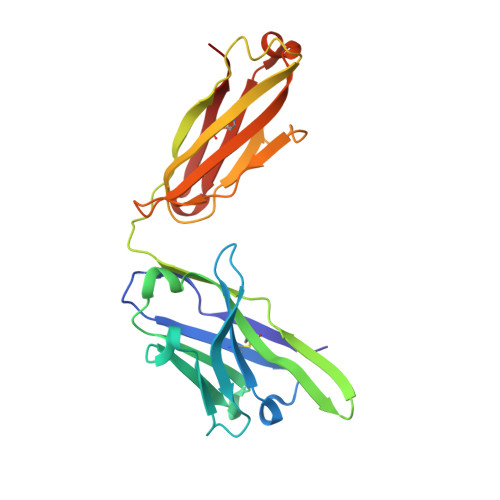
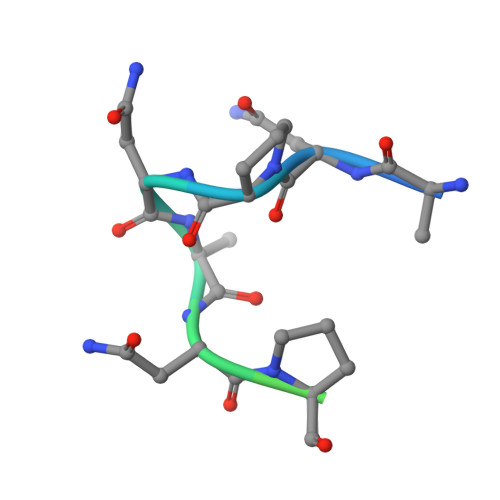
Crystal structure of 663 Fab bound to circumsporozoite protein NANP 5-mer


Experimental Data Snapshot

  • Method: X-RAY DIFFRACTION
  • Resolution: 3.15 Å
  • R-Value Free: 
    0.274 (Depositor), 0.271 (DCC) 
  • R-Value Work: 
    0.234 (Depositor), 0.235 (DCC) 
  • R-Value Observed: 
    0.236 (Depositor) 

Starting Model: experimental
View more details

wwPDB Validation 3D Report Full Report

Validation slider image for 5BK0

This is version 1.4 of the entry. See complete history

Literature

Natural Parasite Exposure Induces Protective Human Anti-Malarial Antibodies.

Triller, G.Scally, S.W.Costa, G.Pissarev, M.Kreschel, C.Bosch, A.Marois, E.Sack, B.K.Murugan, R.Salman, A.M.Janse, C.J.Khan, S.M.Kappe, S.H.I.Adegnika, A.A.Mordmuller, B.Levashina, E.A.Julien, J.P.Wardemann, H.

(2017) Immunity 47: 1197-1209.e10

  • DOI: https://doi.org/10.1016/j.immuni.2017.11.007
  • Primary Citation Related Structures: 
    5BK0, 5BK3, 5BK5, 6AZM, 6AZX

  • PubMed Abstract: 

    Antibodies against the NANP repeat of circumsporozoite protein (CSP), the major surface antigen of Plasmodium falciparum (Pf) sporozoites, can protect from malaria in animal models but protective humoral immunity is difficult to induce in humans. Here we cloned and characterized rare affinity-matured human NANP-reactive memory B cell antibodies elicited by natural Pf exposure that potently inhibited parasite transmission and development in vivo. We unveiled the molecular details of antibody binding to two distinct protective epitopes within the NANP repeat. NANP repeat recognition was largely mediated by germline encoded and immunoglobulin (Ig) heavy-chain complementarity determining region 3 (HCDR3) residues, whereas affinity maturation contributed predominantly to stabilizing the antigen-binding site conformation. Combined, our findings illustrate the power of exploring human anti-CSP antibody responses to develop tools for malaria control in the mammalian and the mosquito vector and provide a molecular basis for the structure-based design of next-generation CSP malaria vaccines.


  • Organizational Affiliation
    • B Cell Immunology, German Cancer Research Center, Heidelberg, 69120, Germany.

Macromolecule Content 

  • Total Structure Weight: 97.53 kDa 
  • Atom Count: 6,548 
  • Modeled Residue Count: 881 
  • Deposited Residue Count: 898 
  • Unique protein chains: 3

Macromolecules

Find similar proteins by:|  3D Structure
Entity ID: 1
MoleculeChains  Sequence LengthOrganismDetailsImage
663 Antibody, light chain
A, C
217Homo sapiensMutation(s): 0 
Find similar proteins by:|  3D Structure
Entity ID: 2
MoleculeChains  Sequence LengthOrganismDetailsImage
663 Antibody, heavy chain
B, D
222Homo sapiensMutation(s): 0 
Find similar proteins by:  Sequence   |   3D Structure  
Entity ID: 3
MoleculeChains  Sequence LengthOrganismDetailsImage
Circumsporozoite protein NANP 5-mer20Plasmodium falciparumMutation(s): 0 
UniProt
Find proteins for P02893 (Plasmodium falciparum)
Explore P02893 
Go to UniProtKB:  P02893
Entity Groups
Sequence Clusters30% Identity50% Identity70% Identity90% Identity95% Identity100% Identity
UniProt GroupP02893
Sequence Annotations
Expand
Reference Sequence

Experimental Data & Validation

Experimental Data

  • Method: X-RAY DIFFRACTION
  • Resolution: 3.15 Å
  • R-Value Free:  0.274 (Depositor), 0.271 (DCC) 
  • R-Value Work:  0.234 (Depositor), 0.235 (DCC) 
  • R-Value Observed: 0.236 (Depositor) 
Space Group: C 1 2 1
Unit Cell:
Length ( Å )Angle ( ˚ )
a = 179.815α = 90
b = 132.674β = 93.49
c = 51.02γ = 90
Software Package:
Software NamePurpose
PHENIXrefinement
XDSdata reduction
SHELXPREPdata scaling
PHENIXphasing

Structure Validation

View Full Validation Report


Entry History 

Deposition Data

Revision History  (Full details and data files)

  • Version 1.0: 2017-12-13
    Type: Initial release
  • Version 1.1: 2018-01-24
    Changes: Database references
  • Version 1.2: 2020-02-26
    Changes: Data collection
  • Version 1.3: 2024-04-03
    Changes: Data collection, Database references, Refinement description
  • Version 1.4: 2024-11-13
    Changes: Structure summary