5B59 | pdb_00005b59

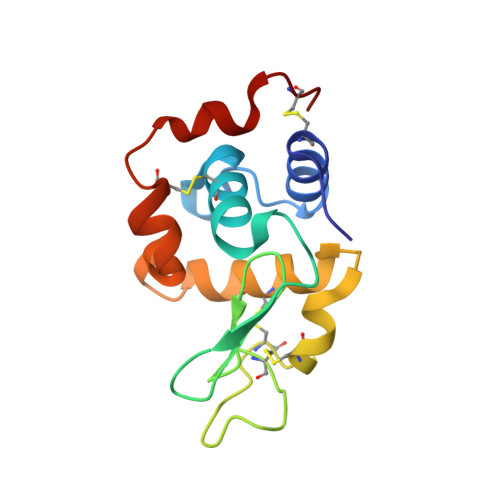
Hen egg-white lysozyme modified with a keto-ABNO.


Experimental Data Snapshot

  • Method: X-RAY DIFFRACTION
  • Resolution: 2.00 Å
  • R-Value Free: 
    0.248 (Depositor), 0.251 (DCC) 
  • R-Value Work: 
    0.182 (Depositor), 0.190 (DCC) 
  • R-Value Observed: 
    0.185 (Depositor) 

Starting Model: experimental
View more details

wwPDB Validation 3D Report Full Report

Validation slider image for 5B59

Ligand Structure Quality Assessment 


This is version 3.1 of the entry. See complete history

Literature

Transition Metal-Free Tryptophan-Selective Bioconjugation of Proteins

Seki, Y.Ishiyama, T.Sasaki, D.Abe, J.Sohma, Y.Oisaki, K.Kanai, M.

(2016) J Am Chem Soc 138: 10798-10801

  • DOI: https://doi.org/10.1021/jacs.6b06692
  • Primary Citation Related Structures: 
    5B59

  • PubMed Abstract: 

    Chemical modifications of native proteins can facilitate production of supernatural protein functions that are not easily accessible by complementary methods relying on genetic manipulations. However, accomplishing precise control over selectivity while maintaining structural integrity and homogeneity still represents a formidable challenge. Herein, we report a transition metal-free method for tryptophan-selective bioconjugation of proteins that is based on an organoradical and operates under ambient conditions. This method exhibits low levels of cross-reactivity and leaves higher-order structures of the protein and various functional groups therein unaffected. The strategy to target less abundant amino acids contributes to the formation of structurally homogeneous conjugates, which may even be suitable for protein crystallography. The absence of toxic metals and biochemically incompatible conditions allows a rapid functional modulation of native proteins such as antibodies and pathogenic aggregative proteins, and this method may thus easily find therapeutic applications.


  • Organizational Affiliation
    • Graduate School of Pharmaceutical Sciences, The University of Tokyo , 7-3-1 Hongo, Bunkyo-ku, Tokyo 113-0033, Japan.

Macromolecule Content 

  • Total Structure Weight: 14.5 kDa 
  • Atom Count: 1,120 
  • Modeled Residue Count: 129 
  • Deposited Residue Count: 129 
  • Unique protein chains: 1

Macromolecules

Find similar proteins by:|  3D Structure
Entity ID: 1
MoleculeChains  Sequence LengthOrganismDetailsImage
Lysozyme C129Gallus gallusMutation(s): 0 
EC: 3.2.1.17
UniProt
Find proteins for P00698 (Gallus gallus)
Explore P00698 
Go to UniProtKB:  P00698
Entity Groups
Sequence Clusters30% Identity50% Identity70% Identity90% Identity95% Identity100% Identity
UniProt GroupP00698
Sequence Annotations
Expand
Reference Sequence

Small Molecules

Ligands 1 Unique
IDChains Name / Formula / InChI Key2D Diagram3D Interactions
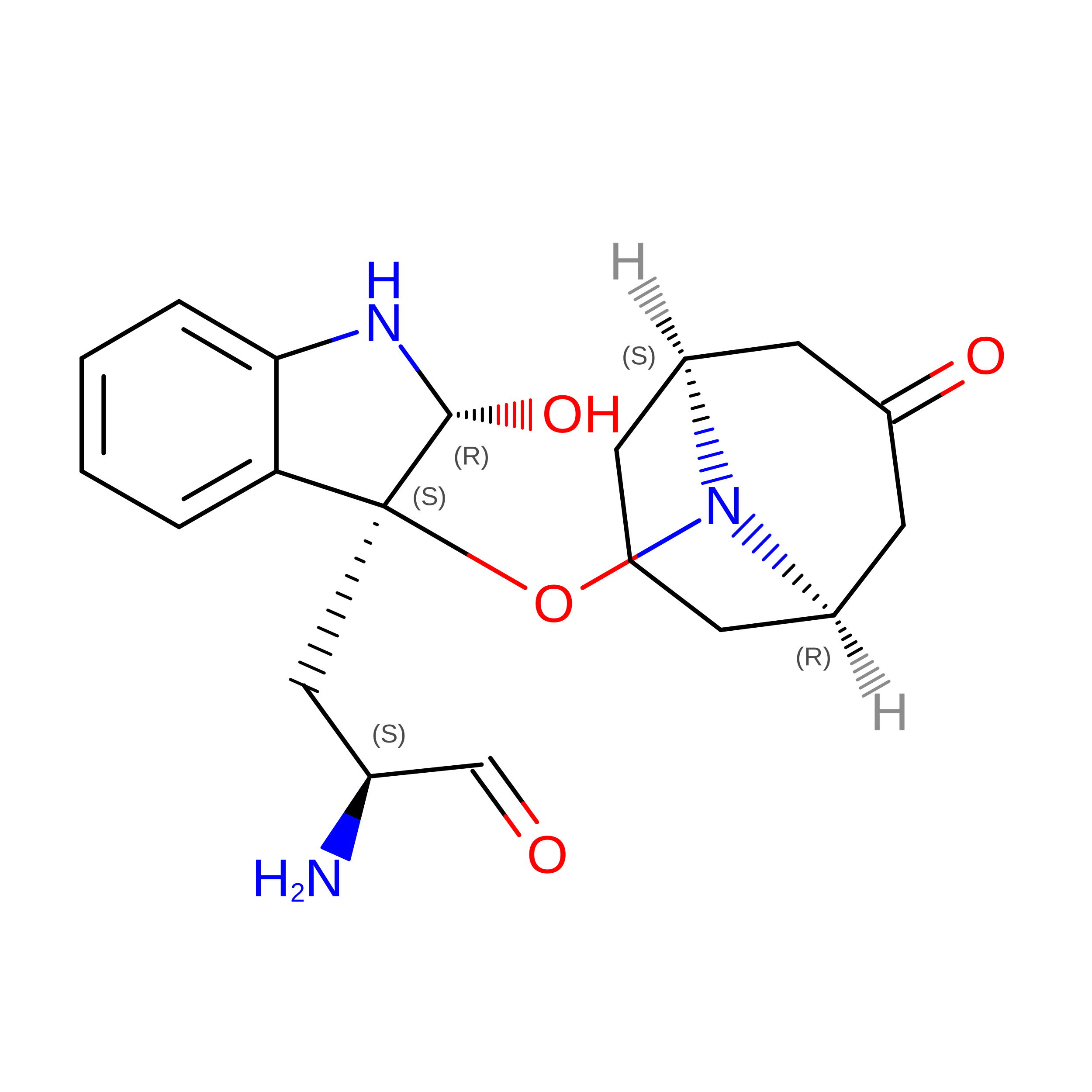
KTO

Query on KTO


Download:Ideal Coordinates CCD File
B [auth A](1~{S},5~{R})-9-oxidanyl-9-azabicyclo[3.3.1]nonan-3-one
C8 H13 N O2
KCMINNPTGLFCCL-KNVOCYPGSA-N
Modified Residues  1 Unique
IDChains TypeFormula2D DiagramParent
TRO
Query on TRO
A
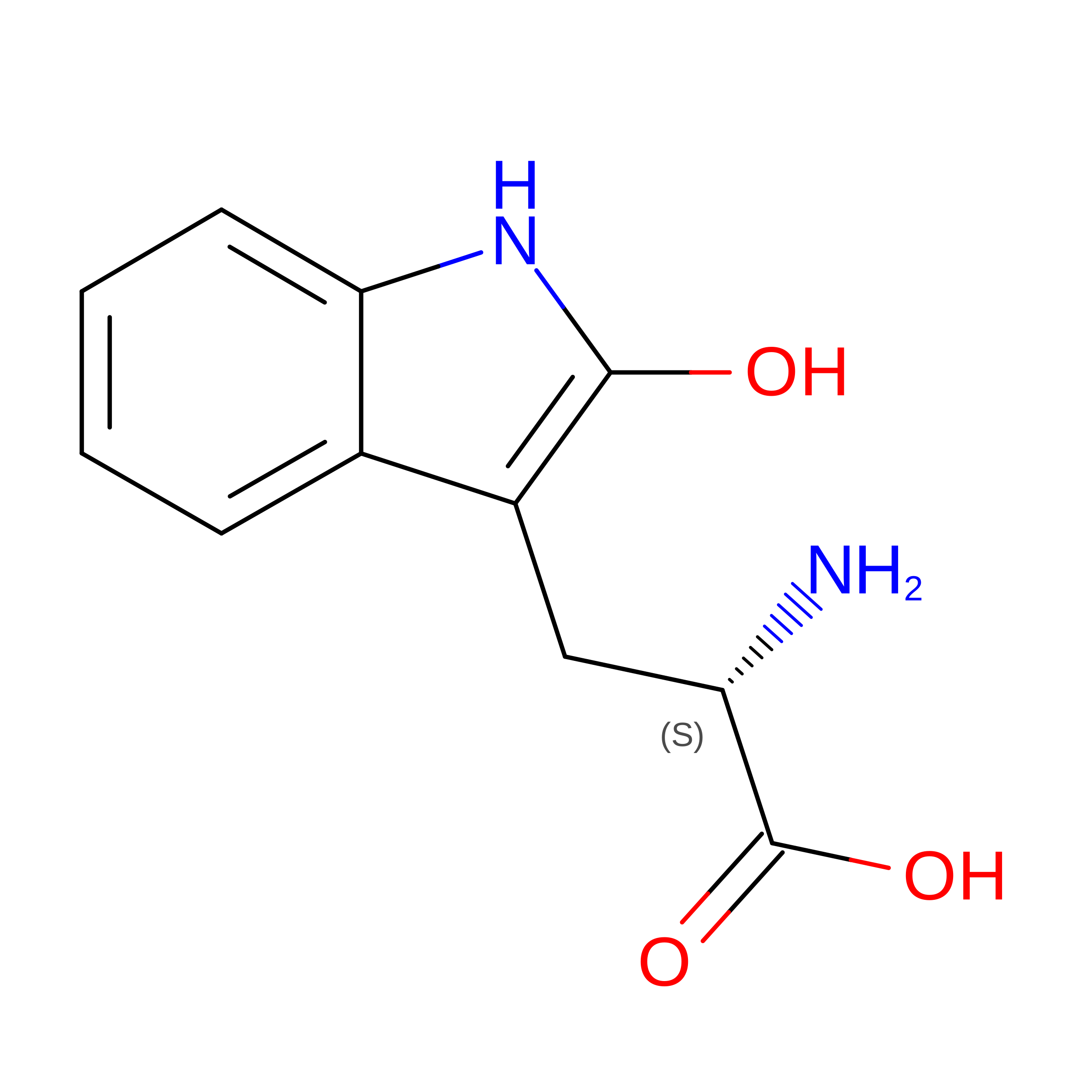
L-PEPTIDE LINKINGC11 H12 N2 O3TRP

Experimental Data & Validation

Experimental Data

  • Method: X-RAY DIFFRACTION
  • Resolution: 2.00 Å
  • R-Value Free:  0.248 (Depositor), 0.251 (DCC) 
  • R-Value Work:  0.182 (Depositor), 0.190 (DCC) 
  • R-Value Observed: 0.185 (Depositor) 
Space Group: P 43 21 2
Unit Cell:
Length ( Å )Angle ( ˚ )
a = 79.03α = 90
b = 79.03β = 90
c = 36.91γ = 90
Software Package:
Software NamePurpose
REFMACrefinement
iMOSFLMdata reduction
SCALAdata scaling
MOLREPphasing

Structure Validation

View Full Validation Report


Ligand Structure Quality Assessment 


Entry History 

& Funding Information

Deposition Data


Funding OrganizationLocationGrant Number
Japan Science and Technology Agency (JST)JapanERATO, Kanai Life Science Catalysis Project

Revision History  (Full details and data files)

  • Version 1.0: 2016-09-14
    Type: Initial release
  • Version 1.1: 2017-09-27
    Changes: Data collection, Derived calculations
  • Version 1.2: 2023-11-08
    Changes: Data collection, Database references, Refinement description
  • Version 2.0: 2024-07-10
    Changes: Data collection, Derived calculations, Non-polymer description, Structure summary
  • Version 3.0: 2024-10-02
    Changes: Advisory, Atomic model, Data collection, Derived calculations, Non-polymer description, Polymer sequence, Source and taxonomy, Structure summary
  • Version 3.1: 2024-11-06
    Changes: Structure summary