5A35 | pdb_00005a35

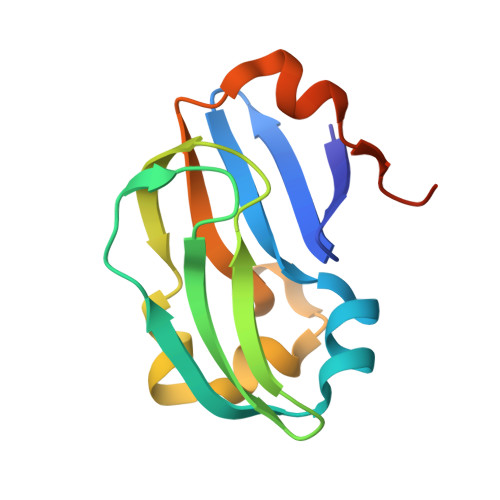
Crystal structure of Glycine Cleavage Protein H-Like (GcvH-L) from Streptococcus pyogenes


Experimental Data Snapshot

  • Method: X-RAY DIFFRACTION
  • Resolution: 1.50 Å
  • R-Value Free: 
    0.173 (Depositor), 0.177 (DCC) 
  • R-Value Work: 
    0.153 (Depositor), 0.164 (DCC) 
  • R-Value Observed: 
    0.154 (Depositor) 

Starting Model: experimental
View more details

wwPDB Validation 3D Report Full Report

Validation slider image for 5A35

This is version 1.1 of the entry. See complete history

Literature

Identification of a Class of Protein Adp-Ribosylating Sirtuins in Microbial Pathogens.

Rack, J.G.Morra, R.Barkauskaite, E.Kraehenbuehl, R.Ariza, A.Qu, Y.Ortmayer, M.Leidecker, O.Cameron, D.R.Matic, I.Peleg, A.Y.Leys, D.Traven, A.Ahel, I.

(2015) Mol Cell 59: 309

  • DOI: https://doi.org/10.1016/j.molcel.2015.06.013
  • Primary Citation Related Structures: 
    5A35, 5A3A, 5A3B, 5A3C

  • PubMed Abstract: 

    Sirtuins are an ancient family of NAD(+)-dependent deacylases connected with the regulation of fundamental cellular processes including metabolic homeostasis and genome integrity. We show the existence of a hitherto unrecognized class of sirtuins, found predominantly in microbial pathogens. In contrast to earlier described classes, these sirtuins exhibit robust protein ADP-ribosylation activity. In our model organisms, Staphylococcus aureus and Streptococcus pyogenes, the activity is dependent on prior lipoylation of the target protein and can be reversed by a sirtuin-associated macrodomain protein. Together, our data describe a sirtuin-dependent reversible protein ADP-ribosylation system and establish a crosstalk between lipoylation and mono-ADP-ribosylation. We propose that these posttranslational modifications modulate microbial virulence by regulating the response to host-derived reactive oxygen species.


  • Organizational Affiliation
    • Sir William Dunn School of Pathology, University of Oxford, South Parks Road, Oxford OX1 3RE, UK.

Macromolecule Content 

  • Total Structure Weight: 13.5 kDa 
  • Atom Count: 1,201 
  • Modeled Residue Count: 112 
  • Deposited Residue Count: 120 
  • Unique protein chains: 1

Macromolecules

Find similar proteins by:|  3D Structure
Entity ID: 1
MoleculeChains  Sequence LengthOrganismDetailsImage
GLYCINE CLEAVAGE SYSTEM H PROTEIN120Streptococcus pyogenes str. ManfredoMutation(s): 0 
UniProt
Find proteins for P0DN69 (Streptococcus pyogenes serotype M5 (strain Manfredo))
Explore P0DN69 
Go to UniProtKB:  P0DN69
Entity Groups
Sequence Clusters30% Identity50% Identity70% Identity90% Identity95% Identity100% Identity
UniProt GroupP0DN69
Sequence Annotations
Expand
Reference Sequence

Small Molecules

Ligands 1 Unique
IDChains Name / Formula / InChI Key2D Diagram3D Interactions
1PE

Query on 1PE


Download:Ideal Coordinates CCD File
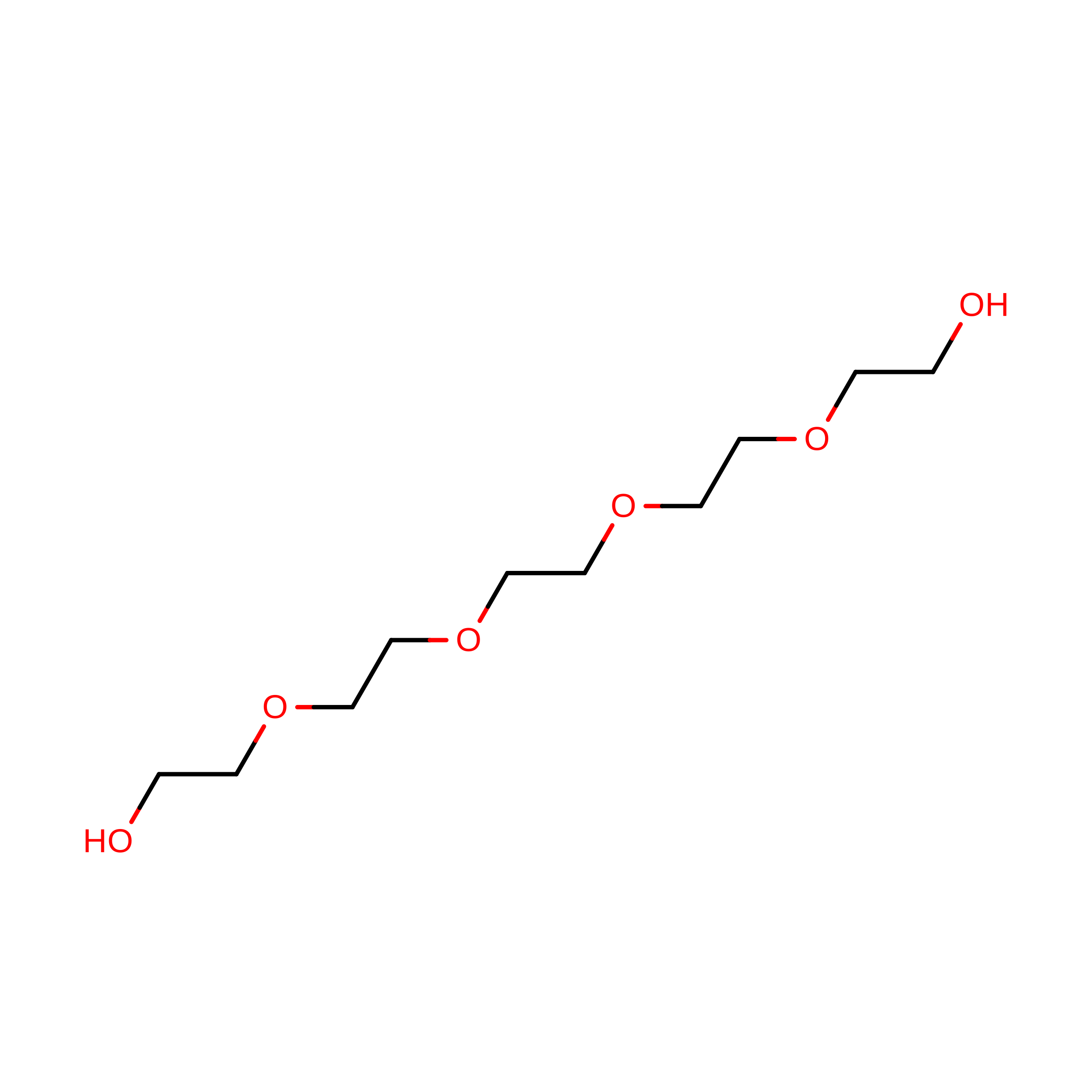
B [auth A]PENTAETHYLENE GLYCOL
C10 H22 O6
JLFNLZLINWHATN-UHFFFAOYSA-N

Experimental Data & Validation

Experimental Data

  • Method: X-RAY DIFFRACTION
  • Resolution: 1.50 Å
  • R-Value Free:  0.173 (Depositor), 0.177 (DCC) 
  • R-Value Work:  0.153 (Depositor), 0.164 (DCC) 
  • R-Value Observed: 0.154 (Depositor) 
Space Group: P 31 2 1
Unit Cell:
Length ( Å )Angle ( ˚ )
a = 64.123α = 90
b = 64.123β = 90
c = 73.042γ = 120
Software Package:
Software NamePurpose
REFMACrefinement
XDSdata reduction
Aimlessdata scaling
PHASERphasing

Structure Validation

View Full Validation Report


Entry History 

Revision History  (Full details and data files)

  • Version 1.0: 2015-07-29
    Type: Initial release
  • Version 1.1: 2024-01-10
    Changes: Data collection, Database references, Derived calculations, Other, Refinement description