4ZPM | pdb_00004zpm

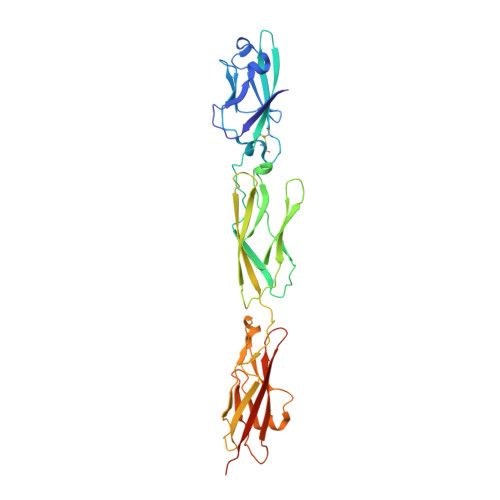
Crystal Structure of Protocadherin Alpha C2 EC1-3


Experimental Data Snapshot

  • Method: X-RAY DIFFRACTION
  • Resolution: 2.40 Å
  • R-Value Free: 
    0.252 (Depositor), 0.256 (DCC) 
  • R-Value Work: 
    0.208 (Depositor), 0.220 (DCC) 
  • R-Value Observed: 
    0.210 (Depositor) 

Starting Model: experimental
View more details

wwPDB Validation 3D Report Full Report

Validation slider image for 4ZPM

Ligand Structure Quality Assessment 


This is version 1.4 of the entry. See complete history

Literature

Molecular Logic of Neuronal Self-Recognition through Protocadherin Domain Interactions.

Rubinstein, R.Thu, C.A.Goodman, K.M.Wolcott, H.N.Bahna, F.Mannepalli, S.Ahlsen, G.Chevee, M.Halim, A.Clausen, H.Maniatis, T.Shapiro, L.Honig, B.

(2015) Cell 163: 629-642

  • DOI: https://doi.org/10.1016/j.cell.2015.09.026
  • Primary Citation Related Structures: 
    4ZPL, 4ZPM, 4ZPN, 4ZPO, 4ZPP, 4ZPQ, 4ZPS

  • PubMed Abstract: 

    Self-avoidance, a process preventing interactions of axons and dendrites from the same neuron during development, is mediated in vertebrates through the stochastic single-neuron expression of clustered protocadherin protein isoforms. Extracellular cadherin (EC) domains mediate isoform-specific homophilic binding between cells, conferring cell recognition through a poorly understood mechanism. Here, we report crystal structures for the EC1-EC3 domain regions from four protocadherin isoforms representing the α, β, and γ subfamilies. All are rod shaped and monomeric in solution. Biophysical measurements, cell aggregation assays, and computational docking reveal that trans binding between cells depends on the EC1-EC4 domains, which interact in an antiparallel orientation. We also show that the EC6 domains are required for the formation of cis-dimers. Overall, our results are consistent with a model in which protocadherin cis-dimers engage in a head-to-tail interaction between EC1-EC4 domains from apposed cell surfaces, possibly forming a zipper-like protein assembly, and thus providing a size-dependent self-recognition mechanism.


  • Organizational Affiliation
    • Department of Biochemistry and Molecular Biophysics, Columbia University, New York, NY 10032, USA; Department of Systems Biology, Columbia University, New York, NY 10032, USA.

Macromolecule Content 

  • Total Structure Weight: 73.65 kDa 
  • Atom Count: 4,855 
  • Modeled Residue Count: 631 
  • Deposited Residue Count: 652 
  • Unique protein chains: 1

Macromolecules

Find similar proteins by:|  3D Structure
Entity ID: 1
MoleculeChains  Sequence LengthOrganismDetailsImage
Protein Pcdhac2
A, B
326Mus musculusMutation(s): 0 
Gene Names: Pcdhac2
UniProt
Find proteins for Q91Y09 (Mus musculus)
Explore Q91Y09 
Go to UniProtKB:  Q91Y09
Entity Groups
Sequence Clusters30% Identity50% Identity70% Identity90% Identity95% Identity100% Identity
UniProt GroupQ91Y09
Glycosylation
Glycosylation Sites: 3Go to GlyGen: Q91Y09-1
Sequence Annotations
Expand
Reference Sequence

Small Molecules

Ligands 3 Unique
IDChains Name / Formula / InChI Key2D Diagram3D Interactions
NAG

Query on NAG


Download:Ideal Coordinates CCD File
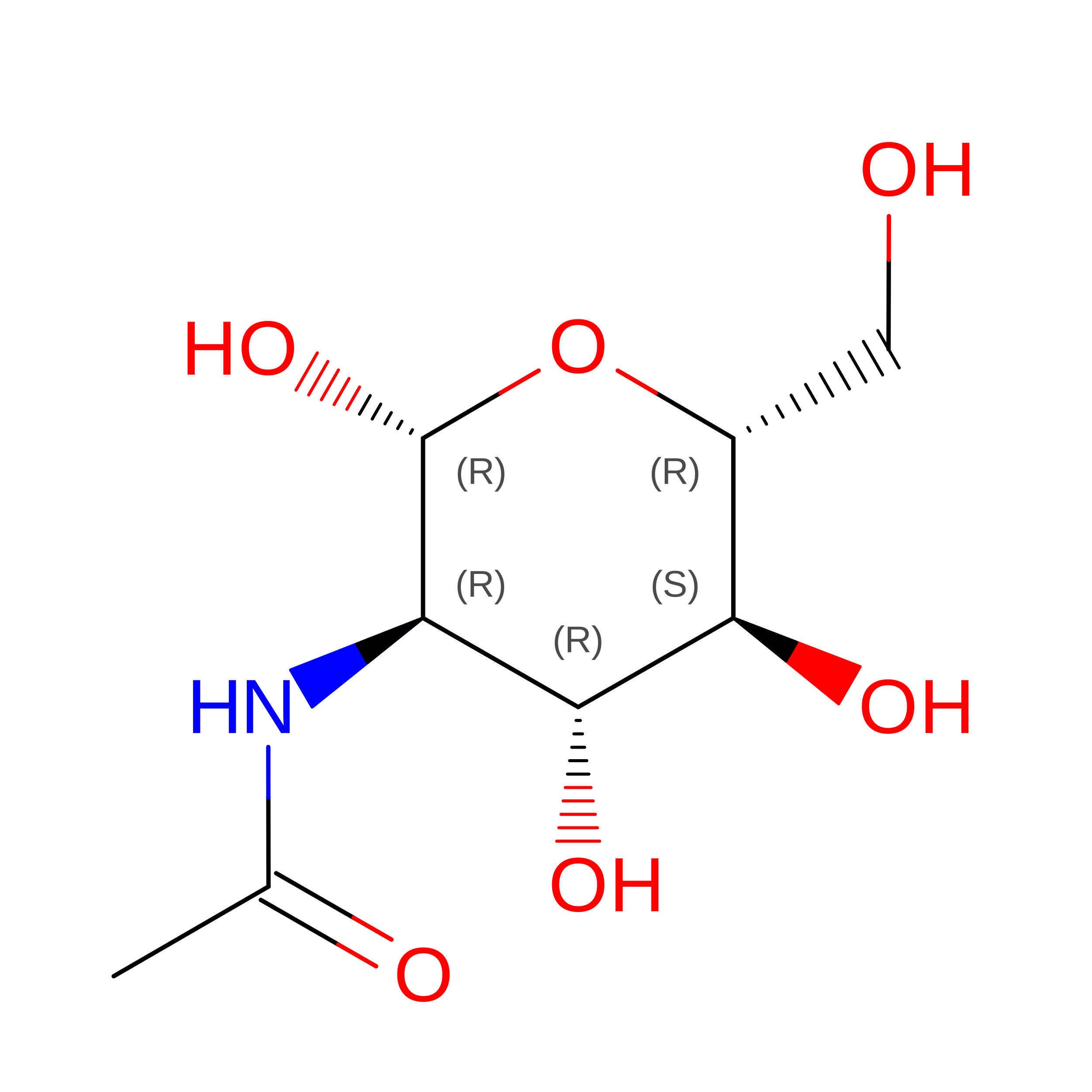
E [auth A]2-acetamido-2-deoxy-beta-D-glucopyranose
C8 H15 N O6
OVRNDRQMDRJTHS-FMDGEEDCSA-N
MAN

Query on MAN


Download:Ideal Coordinates CCD File
C [auth A],
D [auth A],
L [auth B],
M [auth B]
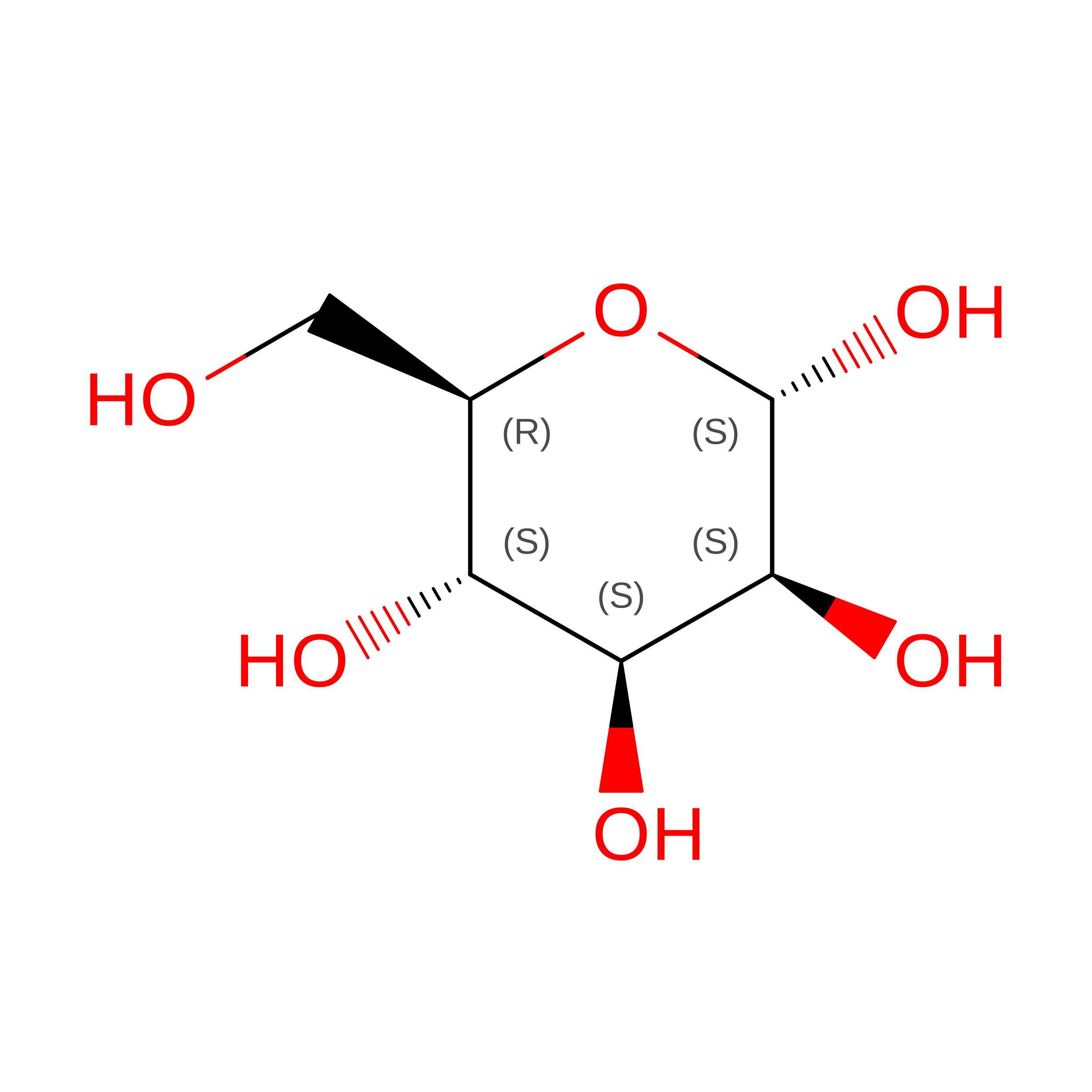
alpha-D-mannopyranose
C6 H12 O6
WQZGKKKJIJFFOK-PQMKYFCFSA-N
CA

Query on CA


Download:Ideal Coordinates CCD File
F [auth A]
G [auth A]
H [auth A]
I [auth A]
J [auth A]
F [auth A],
G [auth A],
H [auth A],
I [auth A],
J [auth A],
K [auth A],
N [auth B],
O [auth B],
P [auth B],
Q [auth B],
R [auth B],
S [auth B]
CALCIUM ION
Ca
BHPQYMZQTOCNFJ-UHFFFAOYSA-N

Experimental Data & Validation

Experimental Data

  • Method: X-RAY DIFFRACTION
  • Resolution: 2.40 Å
  • R-Value Free:  0.252 (Depositor), 0.256 (DCC) 
  • R-Value Work:  0.208 (Depositor), 0.220 (DCC) 
  • R-Value Observed: 0.210 (Depositor) 
Space Group: P 1 21 1
Unit Cell:
Length ( Å )Angle ( ˚ )
a = 24.99α = 90
b = 97.13β = 94.18
c = 147.68γ = 90
Software Package:
Software NamePurpose
PHENIXrefinement
MOSFLMdata reduction
SCALAdata scaling
PHASERphasing

Structure Validation

View Full Validation Report


Ligand Structure Quality Assessment 


Entry History 

Deposition Data

Revision History  (Full details and data files)

  • Version 1.0: 2015-10-28
    Type: Initial release
  • Version 1.1: 2015-11-04
    Changes: Database references
  • Version 1.2: 2020-07-29
    Type: Remediation
    Reason: Carbohydrate remediation
    Changes: Data collection, Derived calculations, Structure summary
  • Version 1.3: 2023-09-27
    Changes: Data collection, Database references, Refinement description, Structure summary
  • Version 1.4: 2024-10-16
    Changes: Structure summary