4YWT | pdb_00004ywt

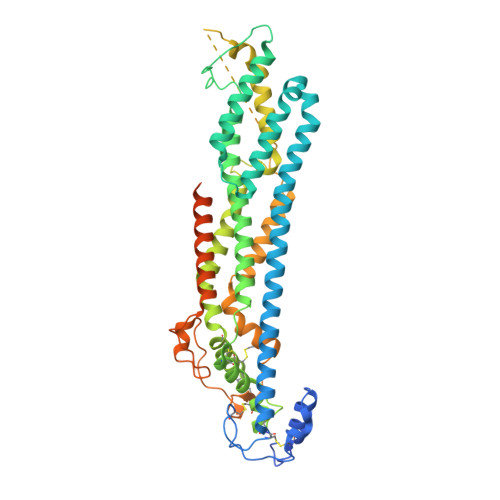
Crystal structure of full-length glypican-1 core protein after controlled crystal dehydration to 87% relative humidity


Experimental Data Snapshot

  • Method: X-RAY DIFFRACTION
  • Resolution: 2.38 Å
  • R-Value Free: 
    0.273 (Depositor), 0.273 (DCC) 
  • R-Value Work: 
    0.239 (Depositor), 0.241 (DCC) 
  • R-Value Observed: 
    0.240 (Depositor) 

Starting Model: experimental
View more details

wwPDB Validation 3D Report Full Report

Validation slider image for 4YWT

Ligand Structure Quality Assessment 


This is version 1.7 of the entry. See complete history

Literature

Structural Aspects of N-Glycosylations and the C-terminal Region in Human Glypican-1.

Awad, W.Adamczyk, B.Ornros, J.Karlsson, N.G.Mani, K.Logan, D.T.

(2015) J Biological Chem 290: 22991-23008

  • DOI: https://doi.org/10.1074/jbc.M115.660878
  • Primary Citation Related Structures: 
    4YWT

  • PubMed Abstract: 

    Glypicans are multifunctional cell surface proteoglycans involved in several important cellular signaling pathways. Glypican-1 (Gpc1) is the predominant heparan sulfate proteoglycan in the developing and adult human brain. The two N-linked glycans and the C-terminal domain that attach the core protein to the cell membrane are not resolved in the Gpc1 crystal structure. Therefore, we have studied Gpc1 using crystallography, small angle x-ray scattering, and chromatographic approaches to elucidate the composition, structure, and function of the N-glycans and the C terminus and also the topology of Gpc1 with respect to the membrane. The C terminus is shown to be highly flexible in solution, but it orients the core protein transverse to the membrane, directing a surface evolutionarily conserved in Gpc1 orthologs toward the membrane, where it may interact with signaling molecules and/or membrane receptors on the cell surface, or even the enzymes involved in heparan sulfate substitution in the Golgi apparatus. Furthermore, the N-glycans are shown to extend the protein stability and lifetime by protection against proteolysis and aggregation.


  • Organizational Affiliation
    • From the Department of Biochemistry and Structural Biology, Centre for Molecular Protein Science, Lund University, Box 124, SE-221 00 Lund.

Macromolecule Content 

  • Total Structure Weight: 235.27 kDa 
  • Atom Count: 13,110 
  • Modeled Residue Count: 1,671 
  • Deposited Residue Count: 2,104 
  • Unique protein chains: 1

Macromolecules

Find similar proteins by:|  3D Structure
Entity ID: 1
MoleculeChains  Sequence LengthOrganismDetailsImage
Glypican-1
A, B, C, D
526Homo sapiensMutation(s): 3 
Gene Names: GPC1
UniProt & NIH Common Fund Data Resources
Find proteins for P35052 (Homo sapiens)
Explore P35052 
Go to UniProtKB:  P35052
PHAROS:  P35052
GTEx:  ENSG00000063660 
Entity Groups
Sequence Clusters30% Identity50% Identity70% Identity90% Identity95% Identity100% Identity
UniProt GroupP35052
Glycosylation
Glycosylation Sites: 1Go to GlyGen: P35052-1
Sequence Annotations
Expand
Reference Sequence

Small Molecules

Ligands 2 Unique
IDChains Name / Formula / InChI Key2D Diagram3D Interactions
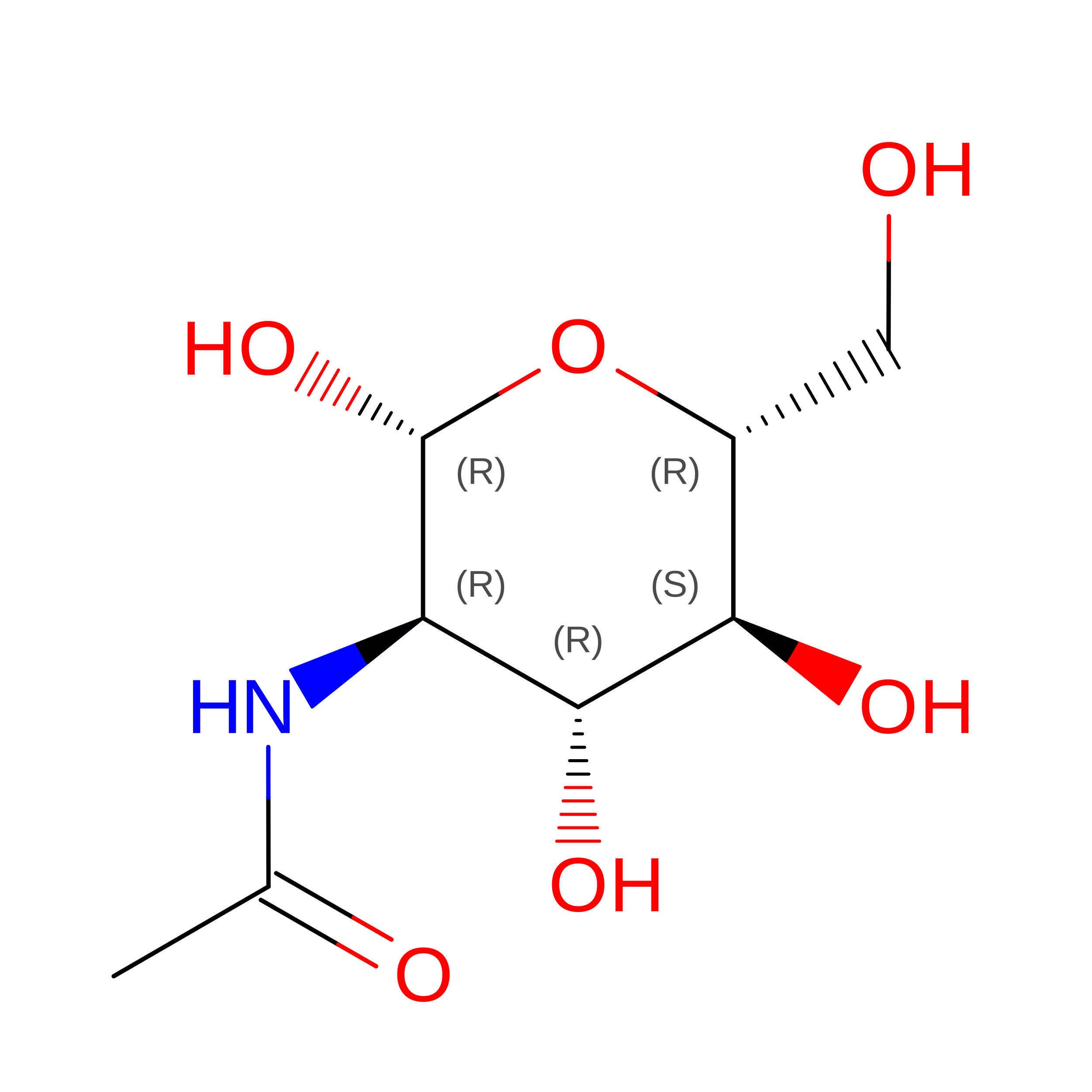
NAG

Query on NAG


Download:Ideal Coordinates CCD File
E [auth A],
H [auth B],
K [auth C],
O [auth D]
2-acetamido-2-deoxy-beta-D-glucopyranose
C8 H15 N O6
OVRNDRQMDRJTHS-FMDGEEDCSA-N
CA

Query on CA


Download:Ideal Coordinates CCD File
F [auth A]
G [auth A]
I [auth B]
J [auth B]
L [auth C]
F [auth A],
G [auth A],
I [auth B],
J [auth B],
L [auth C],
M [auth C],
N [auth C],
P [auth D],
Q [auth D]
CALCIUM ION
Ca
BHPQYMZQTOCNFJ-UHFFFAOYSA-N

Experimental Data & Validation

Experimental Data

  • Method: X-RAY DIFFRACTION
  • Resolution: 2.38 Å
  • R-Value Free:  0.273 (Depositor), 0.273 (DCC) 
  • R-Value Work:  0.239 (Depositor), 0.241 (DCC) 
  • R-Value Observed: 0.240 (Depositor) 
Space Group: P 1 21 1
Unit Cell:
Length ( Å )Angle ( ˚ )
a = 46.78α = 90
b = 166.59β = 90.38
c = 137.7γ = 90
Software Package:
Software NamePurpose
PHENIXrefinement
PDB_EXTRACTdata extraction
XDSdata reduction
XSCALEdata scaling
PHASERphasing

Structure Validation

View Full Validation Report


Ligand Structure Quality Assessment 


Entry History 

Deposition Data

Revision History  (Full details and data files)

  • Version 1.0: 2015-07-29
    Type: Initial release
  • Version 1.1: 2015-08-05
    Changes: Database references
  • Version 1.2: 2015-09-30
    Changes: Database references
  • Version 1.3: 2018-01-17
    Changes: Data collection
  • Version 1.4: 2019-04-03
    Changes: Data collection, Source and taxonomy
  • Version 1.5: 2020-07-29
    Type: Remediation
    Reason: Carbohydrate remediation
    Changes: Data collection, Derived calculations, Structure summary
  • Version 1.6: 2024-01-10
    Changes: Data collection, Database references, Refinement description, Structure summary
  • Version 1.7: 2024-11-13
    Changes: Structure summary