4YCN | pdb_00004ycn

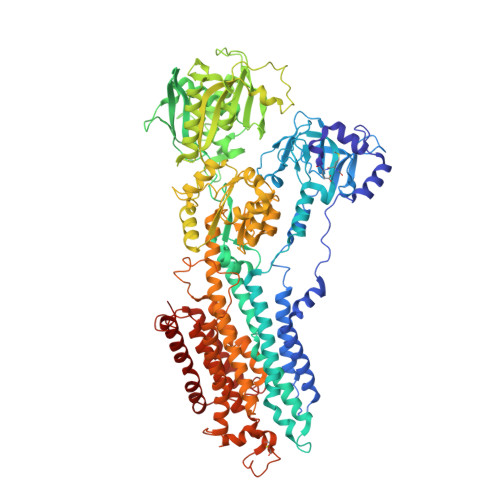
Crystal structure of the calcium pump with bound marine macrolide BLLB


Experimental Data Snapshot

  • Method: X-RAY DIFFRACTION
  • Resolution: 3.50 Å
  • R-Value Free: 
    0.247 (Depositor), 0.278 (DCC) 
  • R-Value Work: 
    0.210 (Depositor), 0.234 (DCC) 
  • R-Value Observed: 
    0.211 (Depositor) 

wwPDB Validation 3D Report Full Report

Validation slider image for 4YCN

Ligand Structure Quality Assessment 


This is version 2.0 of the entry. See complete history

Literature

Biselyngbyasides, cytotoxic marine macrolides, are novel and potent inhibitors of the Ca(2+) pumps with a unique mode of binding

Morita, M.Ogawa, H.Ohno, O.Yamori, T.Suenaga, K.Toyoshima, C.

(2015) FEBS Lett 589: 1406-1411

  • DOI: https://doi.org/10.1016/j.febslet.2015.04.056
  • Primary Citation Related Structures: 
    4YCM, 4YCN

  • PubMed Abstract: 

    Biselyngbyasides (BLSs), macrolides from a marine cyanobacterium, are cytotoxic natural products whose target molecule is unknown. Here we report that BLSs are high affinity (Ki∼10 nM) inhibitors of Ca(2+)-pumps with a unique binding mode. The crystal structures of the Ca(2+)-pump in complex with BLSs at 3.2-3.5 Å-resolution show that BLSs bind to the pump near the cytoplasmic surface of the transmembrane region. The crystal structures and activity measurement of BLS analogs allow us to identify the structural features that confer high potency to BLSs as inhibitors of the pump.


  • Organizational Affiliation
    • Department of Chemistry, Keio University, Kohoku-ku, Yokohama, Kanagawa 223-8522, Japan; Institute of Molecular and Cellular Biosciences, The University of Tokyo, Bunkyo-ku, Tokyo 113-0032, Japan.

Macromolecule Content 

  • Total Structure Weight: 111.76 kDa 
  • Atom Count: 7,754 
  • Modeled Residue Count: 994 
  • Deposited Residue Count: 994 
  • Unique protein chains: 1

Macromolecules

Find similar proteins by:|  3D Structure
Entity ID: 1
MoleculeChains  Sequence LengthOrganismDetailsImage
Sarcoplasmic/endoplasmic reticulum calcium ATPase 1994Oryctolagus cuniculusMutation(s): 0 
EC: 3.6.3.8 (PDB Primary Data), 7.2.2.10 (UniProt)
Membrane Entity: Yes 
UniProt
Find proteins for P04191 (Oryctolagus cuniculus)
Explore P04191 
Go to UniProtKB:  P04191
Entity Groups
Sequence Clusters30% Identity50% Identity70% Identity90% Identity95% Identity100% Identity
UniProt GroupP04191
Sequence Annotations
Expand
Reference Sequence

Small Molecules

Ligands 4 Unique
IDChains Name / Formula / InChI Key2D Diagram3D Interactions
PTY

Query on PTY


Download:Ideal Coordinates CCD File
F [auth A],
G [auth A]
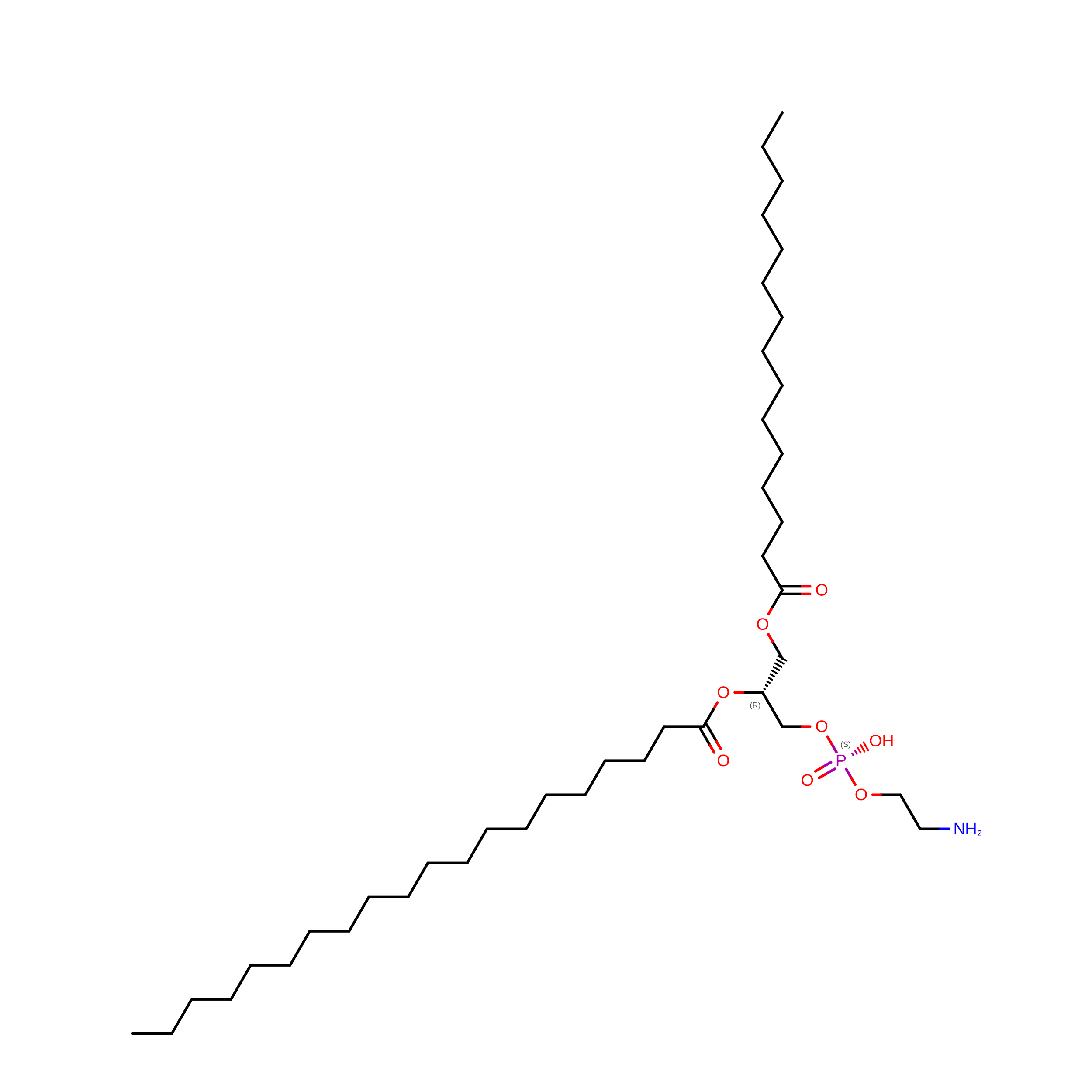
PHOSPHATIDYLETHANOLAMINE
C40 H80 N O8 P
NJGIRBISCGPRPF-KXQOOQHDSA-N
7BL

Query on 7BL


Download:Ideal Coordinates CCD File
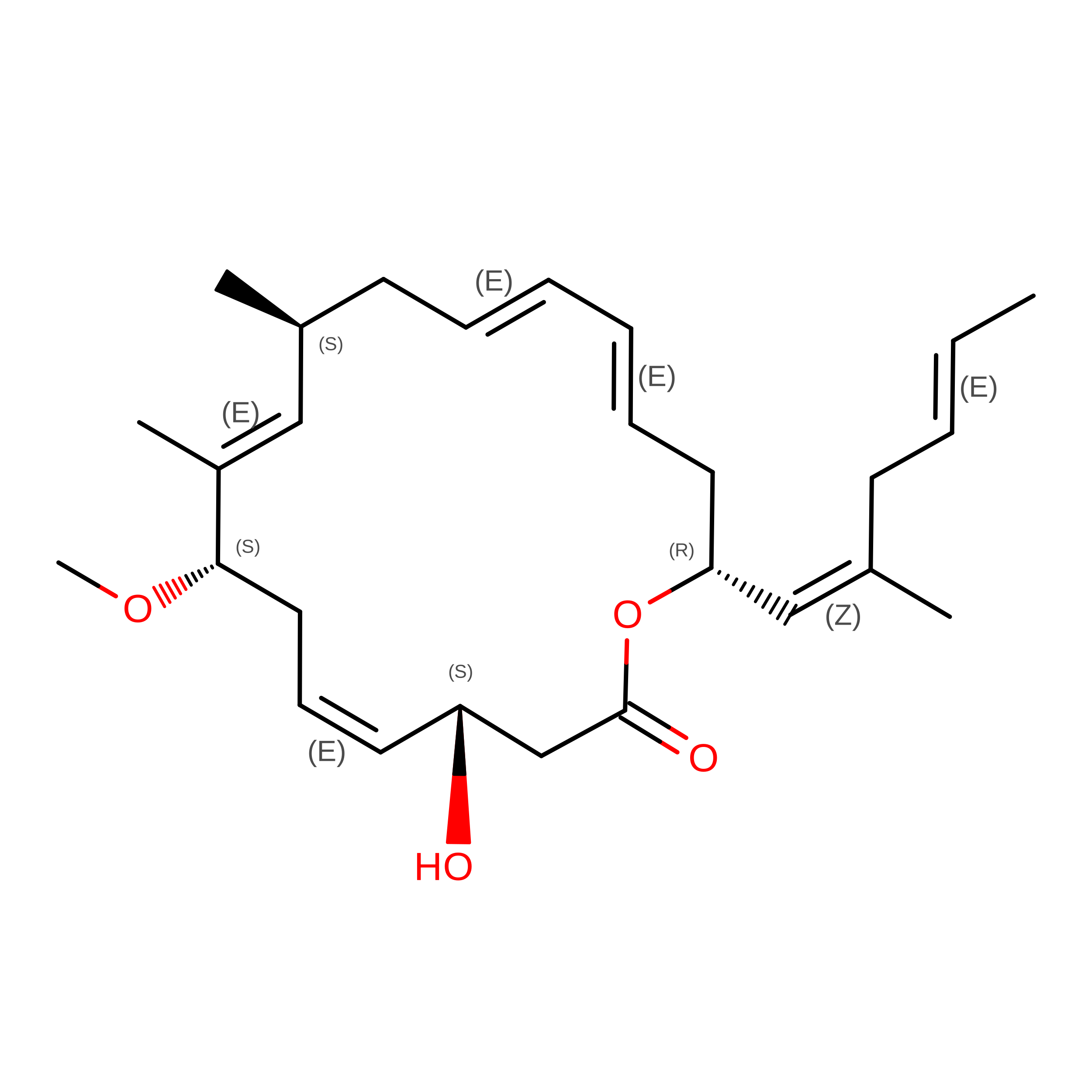
E [auth A](4S,5E,8S,9E,11S,13E,15E,18R)-4-hydroxy-8-methoxy-9,11-dimethyl-18-[(1Z,4E)-2-methylhexa-1,4-dien-1-yl]oxacyclooctadeca-5,9,13,15-tetraen-2-one
C27 H40 O4
DVYYXLNVAXSASA-BEVCVMOBSA-N
SO4

Query on SO4


Download:Ideal Coordinates CCD File
C [auth A],
D [auth A]
SULFATE ION
O4 S
QAOWNCQODCNURD-UHFFFAOYSA-L
NA

Query on NA


Download:Ideal Coordinates CCD File
B [auth A]SODIUM ION
Na
FKNQFGJONOIPTF-UHFFFAOYSA-N
Binding Affinity Annotations 
IDSourceBinding Affinity
7BL BindingDB:  4YCN Ki: min: 17, max: 17 (nM) from 2 assay(s)

Experimental Data & Validation

Experimental Data

  • Method: X-RAY DIFFRACTION
  • Resolution: 3.50 Å
  • R-Value Free:  0.247 (Depositor), 0.278 (DCC) 
  • R-Value Work:  0.210 (Depositor), 0.234 (DCC) 
  • R-Value Observed: 0.211 (Depositor) 
Space Group: P 41 21 2
Unit Cell:
Length ( Å )Angle ( ˚ )
a = 71.54α = 90
b = 71.54β = 90
c = 587.669γ = 90
Software Package:
Software NamePurpose
PHENIXrefinement
DENZOdata scaling
SCALEPACKdata scaling

Structure Validation

View Full Validation Report


Ligand Structure Quality Assessment 


Entry History 

Deposition Data

Revision History  (Full details and data files)

  • Version 1.0: 2016-01-13
    Type: Initial release
  • Version 1.1: 2020-02-05
    Changes: Data collection, Database references, Derived calculations
  • Version 2.0: 2025-04-09
    Changes: Data collection, Database references, Polymer sequence, Structure summary