4YBO | pdb_00004ybo

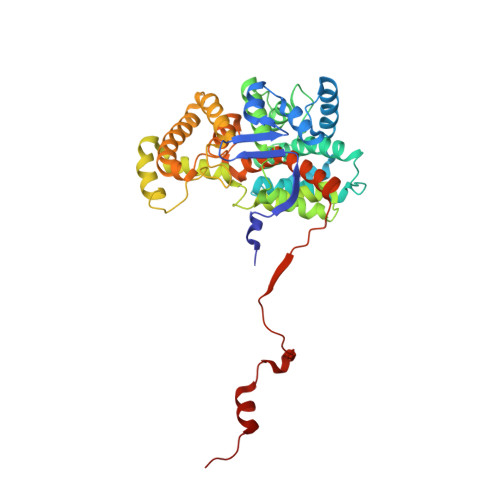
Structure of Citrate Synthase from the Thermoacidophilic Euryarchaeon Thermolasma acidophilum


Experimental Data Snapshot

  • Method: X-RAY DIFFRACTION
  • Resolution: 2.18 Å
  • R-Value Free: 
    0.212 (Depositor), 0.214 (DCC) 
  • R-Value Work: 
    0.164 (Depositor), 0.167 (DCC) 
  • R-Value Observed: 
    0.166 (Depositor) 

Starting Model: experimental
View more details

wwPDB Validation 3D Report Full Report

Validation slider image for 4YBO

This is version 1.3 of the entry. See complete history

Literature

An active site-tail interaction in the structure of hexahistidine-tagged Thermoplasma acidophilum citrate synthase.

Murphy, J.R.Donini, S.Kappock, T.J.

(2015) Acta Crystallogr F Struct Biol Commun 71: 1292-1299

  • DOI: https://doi.org/10.1107/S2053230X15015939
  • Primary Citation Related Structures: 
    4YBO

  • PubMed Abstract: 

    Citrate synthase (CS) plays a central metabolic role in aerobes and many other organisms. The CS reaction comprises two half-reactions: a Claisen aldol condensation of acetyl-CoA (AcCoA) and oxaloacetate (OAA) that forms citryl-CoA (CitCoA), and CitCoA hydrolysis. Protein conformational changes that `close' the active site play an important role in the assembly of a catalytically competent condensation active site. CS from the thermoacidophile Thermoplasma acidophilum (TpCS) possesses an endogenous Trp fluorophore that can be used to monitor the condensation reaction. The 2.2 Å resolution crystal structure of TpCS fused to a C-terminal hexahistidine tag (TpCSH6) reported here is an `open' structure that, when compared with several liganded TpCS structures, helps to define a complete path for active-site closure. One active site in each dimer binds a neighboring His tag, the first nonsubstrate ligand known to occupy both the AcCoA and OAA binding sites. Solution data collectively suggest that this fortuitous interaction is stabilized by the crystalline lattice. As a polar but almost neutral ligand, the active site-tail interaction provides a new starting point for the design of bisubstrate-analog inhibitors of CS.


  • Organizational Affiliation
    • Department of Biochemistry, Purdue University, 175 South University Street, West Lafayette, IN 47907-2063, USA.

Macromolecule Content 

  • Total Structure Weight: 179.07 kDa 
  • Atom Count: 13,127 
  • Modeled Residue Count: 1,553 
  • Deposited Residue Count: 1,596 
  • Unique protein chains: 1

Macromolecules

Find similar proteins by:|  3D Structure
Entity ID: 1
MoleculeChains  Sequence LengthOrganismDetailsImage
Citrate synthase
A, B, C, D
399Thermoplasma acidophilum DSM 1728Mutation(s): 0 
Gene Names: gltATa0169
EC: 2.3.3.16
UniProt
Find proteins for P21553 (Thermoplasma acidophilum (strain ATCC 25905 / DSM 1728 / JCM 9062 / NBRC 15155 / AMRC-C165))
Explore P21553 
Go to UniProtKB:  P21553
Entity Groups
Sequence Clusters30% Identity50% Identity70% Identity90% Identity95% Identity100% Identity
UniProt GroupP21553
Sequence Annotations
Expand
Reference Sequence

Experimental Data & Validation

Experimental Data

  • Method: X-RAY DIFFRACTION
  • Resolution: 2.18 Å
  • R-Value Free:  0.212 (Depositor), 0.214 (DCC) 
  • R-Value Work:  0.164 (Depositor), 0.167 (DCC) 
  • R-Value Observed: 0.166 (Depositor) 
Space Group: P 1 21 1
Unit Cell:
Length ( Å )Angle ( ˚ )
a = 56.505α = 90
b = 113.406β = 95.08
c = 120.066γ = 90
Software Package:
Software NamePurpose
PHENIXrefinement
HKL-2000data reduction
HKL-2000data scaling
PHASERphasing

Structure Validation

View Full Validation Report


Entry History 

Deposition Data

Revision History  (Full details and data files)

  • Version 1.0: 2015-09-02
    Type: Initial release
  • Version 1.1: 2015-10-14
    Changes: Database references
  • Version 1.2: 2018-04-18
    Changes: Data collection, Database references, Derived calculations
  • Version 1.3: 2023-09-27
    Changes: Data collection, Database references, Refinement description