4Y66 | pdb_00004y66

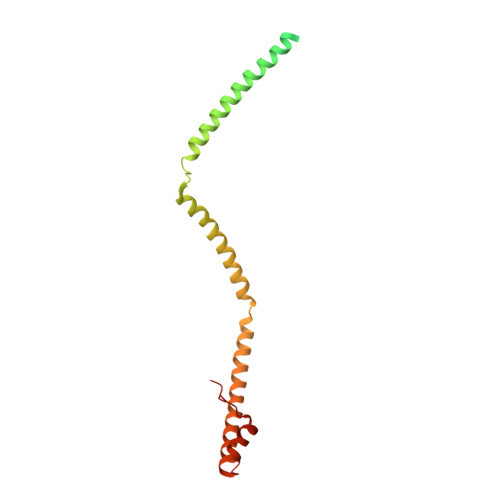
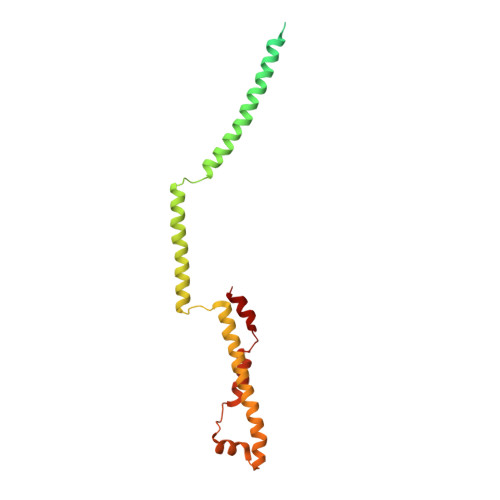
Crystal structure of Giardia lamblia Hop2-Mnd1 complex


Experimental Data Snapshot

  • Method: X-RAY DIFFRACTION
  • Resolution: 3.20 Å
  • R-Value Free: 
    0.286 (Depositor), 0.262 (DCC) 
  • R-Value Work: 
    0.239 (Depositor), 0.247 (DCC) 
  • R-Value Observed: 
    0.241 (Depositor) 

wwPDB Validation 3D Report Full Report

Validation slider image for 4Y66

This is version 1.2 of the entry. See complete history. 

Literature

Crystal structure of Hop2-Mnd1 and mechanistic insights into its role in meiotic recombination

Kang, H.A., Shin, H.C., Kalantzi, A.S., Toseland, C.P., Kim, H.M., Gruber, S., Peraro, M.D., Oh, B.H.

(2015) Nucleic Acids Res 43: 3841-3856

  • DOI: https://doi.org/10.1093/nar/gkv172
  • Primary Citation Related Structures: 
    4Y66

  • PubMed Abstract: 

    In meiotic DNA recombination, the Hop2-Mnd1 complex promotes Dmc1-mediated single-stranded DNA (ssDNA) invasion into homologous chromosomes to form a synaptic complex by a yet-unclear mechanism. Here, the crystal structure of Hop2-Mnd1 reveals that it forms a curved rod-like structure consisting of three leucine zippers and two kinked junctions. One end of the rod is linked to two juxtaposed winged-helix domains, and the other end is capped by extra α-helices to form a helical bundle-like structure. Deletion analysis shows that the helical bundle-like structure is sufficient for interacting with the Dmc1-ssDNA nucleofilament, and molecular modeling suggests that the curved rod could be accommodated into the helical groove of the nucleofilament. Remarkably, the winged-helix domains are juxtaposed at fixed relative orientation, and their binding to DNA is likely to perturb the base pairing according to molecular simulations. These findings allow us to propose a model explaining how Hop2-Mnd1 juxtaposes Dmc1-bound ssDNA with distorted recipient double-stranded DNA and thus facilitates strand invasion.


  • Organizational Affiliation: 
    • Department of Biological Sciences, KAIST Institute for the Biocentury, Cancer Metastasis Control Center, Korea Advanced Institute of Science and Technology, Daejeon 305-701, Korea.

Macromolecule Content 

  • Total Structure Weight: 147.15 kDa 
  • Atom Count: 7,211 
  • Modeled Residue Count: 1,002 
  • Deposited Residue Count: 1,302 
  • Unique protein chains: 2

Macromolecules

Find similar proteins by:|  3D Structure
Entity ID: 1
MoleculeChains  Sequence LengthOrganismDetailsImage
Mnd1
A, C, E
203Giardia lamblia ATCC 50803Mutation(s): 0 
Gene Names: GL50803_6626
UniProt
Find proteins for E2RTU1 (Giardia intestinalis (strain ATCC 50803 / WB clone C6))
Explore E2RTU1 
Go to UniProtKB:  E2RTU1
Entity Groups
Sequence Clusters30% Identity50% Identity70% Identity90% Identity95% Identity100% Identity
UniProt GroupE2RTU1
Sequence Annotations
Expand
Reference Sequence
Find similar proteins by:|  3D Structure
Entity ID: 2
MoleculeChains  Sequence LengthOrganismDetailsImage
Putative tbpip family protein
B, D, F
231Giardia duodenalisMutation(s): 0 
Gene Names: GSB_17044
UniProt
Find proteins for V6TR15 (Giardia intestinalis)
Explore V6TR15 
Go to UniProtKB:  V6TR15
Entity Groups
Sequence Clusters30% Identity50% Identity70% Identity90% Identity95% Identity100% Identity
UniProt GroupV6TR15
Sequence Annotations
Expand
Reference Sequence

Experimental Data & Validation

Experimental Data

  • Method: X-RAY DIFFRACTION
  • Resolution: 3.20 Å
  • R-Value Free:  0.286 (Depositor), 0.262 (DCC) 
  • R-Value Work:  0.239 (Depositor), 0.247 (DCC) 
  • R-Value Observed: 0.241 (Depositor) 
Space Group: C 1 2 1
Unit Cell:
Length ( Å )Angle ( ˚ )
a = 117.847α = 90
b = 69.066β = 95.34
c = 292.137γ = 90
Software Package:
Software NamePurpose
PHENIXrefinement
HKL-2000data reduction
HKL-2000data scaling
PHENIXphasing

Structure Validation

View Full Validation Report


Entry History 

Deposition Data

Revision History  (Full details and data files)

  • Version 1.0: 2015-03-18
    Type: Initial release
  • Version 1.1: 2015-05-06
    Changes: Database references
  • Version 1.2: 2024-03-20
    Changes: Data collection, Database references, Derived calculations, Source and taxonomy