4X8Q | pdb_00004x8q

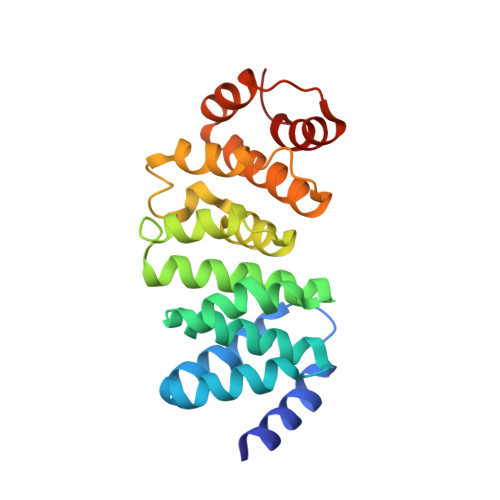
X-ray crystal structure of AlkD2 from Streptococcus mutans


Experimental Data Snapshot

  • Method: X-RAY DIFFRACTION
  • Resolution: 1.73 Å
  • R-Value Free: 
    0.168 (Depositor), 0.176 (DCC) 
  • R-Value Work: 
    0.152 (Depositor), 0.159 (DCC) 
  • R-Value Observed: 
    0.153 (Depositor) 

Starting Model: experimental
View more details

wwPDB Validation 3D Report Full Report

Validation slider image for 4X8Q

This is version 1.3 of the entry. See complete history

Literature

A New Family of HEAT-Like Repeat Proteins Lacking a Critical Substrate Recognition Motif Present in Related DNA Glycosylases.

Mullins, E.A.Shi, R.Kotsch, L.A.Eichman, B.F.

(2015) PLoS One 10: e0127733-e0127733

  • DOI: https://doi.org/10.1371/journal.pone.0127733
  • Primary Citation Related Structures: 
    4X8Q

  • PubMed Abstract: 

    DNA glycosylases are important repair enzymes that eliminate a diverse array of aberrant nucleobases from the genomes of all organisms. Individual bacterial species often contain multiple paralogs of a particular glycosylase, yet the molecular and functional distinctions between these paralogs are not well understood. The recently discovered HEAT-like repeat (HLR) DNA glycosylases are distributed across all domains of life and are distinct in their specificity for cationic alkylpurines and mechanism of damage recognition. Here, we describe a number of phylogenetically diverse bacterial species with two orthologs of the HLR DNA glycosylase AlkD. One ortholog, which we designate AlkD2, is substantially less conserved. The crystal structure of Streptococcus mutans AlkD2 is remarkably similar to AlkD but lacks the only helix present in AlkD that penetrates the DNA minor groove. We show that AlkD2 possesses only weak DNA binding affinity and lacks alkylpurine excision activity. Mutational analysis of residues along this DNA binding helix in AlkD substantially reduced binding affinity for damaged DNA, for the first time revealing the importance of this structural motif for damage recognition by HLR glycosylases.


  • Organizational Affiliation
    • Department of Biological Sciences and Center for Structural Biology, Vanderbilt University, Nashville, Tennessee, United States of America.

Macromolecule Content 

  • Total Structure Weight: 25.04 kDa 
  • Atom Count: 2,051 
  • Modeled Residue Count: 207 
  • Deposited Residue Count: 210 
  • Unique protein chains: 1

Macromolecules

Find similar proteins by:|  3D Structure
Entity ID: 1
MoleculeChains  Sequence LengthOrganismDetailsImage
Uncharacterized protein210Streptococcus mutansMutation(s): 0 
Gene Names: ALKD2
UniProt
Find proteins for A0A0M3KL00 (Streptococcus mutans)
Explore A0A0M3KL00 
Go to UniProtKB:  A0A0M3KL00
Entity Groups
Sequence Clusters30% Identity50% Identity70% Identity90% Identity95% Identity100% Identity
UniProt GroupA0A0M3KL00
Sequence Annotations
Expand
Reference Sequence

Experimental Data & Validation

Experimental Data

  • Method: X-RAY DIFFRACTION
  • Resolution: 1.73 Å
  • R-Value Free:  0.168 (Depositor), 0.176 (DCC) 
  • R-Value Work:  0.152 (Depositor), 0.159 (DCC) 
  • R-Value Observed: 0.153 (Depositor) 
Space Group: P 21 21 21
Unit Cell:
Length ( Å )Angle ( ˚ )
a = 51.016α = 90
b = 65.091β = 90
c = 87.497γ = 90
Software Package:
Software NamePurpose
HKL-2000data reduction
HKL-2000data scaling
PHASERphasing
PHENIXrefinement
PDB_EXTRACTdata extraction

Structure Validation

View Full Validation Report


Entry History 

& Funding Information

Deposition Data


Funding OrganizationLocationGrant Number
National Science Foundation (NSF, United States)United StatesMCB-1122098

Revision History  (Full details and data files)

  • Version 1.0: 2015-05-27
    Type: Initial release
  • Version 1.1: 2017-09-27
    Changes: Author supporting evidence, Derived calculations, Refinement description, Source and taxonomy
  • Version 1.2: 2019-11-27
    Changes: Author supporting evidence
  • Version 1.3: 2023-09-27
    Changes: Data collection, Database references, Derived calculations, Refinement description