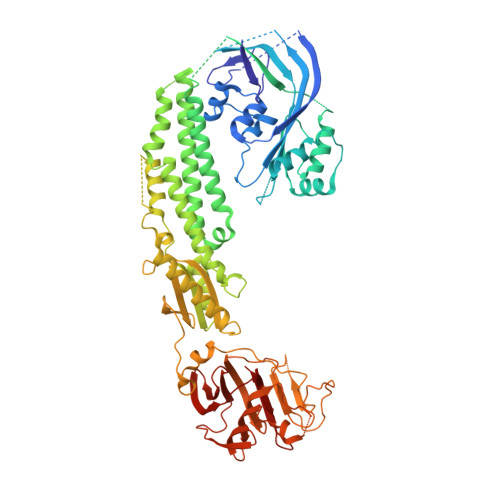
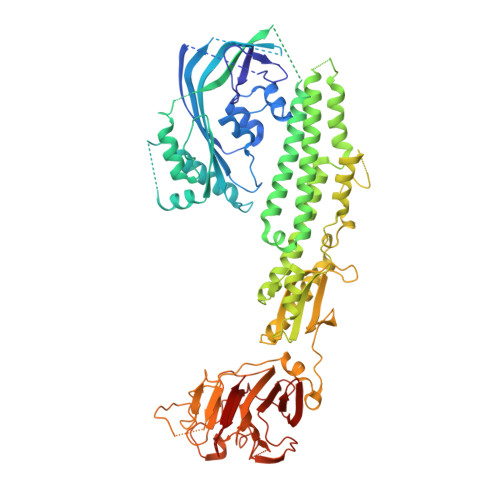
4WVM | pdb_00004wvm

Stonustoxin structure


Experimental Data Snapshot

  • Method: X-RAY DIFFRACTION
  • Resolution: 3.10 Å
  • R-Value Free: 
    0.236 (Depositor), 0.260 (DCC) 
  • R-Value Work: 
    0.207 (Depositor), 0.231 (DCC) 
  • R-Value Observed: 
    0.209 (Depositor) 

wwPDB Validation 3D Report Full Report

Validation slider image for 4WVM

This is version 1.4 of the entry. See complete history

Literature

Stonefish toxin defines an ancient branch of the perforin-like superfamily.

Ellisdon, A.M.Reboul, C.F.Panjikar, S.Huynh, K.Oellig, C.A.Winter, K.L.Dunstone, M.A.Hodgson, W.C.Seymour, J.Dearden, P.K.Tweten, R.K.Whisstock, J.C.McGowan, S.

(2015) Proc Natl Acad Sci U S A 112: 15360-15365

  • DOI: https://doi.org/10.1073/pnas.1507622112
  • Primary Citation Related Structures: 
    4WVM

  • PubMed Abstract: 

    The lethal factor in stonefish venom is stonustoxin (SNTX), a heterodimeric cytolytic protein that induces cardiovascular collapse in humans and native predators. Here, using X-ray crystallography, we make the unexpected finding that SNTX is a pore-forming member of an ancient branch of the Membrane Attack Complex-Perforin/Cholesterol-Dependent Cytolysin (MACPF/CDC) superfamily. SNTX comprises two homologous subunits (α and β), each of which comprises an N-terminal pore-forming MACPF/CDC domain, a central focal adhesion-targeting domain, a thioredoxin domain, and a C-terminal tripartite motif family-like PRY SPla and the RYanodine Receptor immune recognition domain. Crucially, the structure reveals that the two MACPF domains are in complex with one another and arranged into a stable early prepore-like assembly. These data provide long sought after near-atomic resolution insights into how MACPF/CDC proteins assemble into prepores on the surface of membranes. Furthermore, our analyses reveal that SNTX-like MACPF/CDCs are distributed throughout eukaryotic life and play a broader, possibly immune-related function outside venom.


  • Organizational Affiliation
    • Biomedicine Discovery Institute and Department of Biochemistry and Molecular Biology, Monash University, Melbourne, VIC, 3800, Australia; Australian Research Council Centre of Excellence in Advanced Molecular Imaging, Monash University, Melbourne, VIC, 3800, Australia;

Macromolecule Content 

  • Total Structure Weight: 159.14 kDa 
  • Atom Count: 9,691 
  • Modeled Residue Count: 1,228 
  • Deposited Residue Count: 1,403 
  • Unique protein chains: 2

Macromolecules

Find similar proteins by:|  3D Structure
Entity ID: 1
MoleculeChains  Sequence LengthOrganismDetailsImage
Stonustoxin subunit alpha703Synanceia horridaMutation(s): 0 
UniProt
Find proteins for Q98989 (Synanceia horrida)
Explore Q98989 
Go to UniProtKB:  Q98989
Entity Groups
Sequence Clusters30% Identity50% Identity70% Identity90% Identity95% Identity100% Identity
UniProt GroupQ98989
Sequence Annotations
Expand
Reference Sequence
Find similar proteins by:|  3D Structure
Entity ID: 2
MoleculeChains  Sequence LengthOrganismDetailsImage
Stonustoxin subunit beta700Synanceia horridaMutation(s): 0 
UniProt
Find proteins for Q91453 (Synanceia horrida)
Explore Q91453 
Go to UniProtKB:  Q91453
Entity Groups
Sequence Clusters30% Identity50% Identity70% Identity90% Identity95% Identity100% Identity
UniProt GroupQ91453
Sequence Annotations
Expand
Reference Sequence

Experimental Data & Validation

Experimental Data

  • Method: X-RAY DIFFRACTION
  • Resolution: 3.10 Å
  • R-Value Free:  0.236 (Depositor), 0.260 (DCC) 
  • R-Value Work:  0.207 (Depositor), 0.231 (DCC) 
  • R-Value Observed: 0.209 (Depositor) 
Space Group: P 43
Unit Cell:
Length ( Å )Angle ( ˚ )
a = 107.911α = 90
b = 107.911β = 90
c = 244.345γ = 90
Software Package:
Software NamePurpose
BUSTERrefinement
Cootmodel building
XSCALEdata scaling
SHELXDEphasing
XDSdata scaling

Structure Validation

View Full Validation Report


Entry History 

Deposition Data

Revision History  (Full details and data files)

  • Version 1.0: 2015-12-02
    Type: Initial release
  • Version 1.1: 2015-12-16
    Changes: Database references
  • Version 1.2: 2015-12-30
    Changes: Database references
  • Version 1.3: 2017-11-22
    Changes: Data collection, Database references, Derived calculations, Refinement description
  • Version 1.4: 2023-12-27
    Changes: Data collection, Database references