4WOD | pdb_00004wod

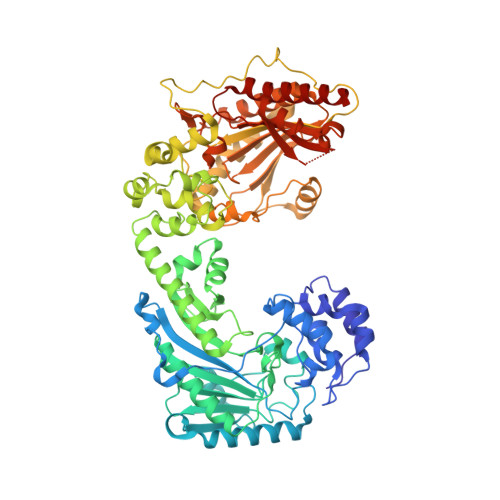
The duplicated taurocyamine kinase from Schistosoma mansoni complexed with arginine


Experimental Data Snapshot

  • Method: X-RAY DIFFRACTION
  • Resolution: 1.90 Å
  • R-Value Free: 
    0.251 (Depositor), 0.250 (DCC) 
  • R-Value Work: 
    0.206 (Depositor), 0.205 (DCC) 
  • R-Value Observed: 
    0.208 (Depositor) 

Starting Model: experimental
View more details

wwPDB Validation 3D Report Full Report

Validation slider image for 4WOD

Ligand Structure Quality Assessment 


This is version 1.3 of the entry. See complete history

Literature

The Substrate-free and -bound Crystal Structures of the Duplicated Taurocyamine Kinase from the Human Parasite Schistosoma mansoni.

Merceron, R.Awama, A.M.Montserret, R.Marcillat, O.Gouet, P.

(2015) J Biological Chem 290: 12951-12963

  • DOI: https://doi.org/10.1074/jbc.M114.628909
  • Primary Citation Related Structures: 
    4WO8, 4WOD, 4WOE

  • PubMed Abstract: 

    The taurocyamine kinase from the blood fluke Schistosoma mansoni (SmTK) belongs to the phosphagen kinase (PK) family and catalyzes the reversible Mg(2+)-dependent transfer of a phosphoryl group between ATP and taurocyamine. SmTK is derived from gene duplication, as are all known trematode TKs. Our crystallographic study of SmTK reveals the first atomic structure of both a TK and a PK with a bilobal structure. The two unliganded lobes present a canonical open conformation and interact via their respective C- and N-terminal domains at a helix-mediated interface. This spatial arrangement differs from that observed in true dimeric PKs, in which both N-terminal domains make contact. Our structures of SmTK complexed with taurocyamine or l-arginine compounds explain the mechanism by which an arginine residue of the phosphagen specificity loop is crucial for substrate specificity. An SmTK crystal was soaked with the dead end transition state analog (TSA) components taurocyamine-NO3 (2-)-MgADP. One SmTK monomer was observed with two bound TSAs and an asymmetric conformation, with the first lobe semiclosed and the second closed. However, isothermal titration calorimetry and enzyme kinetics experiments showed that the two lobes function independently. A small angle x-ray scattering model of SmTK-TSA in solution with two closed active sites was generated.


  • Organizational Affiliation
    • From the Institut de Biologie et Chimie des Protéines, BMSSI-IBCP, UMR 5086 CNRS Université Lyon 1, 7, Passage du Vercors, 69367 Lyon Cedex 07, France and.

Macromolecule Content 

  • Total Structure Weight: 80.6 kDa 
  • Atom Count: 5,920 
  • Modeled Residue Count: 706 
  • Deposited Residue Count: 716 
  • Unique protein chains: 1

Macromolecules

Find similar proteins by:|  3D Structure
Entity ID: 1
MoleculeChains  Sequence LengthOrganismDetailsImage
Taurocyamine kinase716Schistosoma mansoniMutation(s): 4 
Gene Names: Smp_194770
EC: 2.7.3.4
UniProt
Find proteins for P16641 (Schistosoma mansoni)
Explore P16641 
Go to UniProtKB:  P16641
Entity Groups
Sequence Clusters30% Identity50% Identity70% Identity90% Identity95% Identity100% Identity
UniProt GroupP16641
Sequence Annotations
Expand
Reference Sequence

Small Molecules

Ligands 1 Unique
IDChains Name / Formula / InChI Key2D Diagram3D Interactions
ARG

Query on ARG


Download:Ideal Coordinates CCD File
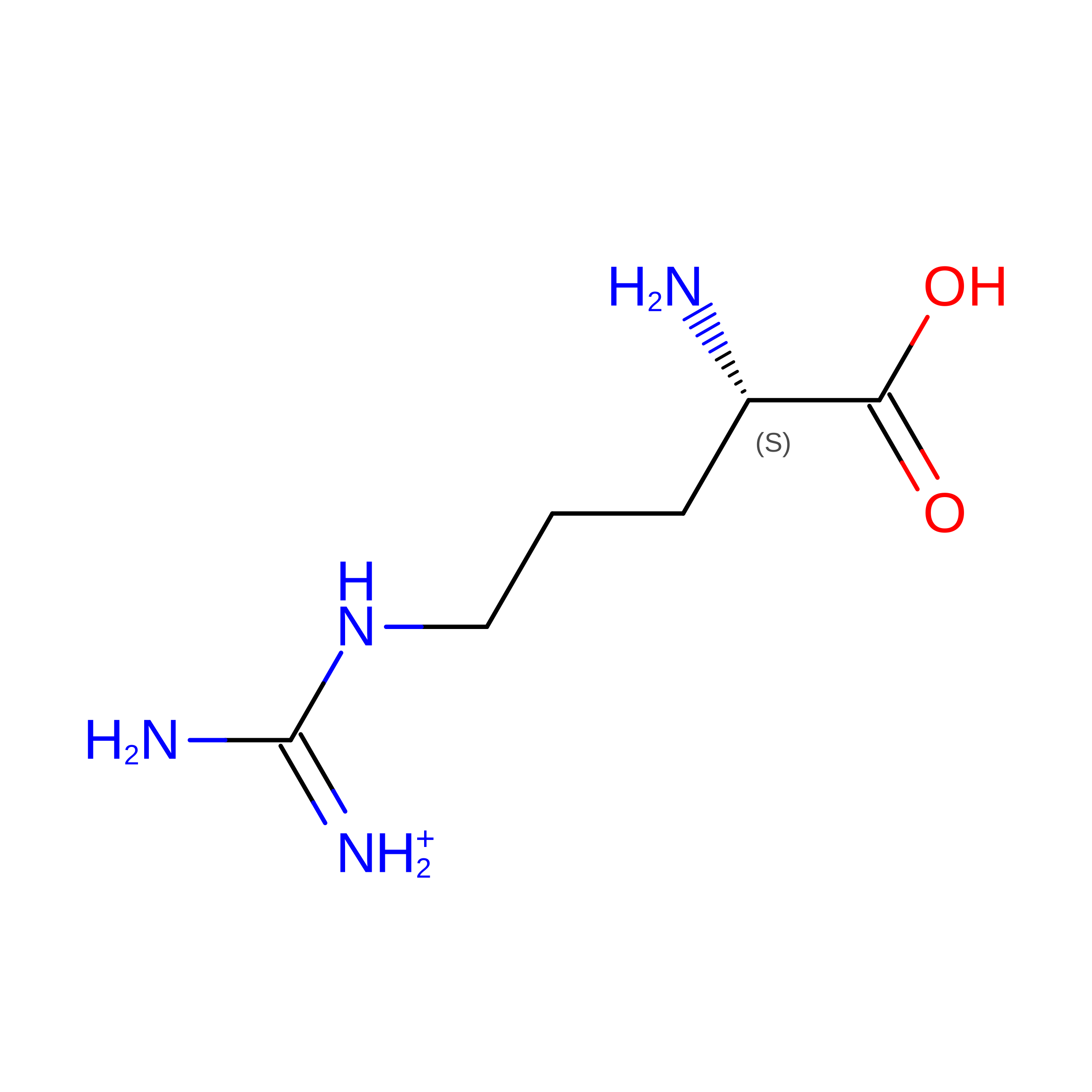
B [auth A]ARGININE
C6 H15 N4 O2
ODKSFYDXXFIFQN-BYPYZUCNSA-O

Experimental Data & Validation

Experimental Data

  • Method: X-RAY DIFFRACTION
  • Resolution: 1.90 Å
  • R-Value Free:  0.251 (Depositor), 0.250 (DCC) 
  • R-Value Work:  0.206 (Depositor), 0.205 (DCC) 
  • R-Value Observed: 0.208 (Depositor) 
Space Group: P 1 21 1
Unit Cell:
Length ( Å )Angle ( ˚ )
a = 51.92α = 90
b = 123.07β = 108.07
c = 62.74γ = 90
Software Package:
Software NamePurpose
PHENIXrefinement
XDSdata reduction
XSCALEdata scaling
MOLREPphasing

Structure Validation

View Full Validation Report


Ligand Structure Quality Assessment 


Entry History 

Deposition Data

Revision History  (Full details and data files)

  • Version 1.0: 2015-04-15
    Type: Initial release
  • Version 1.1: 2015-05-27
    Changes: Database references
  • Version 1.2: 2018-11-21
    Changes: Data collection
  • Version 1.3: 2024-01-10
    Changes: Data collection, Database references, Refinement description