4WAT | pdb_00004wat

Crystal structure of PfRh5, an essential P. falciparum ligand for invasion of human erythrocytes


Experimental Data Snapshot

  • Method: X-RAY DIFFRACTION
  • Resolution: 2.18 Å
  • R-Value Free: 
    0.247 (Depositor), 0.275 (DCC) 
  • R-Value Work: 
    0.202 (Depositor), 0.235 (DCC) 
  • R-Value Observed: 
    0.204 (Depositor) 

wwPDB Validation 3D Report Full Report

Validation slider image for 4WAT

Ligand Structure Quality Assessment 


This is version 1.5 of the entry. See complete history

Literature

Crystal structure of PfRh5, an essential P. falciparum ligand for invasion of human erythrocytes.

Chen, L.Xu, Y.Healer, J.Thompson, J.K.Smith, B.J.Lawrence, M.C.Cowman, A.F.

(2014) Elife 3

  • DOI: https://doi.org/10.7554/eLife.04187
  • Primary Citation Related Structures: 
    4WAT

  • PubMed Abstract: 

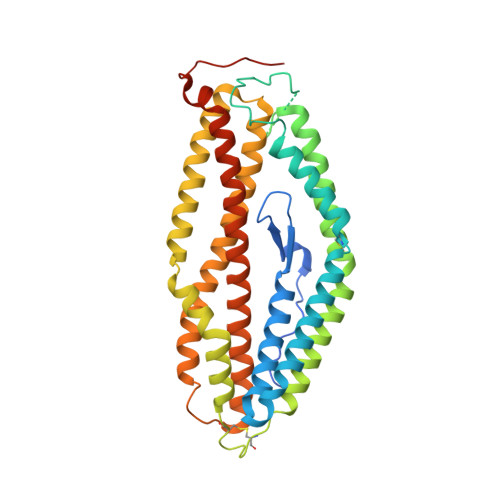
    Plasmodium falciparum causes the most severe form of malaria in humans and is responsible for over 700,000 deaths annually. It is an obligate intracellular parasite and invades erythrocytes where it grows in a relatively protected niche. Invasion of erythrocytes is essential for parasite survival and this involves interplay of multiple protein–protein interactions. One of the most important interactions is binding of parasite invasion ligand families EBLs and PfRhs to host receptors on the surface of erythrocytes. PfRh5 is the only essential invasion ligand within the PfRh family and is an important vaccine candidate. PfRh5 binds the host receptor basigin. In this study, we have determined the crystal structure of PfRh5 using diffraction data to 2.18 Å resolution. PfRh5 exhibits a novel fold, comprising nine mostly anti-parallel α-helices encasing an N-terminal β-hairpin, with the overall shape being an elliptical disk. This is the first three-dimensional structure determined for the PfRh family of proteins. DOI: http://dx.doi.org/10.7554/eLife.04187.001


  • Organizational Affiliation
    • Division of Infection and Immunity, The Walter and Eliza Hall Institute of Medical Research, Melbourne, Australia.

Macromolecule Content 

  • Total Structure Weight: 48.74 kDa 
  • Atom Count: 2,923 
  • Modeled Residue Count: 332 
  • Deposited Residue Count: 402 
  • Unique protein chains: 1

Macromolecules

Find similar proteins by:|  3D Structure
Entity ID: 1
MoleculeChains  Sequence LengthOrganismDetailsImage
PfRh5402Plasmodium falciparum 3D7Mutation(s): 0 
Gene Names: pfrh5
UniProt
Find proteins for Q8IFM5 (Plasmodium falciparum (isolate 3D7))
Explore Q8IFM5 
Go to UniProtKB:  Q8IFM5
Entity Groups
Sequence Clusters30% Identity50% Identity70% Identity90% Identity95% Identity100% Identity
UniProt GroupQ8IFM5
Glycosylation
Glycosylation Sites: 1
Sequence Annotations
Expand
Reference Sequence

Small Molecules

Experimental Data & Validation

Experimental Data

  • Method: X-RAY DIFFRACTION
  • Resolution: 2.18 Å
  • R-Value Free:  0.247 (Depositor), 0.275 (DCC) 
  • R-Value Work:  0.202 (Depositor), 0.235 (DCC) 
  • R-Value Observed: 0.204 (Depositor) 
Space Group: P 21 21 21
Unit Cell:
Length ( Å )Angle ( ˚ )
a = 53.98α = 90
b = 86.26β = 90
c = 114.83γ = 90
Software Package:
Software NamePurpose
BUSTERrefinement

Structure Validation

View Full Validation Report


Ligand Structure Quality Assessment 


Entry History 

& Funding Information

Deposition Data

  • Released Date: 2014-10-22 
  • Deposition Author(s): Chen, L.

Funding OrganizationLocationGrant Number
National Health and Medical Research Council (NHMRC, Australia)Australia637406

Revision History  (Full details and data files)

  • Version 1.0: 2014-10-22
    Type: Initial release
  • Version 1.1: 2017-09-06
    Changes: Author supporting evidence, Data collection, Derived calculations, Other, Source and taxonomy, Structure summary
  • Version 1.2: 2020-01-08
    Changes: Author supporting evidence
  • Version 1.3: 2020-07-29
    Type: Remediation
    Reason: Carbohydrate remediation
    Changes: Data collection, Derived calculations, Refinement description, Structure summary
  • Version 1.4: 2023-12-27
    Changes: Data collection, Database references, Structure summary
  • Version 1.5: 2024-10-16
    Changes: Structure summary