4V0I | pdb_00004v0i

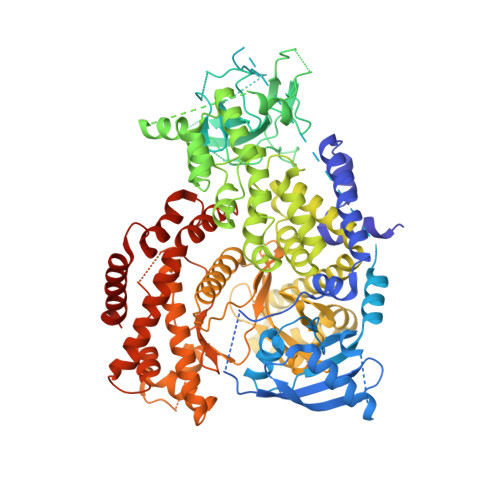
Water Network Determines Selectivity for a Series of Pyrimidone Indoline Amide PI3KBeta Inhibitors over PI3K-Delta


Experimental Data Snapshot

  • Method: X-RAY DIFFRACTION
  • Resolution: 2.54 Å
  • R-Value Free: 
    0.271 (DCC) 
  • R-Value Work: 
    0.234 (Depositor), 0.248 (DCC) 
  • R-Value Observed: 
    0.266 (Depositor) 

Starting Model: experimental
View more details

wwPDB Validation 3D Report Full Report

Validation slider image for 4V0I

Ligand Structure Quality Assessment 


This is version 1.4 of the entry. See complete history

Literature

Differential Water Thermodynamics Determine Pi3K-Beta/Delta Selectivity for Solvent-Exposed Ligand Modifications.

Robinson, D.Bertrand, T.Carry, J.Halley, F.Karlsson, A.Mathieu, M.Minoux, H.Perrin, M.Robert, B.Schio, L.Sherman, W.

(2016) J Chem Inf Model 56: 886

  • DOI: https://doi.org/10.1021/acs.jcim.5b00641
  • Primary Citation Related Structures: 
    4V0I

  • PubMed Abstract: 

    Phosphoinositide 3-kinases (PI3Ks) are involved in important cellular functions and represent desirable targets for drug discovery efforts, especially related to oncology; however, the four PI3K subtypes (α, β, γ, and δ) have highly similar binding sites, making the design of selective inhibitors challenging. A series of inhibitors with selectivity toward the β subtype over δ resulted in compound 3(S), which has entered a phase I/Ib clinical trial for patients with advanced PTEN-deficient cancer. Interestingly, X-ray crystallography revealed that the modifications making inhibitor 3(S) and related compounds selective toward the β-isoform do not interact directly with either PI3Kβ or PI3Kδ, thereby confounding rationalization of the SAR. Here, we apply explicit solvent molecular dynamics and solvent thermodynamic analysis using WaterMap in an effort to understand the unusual affinity and selectivity trends. We find that differences in solvent energetics and water networks, which are modulated upon binding of different ligands, explain the experimental affinity and selectivity trends. This study highlights the critical role of water molecules in molecular recognition and the importance of considering water networks in drug discovery efforts to rationalize and improve selectivity.


  • Organizational Affiliation
    • Schrodinger , 120 W 45th St, New York, New York 10036, United States.

Macromolecule Content 

  • Total Structure Weight: 216.36 kDa 
  • Atom Count: 12,654 
  • Modeled Residue Count: 1,551 
  • Deposited Residue Count: 1,880 
  • Unique protein chains: 1

Macromolecules

Find similar proteins by:|  3D Structure
Entity ID: 1
MoleculeChains  Sequence LengthOrganismDetailsImage
PHOSPHATIDYLINOSITOL-4,5-BISPHOSPHATE 3-KINASE CATALYTIC SUBUNIT DELTA ISOFORM
A, B
940Mus musculusMutation(s): 0 
EC: 2.7.1.153 (PDB Primary Data), 2.7.1.137 (UniProt)
UniProt
Find proteins for O35904 (Mus musculus)
Explore O35904 
Go to UniProtKB:  O35904
Entity Groups
Sequence Clusters30% Identity50% Identity70% Identity90% Identity95% Identity100% Identity
UniProt GroupO35904
Sequence Annotations
Expand
Reference Sequence

Small Molecules

Ligands 1 Unique
IDChains Name / Formula / InChI Key2D Diagram3D Interactions
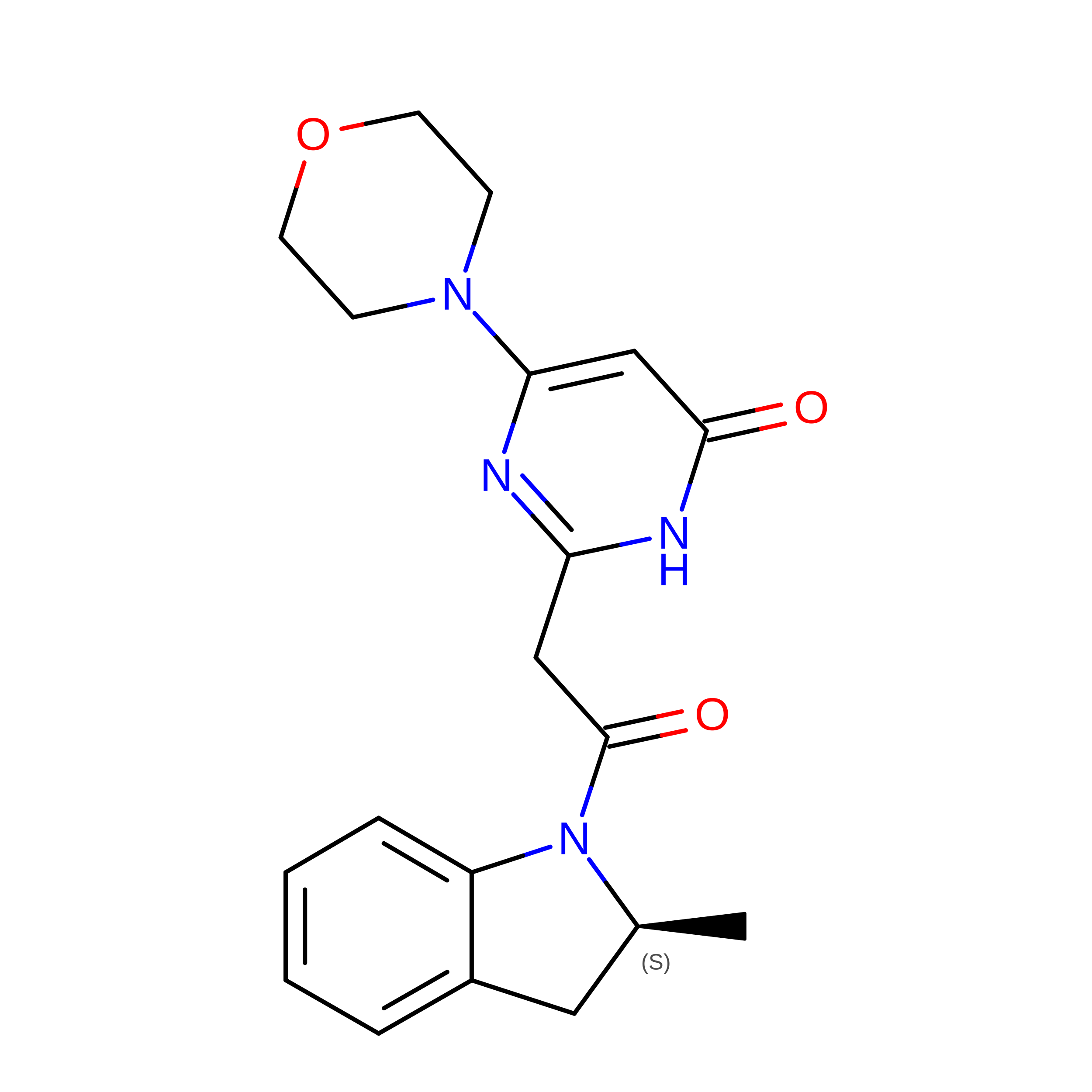
J82

Query on J82


Download:Ideal Coordinates CCD File
C [auth A],
D [auth B]
2-[2-(2-METHYL-2,3-DIHYDRO-INDOL-1-YL)-2-OXO-ETHYL]-6-MORPHOLIN-4-YL-3H-PYRIMIDIN-4-ONE
C19 H22 N4 O3
UAXHPOBBKRWJGA-ZDUSSCGKSA-N
Binding Affinity Annotations 
IDSourceBinding Affinity
J82 BindingDB:  4V0I IC50: 468 (nM) from 1 assay(s)

Experimental Data & Validation

Experimental Data

  • Method: X-RAY DIFFRACTION
  • Resolution: 2.54 Å
  • R-Value Free:  0.271 (DCC) 
  • R-Value Work:  0.234 (Depositor), 0.248 (DCC) 
  • R-Value Observed: 0.266 (Depositor) 
Space Group: P 1 21 1
Unit Cell:
Length ( Å )Angle ( ˚ )
a = 62α = 90
b = 216.43β = 113.29
c = 76.97γ = 90
Software Package:
Software NamePurpose
BUSTERrefinement
XDSdata reduction
SCALAdata scaling
MOLREPphasing

Structure Validation

View Full Validation Report


Ligand Structure Quality Assessment 


Entry History 

Deposition Data

Revision History  (Full details and data files)

  • Version 1.0: 2015-09-30
    Type: Initial release
  • Version 1.1: 2016-10-05
    Changes: Database references
  • Version 1.2: 2019-04-24
    Changes: Data collection, Other, Source and taxonomy
  • Version 1.3: 2019-05-08
    Changes: Data collection, Experimental preparation
  • Version 1.4: 2024-01-10
    Changes: Data collection, Database references, Derived calculations, Other, Refinement description