4TOY | pdb_00004toy

Structure of 35O22 Fab, a HIV-1 neutralizing antibody


Experimental Data Snapshot

  • Method: X-RAY DIFFRACTION
  • Resolution: 1.55 Å
  • R-Value Free: 
    0.182 (Depositor), 0.185 (DCC) 
  • R-Value Work: 
    0.167 (Depositor), 0.171 (DCC) 
  • R-Value Observed: 
    0.167 (Depositor) 

Starting Model: experimental
View more details

wwPDB Validation 3D Report Full Report

Validation slider image for 4TOY

This is version 2.1 of the entry. See complete history

Literature

Broad and potent HIV-1 neutralization by a human antibody that binds the gp41-gp120 interface.

Huang, J.Kang, B.H.Pancera, M.Lee, J.H.Tong, T.Feng, Y.Imamichi, H.Georgiev, I.S.Chuang, G.Y.Druz, A.Doria-Rose, N.A.Laub, L.Sliepen, K.van Gils, M.J.de la Pena, A.T.Derking, R.Klasse, P.J.Migueles, S.A.Bailer, R.T.Alam, M.Pugach, P.Haynes, B.F.Wyatt, R.T.Sanders, R.W.Binley, J.M.Ward, A.B.Mascola, J.R.Kwong, P.D.Connors, M.

(2014) Nature 515: 138-142

  • DOI: https://doi.org/10.1038/nature13601
  • Primary Citation Related Structures: 
    4TOY

  • PubMed Abstract: 

    The isolation of human monoclonal antibodies is providing important insights into the specificities that underlie broad neutralization of HIV-1 (reviewed in ref. 1). Here we report a broad and extremely potent HIV-specific monoclonal antibody, termed 35O22, which binds a novel HIV-1 envelope glycoprotein (Env) epitope. 35O22 neutralized 62% of 181 pseudoviruses with a half-maximum inhibitory concentration (IC50) <50 μg ml(-1). The median IC50 of neutralized viruses was 0.033 μg ml(-1), among the most potent thus far described. 35O22 did not bind monomeric forms of Env tested, but did bind the trimeric BG505 SOSIP.664. Mutagenesis and a reconstruction by negative-stain electron microscopy of the Fab in complex with trimer revealed that it bound to a conserved epitope, which stretched across gp120 and gp41. The specificity of 35O22 represents a novel site of vulnerability on HIV Env, which serum analysis indicates to be commonly elicited by natural infection. Binding to this new site of vulnerability may thus be an important complement to current monoclonal-antibody-based approaches to immunotherapies, prophylaxis and vaccine design.


  • Organizational Affiliation
    • Laboratory of Immunoregulation, National Institute of Allergy and Infectious Diseases, National Institutes of Health, Bethesda, Maryland 20892, USA.

Macromolecule Content 

  • Total Structure Weight: 49.47 kDa 
  • Atom Count: 3,972 
  • Modeled Residue Count: 456 
  • Deposited Residue Count: 459 
  • Unique protein chains: 2

Macromolecules

Find similar proteins by:|  3D Structure
Entity ID: 1
MoleculeChains  Sequence LengthOrganismDetailsImage
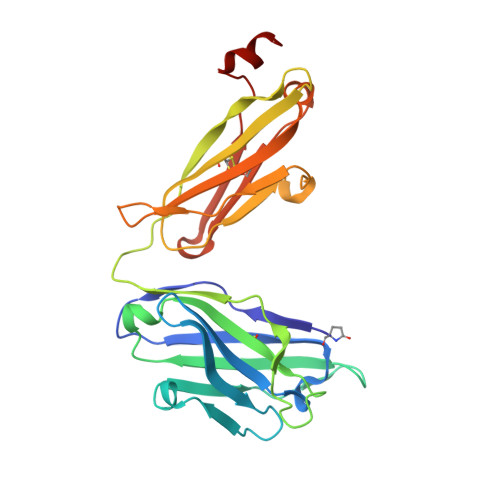
35O22 Fab Heavy chainA [auth H]243Homo sapiensMutation(s): 0 
Find similar proteins by:|  3D Structure
Entity ID: 2
MoleculeChains  Sequence LengthOrganismDetailsImage
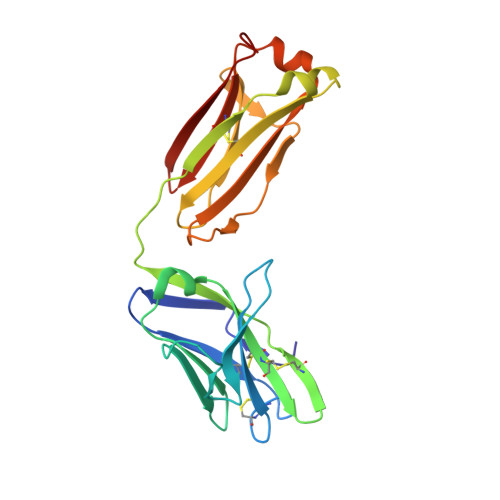
35O22 Fab Light chainB [auth L]216Homo sapiensMutation(s): 0 

Small Molecules

Modified Residues  1 Unique
IDChains TypeFormula2D DiagramParent
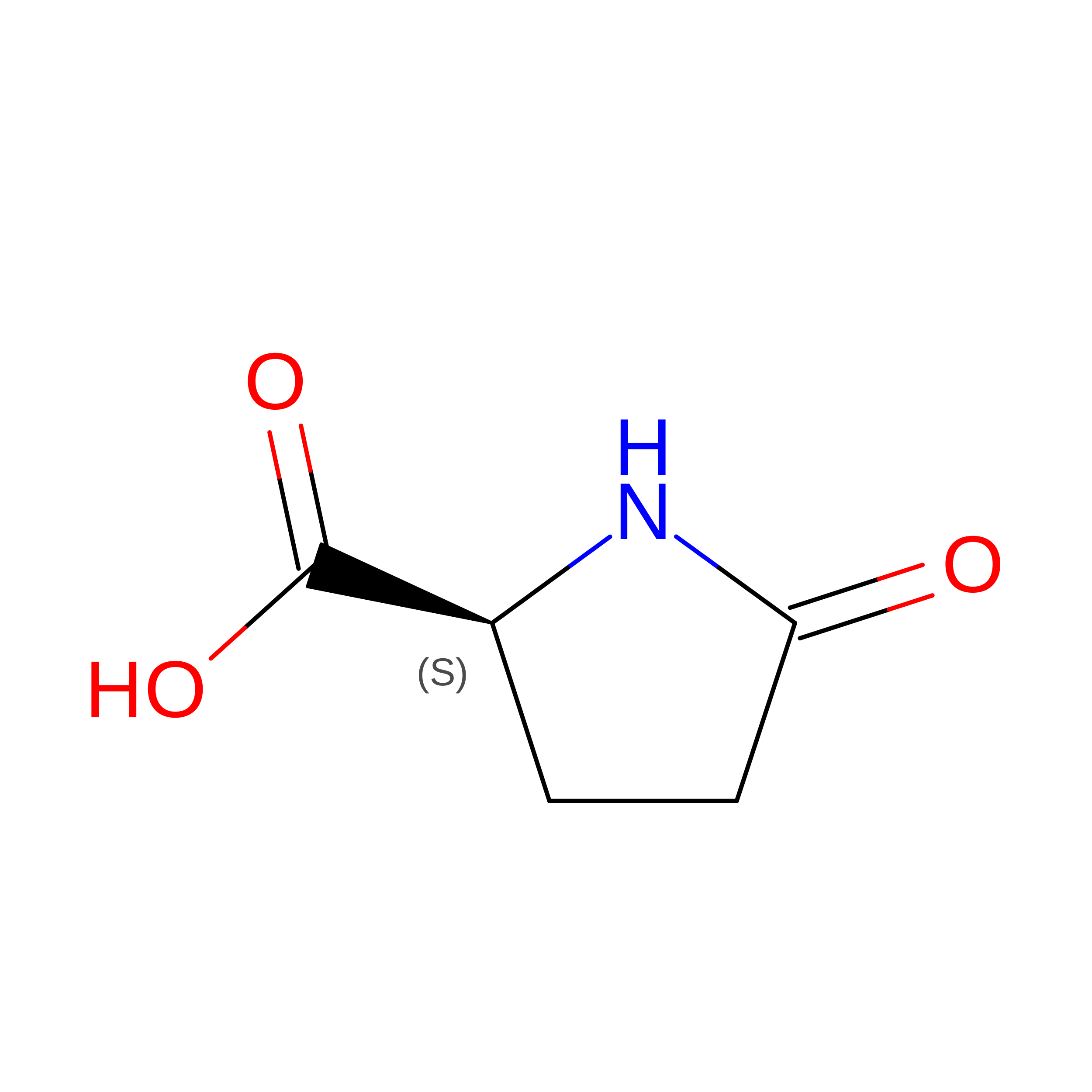
PCA
Query on PCA
A [auth H]L-PEPTIDE LINKINGC5 H7 N O3GLN

Experimental Data & Validation

Experimental Data

  • Method: X-RAY DIFFRACTION
  • Resolution: 1.55 Å
  • R-Value Free:  0.182 (Depositor), 0.185 (DCC) 
  • R-Value Work:  0.167 (Depositor), 0.171 (DCC) 
  • R-Value Observed: 0.167 (Depositor) 
Space Group: P 41 21 2
Unit Cell:
Length ( Å )Angle ( ˚ )
a = 57.183α = 90
b = 57.183β = 90
c = 267.677γ = 90
Software Package:
Software NamePurpose
PHENIXrefinement
HKL-2000data scaling
PHASERphasing
Cootmodel building

Structure Validation

View Full Validation Report


Entry History 

Deposition Data

Revision History  (Full details and data files)

  • Version 1.0: 2014-09-03
    Type: Initial release
  • Version 1.1: 2014-09-17
    Changes: Database references
  • Version 1.2: 2014-11-19
    Changes: Database references
  • Version 1.3: 2017-11-22
    Changes: Advisory, Database references, Derived calculations, Other, Refinement description, Source and taxonomy
  • Version 2.0: 2023-09-27
    Changes: Data collection, Database references, Polymer sequence, Refinement description
  • Version 2.1: 2024-11-20
    Changes: Structure summary