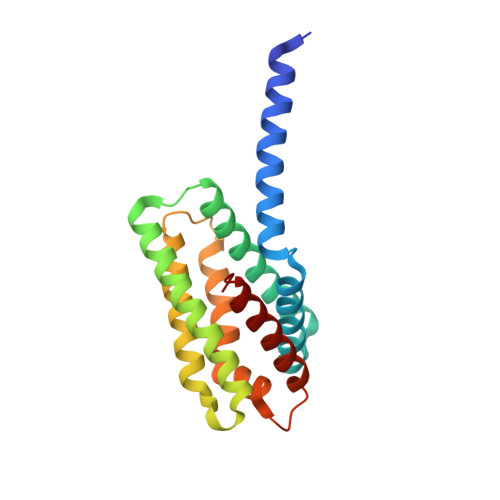
4Q9V | pdb_00004q9v

Crystal structure of TIPE3


Experimental Data Snapshot

  • Method: X-RAY DIFFRACTION
  • Resolution: 2.30 Å
  • R-Value Free: 
    0.262 (Depositor), 0.254 (DCC) 
  • R-Value Work: 
    0.240 (Depositor), 0.237 (DCC) 
  • R-Value Observed: 
    0.241 (Depositor) 

Starting Model: experimental
View more details

wwPDB Validation 3D Report Full Report

Validation slider image for 4Q9V

This is version 1.1 of the entry. See complete history

Literature

TIPE3 Is the Transfer Protein of Lipid Second Messengers that Promote Cancer.

Fayngerts, S.A.Wu, J.Oxley, C.L.Liu, X.Vourekas, A.Cathopoulis, T.Wang, Z.Cui, J.Liu, S.Sun, H.Lemmon, M.A.Zhang, L.Shi, Y.Chen, Y.H.

(2014) Cancer Cell 26: 465-478

  • DOI: https://doi.org/10.1016/j.ccr.2014.07.025
  • Primary Citation Related Structures: 
    4Q9V

  • PubMed Abstract: 

    More than half of human cancers have aberrantly upregulated phosphoinositide signals; yet how phospholipid signals are controlled during tumorigenesis is not fully understood. We report here that TIPE3 (TNFAIP8L3) is the transfer protein of phosphoinositide second messengers that promote cancer. High-resolution crystal structure of TIPE3 shows a large hydrophobic cavity that is occupied by a phospholipid-like molecule. TIPE3 preferentially captures and shuttles two lipid second messengers, i.e., phosphatidylinositol 4,5-bisphosphate and phosphatidylinositol 3,4,5-trisphosphate, and increases their levels in the plasma membrane. Notably, human cancers have markedly upregulated TIPE3 expression. Knocking out TIPE3 diminishes tumorigenesis, whereas enforced TIPE3 expression enhances it in vivo. Thus, the function and metabolism of phosphoinositide second messengers are controlled by a specific transfer protein during tumorigenesis.


  • Organizational Affiliation
    • Department of Pathology and Laboratory Medicine, Perelman School of Medicine, University of Pennsylvania, Philadelphia, PA 19104, USA.

Macromolecule Content 

  • Total Structure Weight: 44.22 kDa 
  • Atom Count: 3,241 
  • Modeled Residue Count: 369 
  • Deposited Residue Count: 372 
  • Unique protein chains: 1

Macromolecules

Find similar proteins by:|  3D Structure
Entity ID: 1
MoleculeChains  Sequence LengthOrganismDetailsImage
Tumor necrosis factor alpha-induced protein 8-like protein 3
A, B
186Homo sapiensMutation(s): 0 
Gene Names: TNFAIP8L3
UniProt & NIH Common Fund Data Resources
Find proteins for Q5GJ75 (Homo sapiens)
Explore Q5GJ75 
Go to UniProtKB:  Q5GJ75
GTEx:  ENSG00000183578 
Entity Groups
Sequence Clusters30% Identity50% Identity70% Identity90% Identity95% Identity100% Identity
UniProt GroupQ5GJ75
Sequence Annotations
Expand
Reference Sequence

Small Molecules

Ligands 2 Unique
IDChains Name / Formula / InChI Key2D Diagram3D Interactions
SO4

Query on SO4


Download:Ideal Coordinates CCD File
G [auth A]
H [auth A]
I [auth A]
J [auth A]
K [auth A]
G [auth A],
H [auth A],
I [auth A],
J [auth A],
K [auth A],
L [auth A],
N [auth B],
O [auth B]
SULFATE ION
O4 S
QAOWNCQODCNURD-UHFFFAOYSA-L
CL

Query on CL


Download:Ideal Coordinates CCD File
C [auth A],
D [auth A],
E [auth A],
F [auth A],
M [auth B]
CHLORIDE ION
Cl
VEXZGXHMUGYJMC-UHFFFAOYSA-M

Experimental Data & Validation

Experimental Data

  • Method: X-RAY DIFFRACTION
  • Resolution: 2.30 Å
  • R-Value Free:  0.262 (Depositor), 0.254 (DCC) 
  • R-Value Work:  0.240 (Depositor), 0.237 (DCC) 
  • R-Value Observed: 0.241 (Depositor) 
Space Group: I 2 2 2
Unit Cell:
Length ( Å )Angle ( ˚ )
a = 61.729α = 90
b = 87.296β = 90
c = 242.309γ = 90
Software Package:
Software NamePurpose
HKL-2000data collection
PHASERphasing
PHENIXrefinement
HKL-2000data reduction
HKL-2000data scaling

Structure Validation

View Full Validation Report


Entry History 

Deposition Data

Revision History  (Full details and data files)

  • Version 1.0: 2014-10-22
    Type: Initial release
  • Version 1.1: 2023-11-08
    Changes: Data collection, Database references, Derived calculations, Refinement description