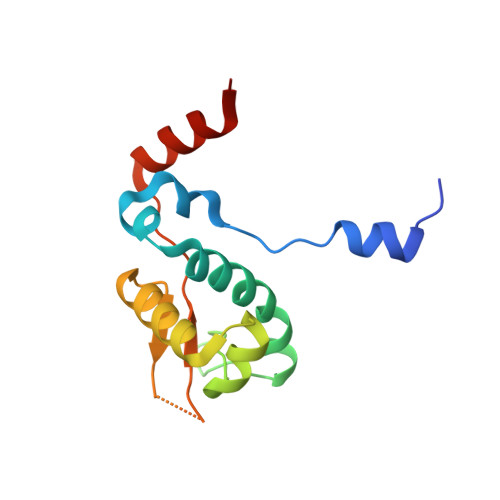
4PTA | pdb_00004pta

Structure of MDR initiator


Experimental Data Snapshot

  • Method: X-RAY DIFFRACTION
  • Resolution: 2.60 Å
  • R-Value Free: 
    0.281 (Depositor), 0.281 (DCC) 
  • R-Value Work: 
    0.225 (Depositor), 0.223 (DCC) 
  • R-Value Observed: 
    0.231 (Depositor) 

wwPDB Validation 3D Report Full Report

Validation slider image for 4PTA

This is version 1.2 of the entry. See complete history

Literature

Mechanism of staphylococcal multiresistance plasmid replication origin assembly by the RepA protein.

Schumacher, M.A.Tonthat, N.K.Kwong, S.M.Chinnam, N.B.Liu, M.A.Skurray, R.A.Firth, N.

(2014) Proc Natl Acad Sci U S A 111: 9121-9126

  • DOI: https://doi.org/10.1073/pnas.1406065111
  • Primary Citation Related Structures: 
    4PQK, 4PQL, 4PT7, 4PTA, 5KBJ

  • PubMed Abstract: 

    The staphylococcal multiresistance plasmids are key contributors to the alarming rise in bacterial multidrug resistance. A conserved replication initiator, RepA, encoded on these plasmids is essential for their propagation. RepA proteins consist of flexibly linked N-terminal (NTD) and C-terminal (CTD) domains. Despite their essential role in replication, the molecular basis for RepA function is unknown. Here we describe a complete structural and functional dissection of RepA proteins. Unexpectedly, both the RepA NTD and CTD show similarity to the corresponding domains of the bacterial primosome protein, DnaD. Although the RepA and DnaD NTD both contain winged helix-turn-helices, the DnaD NTD self-assembles into large scaffolds whereas the tetrameric RepA NTD binds DNA iterons using a newly described DNA binding mode. Strikingly, structural and atomic force microscopy data reveal that the NTD tetramer mediates DNA bridging, suggesting a molecular mechanism for origin handcuffing. Finally, data show that the RepA CTD interacts with the host DnaG primase, which binds the replicative helicase. Thus, these combined data reveal the molecular mechanism by which RepA mediates the specific replicon assembly of staphylococcal multiresistant plasmids.


  • Organizational Affiliation
    • Department of Biochemistry, Duke University Medical Center, Durham, NC 27710; and maria.schumacher@duke.edu.

Macromolecule Content 

  • Total Structure Weight: 15.52 kDa 
  • Atom Count: 1,043 
  • Modeled Residue Count: 121 
  • Deposited Residue Count: 131 
  • Unique protein chains: 1

Macromolecules

Find similar proteins by:|  3D Structure
Entity ID: 1
MoleculeChains  Sequence LengthOrganismDetailsImage
Replication initiator proteinA [auth D]131Staphylococcus aureus subsp. aureus USA300Mutation(s): 0 
Gene Names: repASAUSA300_pUSA030001
UniProt
Find proteins for A0A0H2XIV8 (Staphylococcus aureus (strain USA300))
Explore A0A0H2XIV8 
Go to UniProtKB:  A0A0H2XIV8
Entity Groups
Sequence Clusters30% Identity50% Identity70% Identity90% Identity95% Identity100% Identity
UniProt GroupA0A0H2XIV8
Sequence Annotations
Expand
Reference Sequence

Experimental Data & Validation

Experimental Data

  • Method: X-RAY DIFFRACTION
  • Resolution: 2.60 Å
  • R-Value Free:  0.281 (Depositor), 0.281 (DCC) 
  • R-Value Work:  0.225 (Depositor), 0.223 (DCC) 
  • R-Value Observed: 0.231 (Depositor) 
Space Group: I 41 2 2
Unit Cell:
Length ( Å )Angle ( ˚ )
a = 101.46α = 90
b = 101.46β = 90
c = 62.78γ = 90
Software Package:
Software NamePurpose
ADSCdata collection
SOLVEphasing
PHENIXrefinement
MOSFLMdata reduction
SCALAdata scaling

Structure Validation

View Full Validation Report


Entry History 

Deposition Data

Revision History  (Full details and data files)

  • Version 1.0: 2014-06-25
    Type: Initial release
  • Version 1.1: 2014-07-23
    Changes: Database references
  • Version 1.2: 2024-02-28
    Changes: Data collection, Database references