4PR8 | pdb_00004pr8

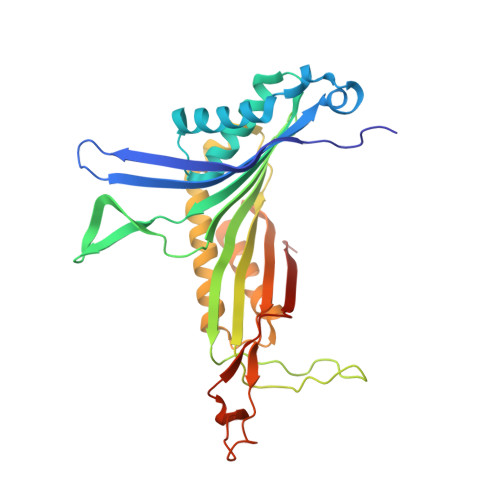
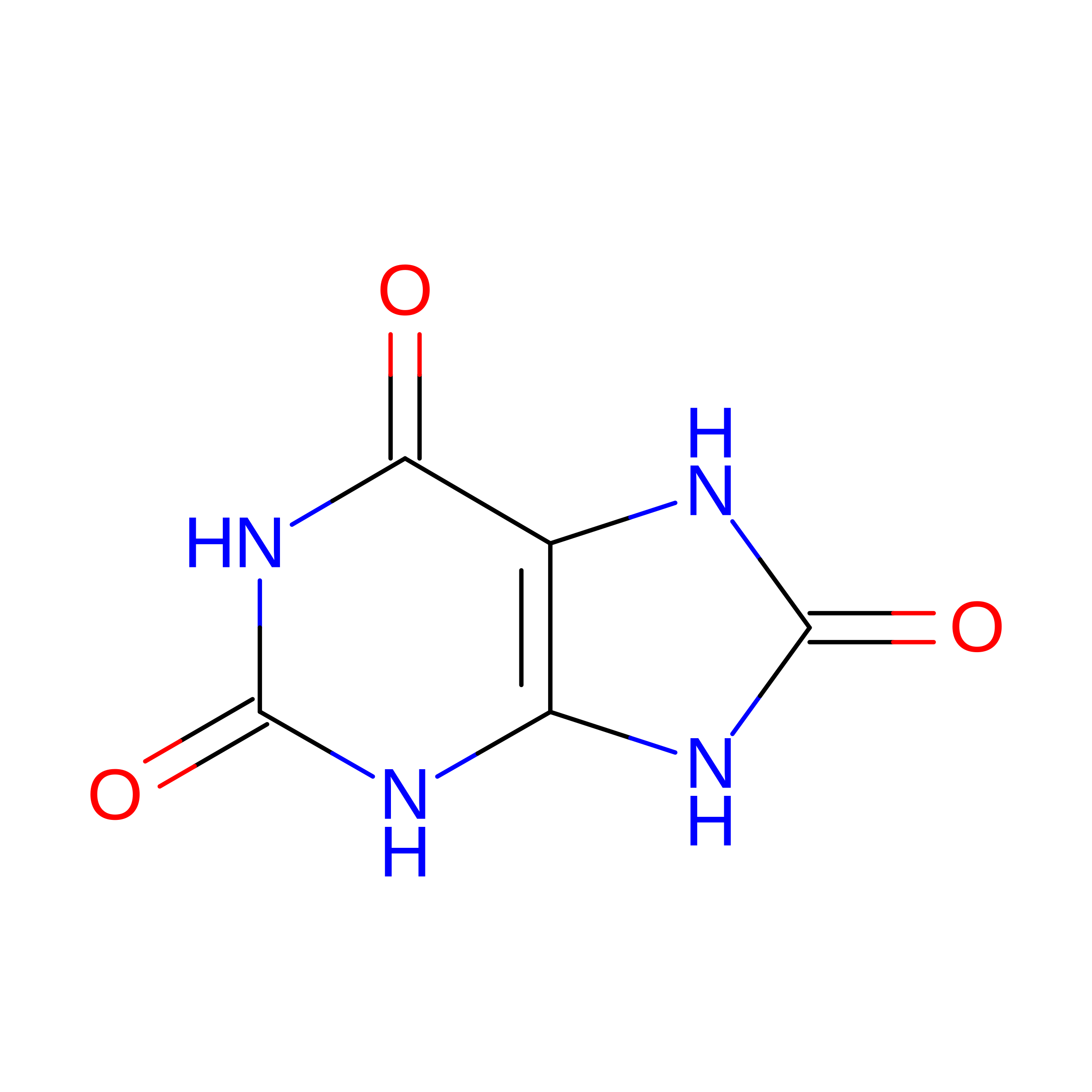
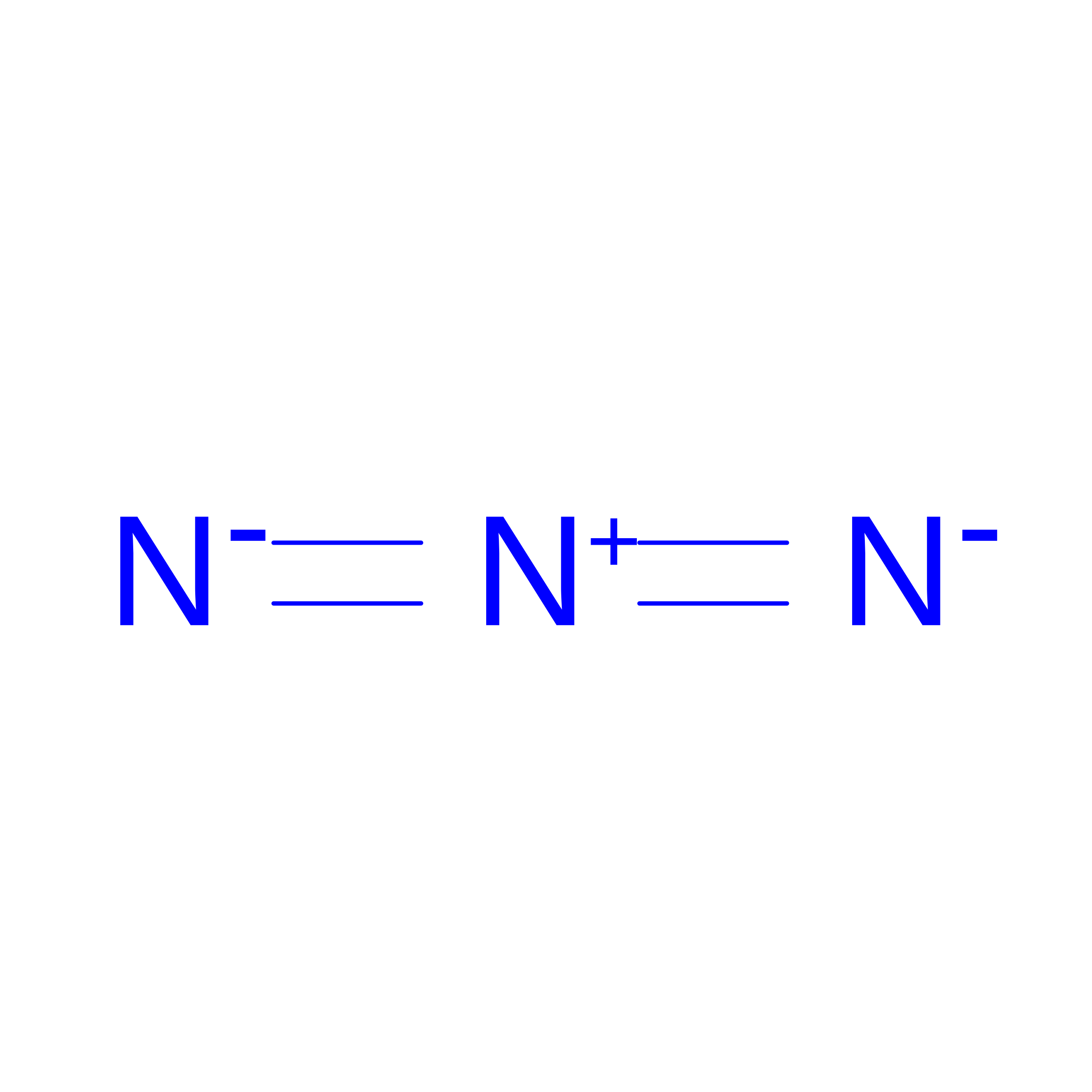
URATE OXIDASE AZIDE URIC ACID TERNARY complex


Experimental Data Snapshot

  • Method: X-RAY DIFFRACTION
  • Resolution: 1.16 Å
  • R-Value Work: 
    0.184 (Depositor), 0.193 (DCC) 
  • R-Value Observed: 
    0.184 (Depositor) 

Starting Model: experimental
View more details

wwPDB Validation 3D Report Full Report

Validation slider image for 4PR8

Ligand Structure Quality Assessment 


This is version 1.3 of the entry. See complete history

Literature

Azide inhibition of urate oxidase.

Gabison, L.Colloc'h, N.Prange, T.

(2014) Acta Crystallogr Sect F Struct Biol Cryst Commun 70: 896-902

  • DOI: https://doi.org/10.1107/S2053230X14011753
  • Primary Citation Related Structures: 
    4OQC, 4POE, 4PR8, 4PUV

  • PubMed Abstract: 

    The inhibition of urate oxidase (UOX) by azide was investigated by X-ray diffraction techniques and compared with cyanide inhibition. Two well characterized sites for reagents are present in the enzyme: the dioxygen site and the substrate-binding site. To examine the selectivity of these sites towards azide inhibition, several crystallization conditions were developed. UOX was co-crystallized with azide (N3) in the presence or absence of either uric acid (UA, the natural substrate) or 8-azaxanthine (8AZA, a competitive inhibitor). In a second set of experiments, previously grown orthorhombic crystals of the UOX-UA or UOX-8AZA complexes were soaked in sodium azide solutions. In a third set of experiments, orthorhombic crystals of UOX with the exchangeable ligand 8-nitroxanthine (8NXN) were soaked in a solution containing uric acid and azide simultaneously (competitive soaking). In all assays, the soaking periods were either short (a few hours) or long (one or two months). These different experimental conditions showed that one or other of the sites, or the two sites together, could be inhibited. This also demonstrated that azide not only competes with dioxygen as cyanide does but also competes with the substrate for its enzymatic site. A model in agreement with experimental data would be an azide in equilibrium between two sites, kinetically in favour of the dioxygen site and thermodynamically in favour of the substrate-binding site.


  • Organizational Affiliation
    • Faculty of Pharmacy, UMR 8015 CNRS Laboratoire de Cristallographie et RMN Biologiques, 4 Avenue de l'Observatoire, 75006 Paris, France.

Macromolecule Content 

  • Total Structure Weight: 34.46 kDa 
  • Atom Count: 2,692 
  • Modeled Residue Count: 296 
  • Deposited Residue Count: 302 
  • Unique protein chains: 1

Macromolecules

Find similar proteins by:|  3D Structure
Entity ID: 1
MoleculeChains  Sequence LengthOrganismDetailsImage
Uricase302Aspergillus flavusMutation(s): 1 
Gene Names: uaZuox
EC: 1.7.3.3
UniProt
Find proteins for Q00511 (Aspergillus flavus)
Explore Q00511 
Go to UniProtKB:  Q00511
Entity Groups
Sequence Clusters30% Identity50% Identity70% Identity90% Identity95% Identity100% Identity
UniProt GroupQ00511
Sequence Annotations
Expand
Reference Sequence

Experimental Data & Validation

Experimental Data

  • Method: X-RAY DIFFRACTION
  • Resolution: 1.16 Å
  • R-Value Work:  0.184 (Depositor), 0.193 (DCC) 
  • R-Value Observed: 0.184 (Depositor) 
Space Group: I 2 2 2
Unit Cell:
Length ( Å )Angle ( ˚ )
a = 78.577α = 90
b = 95.155β = 90
c = 104.823γ = 90
Software Package:
Software NamePurpose
MxCuBEdata collection
SHELXmodel building
SHELXL-97refinement
XDSdata reduction
SCALAdata scaling
TRUNCATEdata scaling
SHELXphasing

Structure Validation

View Full Validation Report


Ligand Structure Quality Assessment 


Entry History 

Deposition Data

Revision History  (Full details and data files)

  • Version 1.0: 2014-12-24
    Type: Initial release
  • Version 1.1: 2016-12-28
    Changes: Derived calculations
  • Version 1.2: 2023-11-08
    Changes: Data collection, Database references, Derived calculations, Refinement description
  • Version 1.3: 2024-10-30
    Changes: Structure summary