4PLP | pdb_00004plp

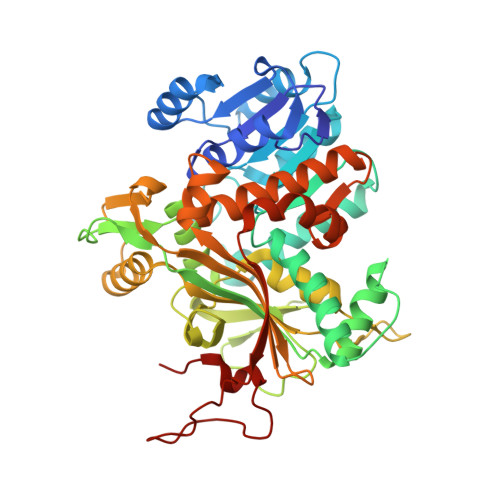
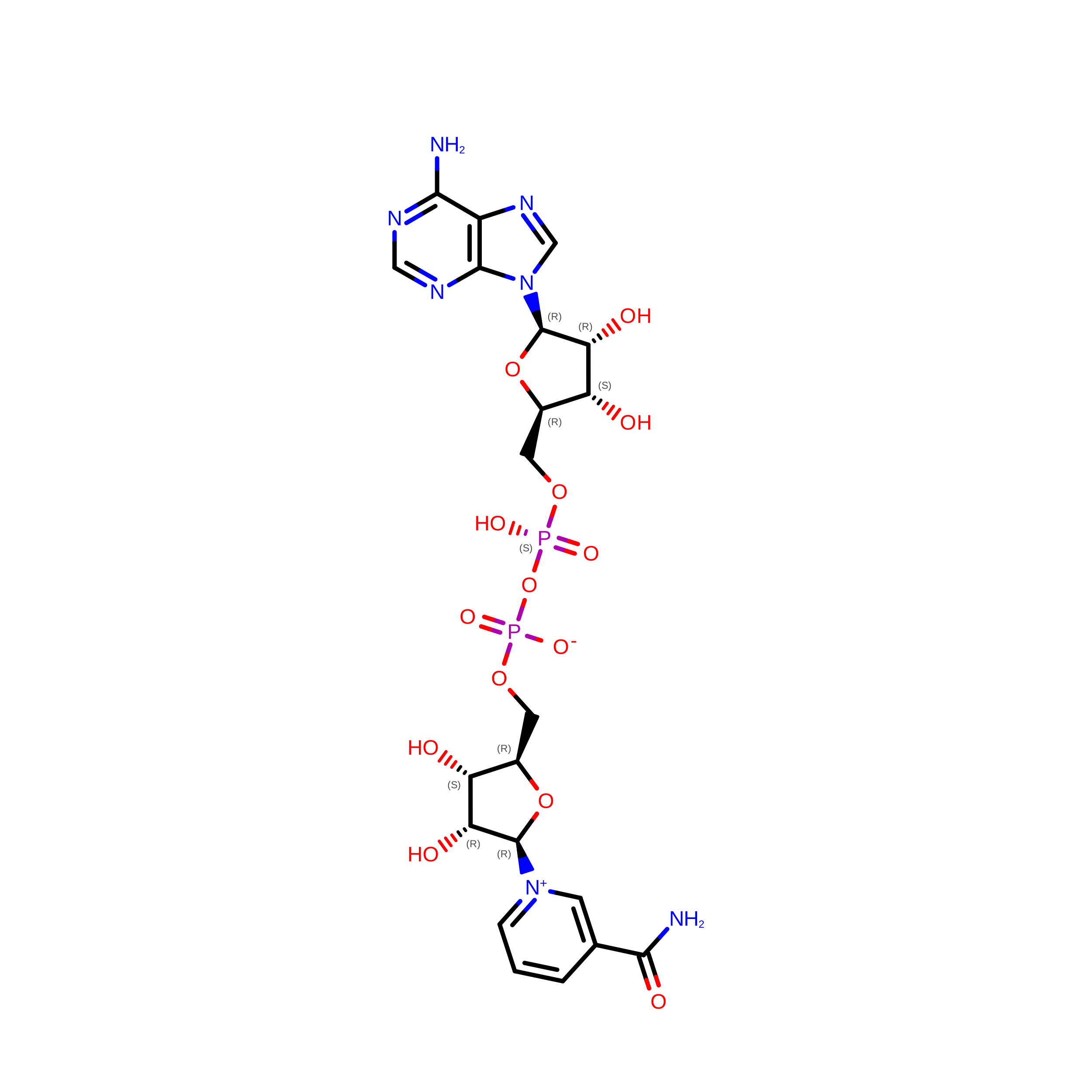
Crystal Structure of the Homospermidine Synthase (HSS) from Blastochloris viridis in Complex with NAD


Experimental Data Snapshot

  • Method: X-RAY DIFFRACTION
  • Resolution: 1.49 Å
  • R-Value Free: 
    0.225 (Depositor), 0.229 (DCC) 
  • R-Value Work: 
    0.191 (Depositor), 0.196 (DCC) 
  • R-Value Observed: 
    0.192 (Depositor) 

Starting Model: experimental
View more details

wwPDB Validation 3D Report Full Report

Validation slider image for 4PLP

Ligand Structure Quality Assessment 


This is version 1.2 of the entry. See complete history

Literature

Comprehensive Structural Characterization of the Bacterial Homospermidine Synthase-an Essential Enzyme of the Polyamine Metabolism.

Krossa, S.Faust, A.Ober, D.Scheidig, A.J.

(2016) Sci Rep 6: 19501-19501

  • DOI: https://doi.org/10.1038/srep19501
  • Primary Citation Related Structures: 
    4PLP, 4TVB, 4XQ9, 4XQC, 4XQE, 4XQG, 4XR4, 4XRG

  • PubMed Abstract: 

    The highly conserved bacterial homospermidine synthase (HSS) is a key enzyme of the polyamine metabolism of many proteobacteria including pathogenic strains such as Legionella pneumophila and Pseudomonas aeruginosa; The unique usage of NAD(H) as a prosthetic group is a common feature of bacterial HSS, eukaryotic HSS and deoxyhypusine synthase (DHS). The structure of the bacterial enzyme does not possess a lysine residue in the active center and thus does not form an enzyme-substrate Schiff base intermediate as observed for the DHS. In contrast to the DHS the active site is not formed by the interface of two subunits but resides within one subunit of the bacterial HSS. Crystal structures of Blastochloris viridis HSS (BvHSS) reveal two distinct substrate binding sites, one of which is highly specific for putrescine. BvHSS features a side pocket in the direct vicinity of the active site formed by conserved amino acids and a potential substrate discrimination, guiding, and sensing mechanism. The proposed reaction steps for the catalysis of BvHSS emphasize cation-π interaction through a conserved Trp residue as a key stabilizer of high energetic transition states.


  • Organizational Affiliation
    • Structural Biology-Zoological Institute, Kiel University, Am Botanischen Garten 11, 24118 Kiel, Germany.

Macromolecule Content 

  • Total Structure Weight: 107.35 kDa 
  • Atom Count: 8,700 
  • Modeled Residue Count: 950 
  • Deposited Residue Count: 958 
  • Unique protein chains: 1

Macromolecules

Find similar proteins by:|  3D Structure
Entity ID: 1
MoleculeChains  Sequence LengthOrganismDetailsImage
Homospermidine synthase
A, B
479Blastochloris viridisMutation(s): 0 
Gene Names: hss
EC: 2.5.1.44
UniProt
Find proteins for O32323 (Blastochloris viridis)
Explore O32323 
Go to UniProtKB:  O32323
Entity Groups
Sequence Clusters30% Identity50% Identity70% Identity90% Identity95% Identity100% Identity
UniProt GroupO32323
Sequence Annotations
Expand
Reference Sequence

Experimental Data & Validation

Experimental Data

  • Method: X-RAY DIFFRACTION
  • Resolution: 1.49 Å
  • R-Value Free:  0.225 (Depositor), 0.229 (DCC) 
  • R-Value Work:  0.191 (Depositor), 0.196 (DCC) 
  • R-Value Observed: 0.192 (Depositor) 
Space Group: P 21 21 21
Unit Cell:
Length ( Å )Angle ( ˚ )
a = 70.045α = 90
b = 109.792β = 90
c = 192.957γ = 90
Software Package:
Software NamePurpose
XDSdata reduction
SCALAdata scaling
MOLREPphasing
ARPmodel building
PDB_EXTRACTdata extraction
PHENIXrefinement

Structure Validation

View Full Validation Report


Ligand Structure Quality Assessment 


Entry History 

Deposition Data

  • Released Date: 2015-05-27 
  • Deposition Author(s): Krossa, S.

Revision History  (Full details and data files)

  • Version 1.0: 2015-05-27
    Type: Initial release
  • Version 1.1: 2016-01-27
    Changes: Database references
  • Version 1.2: 2023-12-20
    Changes: Data collection, Database references, Refinement description