4PGK | pdb_00004pgk

Insights into Substrate and Metal Binding from the Crystal Structure of Cyanobacterial Aldehyde Deformylating Oxygenase with Substrate Bound


Experimental Data Snapshot

  • Method: X-RAY DIFFRACTION
  • Resolution: 2.17 Å
  • R-Value Free: 
    0.223 (Depositor), 0.232 (DCC) 
  • R-Value Work: 
    0.219 (Depositor), 0.221 (DCC) 
  • R-Value Observed: 
    0.219 (Depositor) 

Starting Model: experimental
View more details

wwPDB Validation 3D Report Full Report

Validation slider image for 4PGK

Ligand Structure Quality Assessment 


This is version 1.3 of the entry. See complete history

Literature

Insights into substrate and metal binding from the crystal structure of cyanobacterial aldehyde deformylating oxygenase with substrate bound.

Buer, B.C.Paul, B.Das, D.Stuckey, J.A.Marsh, E.N.

(2014) ACS Chem Biol 9: 2584-2593

  • DOI: https://doi.org/10.1021/cb500343j
  • Primary Citation Related Structures: 
    4PG0, 4PG1, 4PGI, 4PGK, 4TW3

  • PubMed Abstract: 

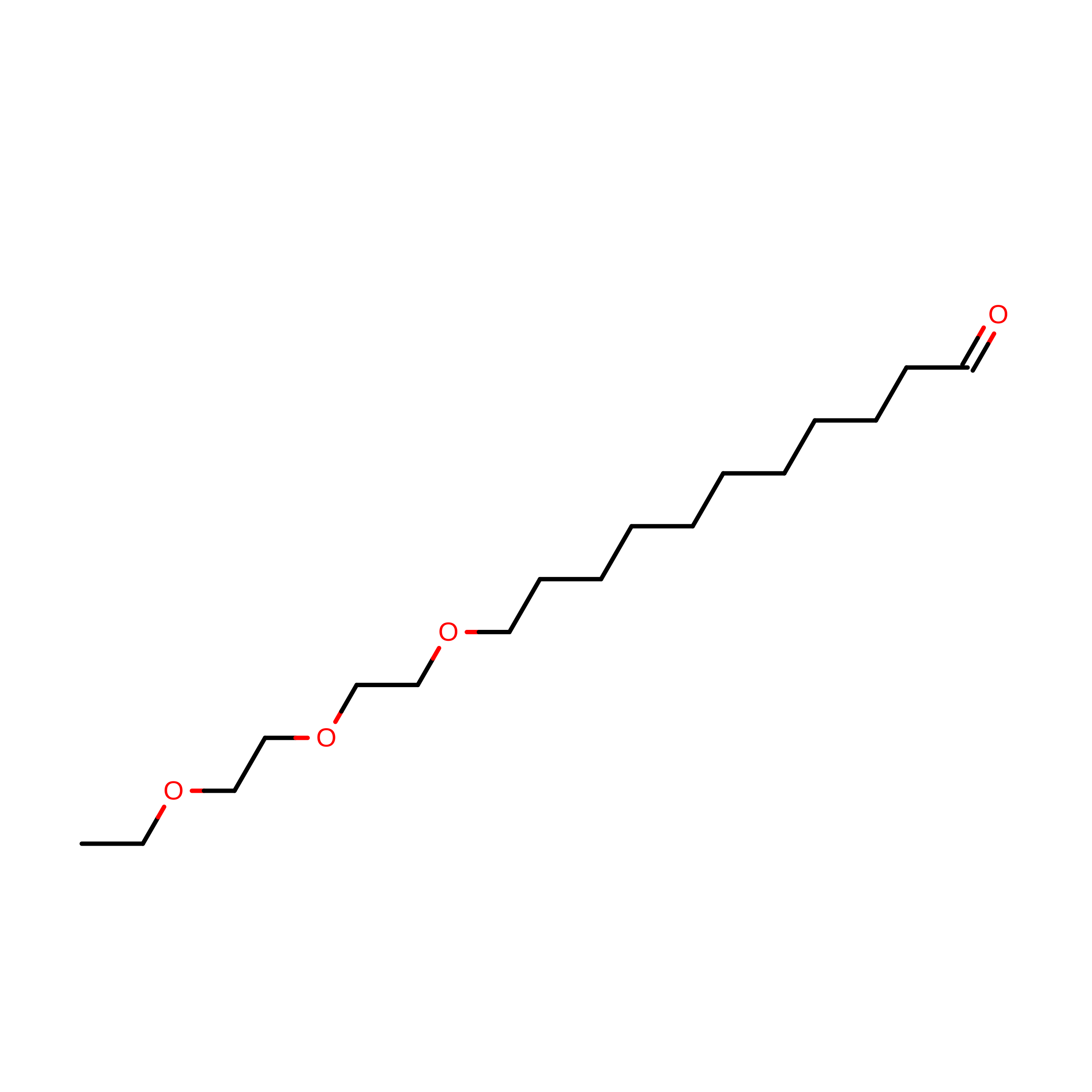
    The nonheme diiron enzyme cyanobacterial aldehyde deformylating oxygenase, cADO, catalyzes the highly unusual deformylation of aliphatic aldehydes to alkanes and formate. We have determined crystal structures for the enzyme with a long-chain water-soluble aldehyde and medium-chain carboxylic acid bound to the active site. These structures delineate a hydrophobic channel that connects the solvent with the deeply buried active site and reveal a mode of substrate binding that is different from previously determined structures with long-chain fatty acids bound. The structures also identify a water channel leading to the active site that could facilitate the entry of protons required in the reaction. NMR studies examining 1-[(13)C]-octanal binding to cADO indicate that the enzyme binds the aldehyde form rather than the hydrated form. Lastly, the fortuitous cocrystallization of the metal-free form of the protein with aldehyde bound has revealed protein conformation changes that are involved in binding iron.


  • Organizational Affiliation
    • Department of Chemistry, ‡Life Sciences Institute, and §Department of Biological Chemistry, University of Michigan , Ann Arbor, Michigan 48109, United States.

Macromolecule Content 

  • Total Structure Weight: 27.64 kDa 
  • Atom Count: 1,997 
  • Modeled Residue Count: 221 
  • Deposited Residue Count: 244 
  • Unique protein chains: 1

Macromolecules

Find similar proteins by:|  3D Structure
Entity ID: 1
MoleculeChains  Sequence LengthOrganismDetailsImage
Aldehyde decarbonylase244Prochlorococcus marinus str. MIT 9313Mutation(s): 2 
Gene Names: PMT_1231
EC: 4.1.99.5
UniProt
Find proteins for Q7V6D4 (Prochlorococcus marinus (strain MIT 9313))
Explore Q7V6D4 
Go to UniProtKB:  Q7V6D4
Entity Groups
Sequence Clusters30% Identity50% Identity70% Identity90% Identity95% Identity100% Identity
UniProt GroupQ7V6D4
Sequence Annotations
Expand
Reference Sequence

Experimental Data & Validation

Experimental Data

  • Method: X-RAY DIFFRACTION
  • Resolution: 2.17 Å
  • R-Value Free:  0.223 (Depositor), 0.232 (DCC) 
  • R-Value Work:  0.219 (Depositor), 0.221 (DCC) 
  • R-Value Observed: 0.219 (Depositor) 
Space Group: P 43 21 2
Unit Cell:
Length ( Å )Angle ( ˚ )
a = 77.34α = 90
b = 77.34β = 90
c = 116.96γ = 90
Software Package:
Software NamePurpose
HKL-2000data reduction
PDB_EXTRACTdata extraction
Cootmodel building
BUSTERrefinement
PHASERphasing

Structure Validation

View Full Validation Report


Ligand Structure Quality Assessment 


Entry History 

Deposition Data

Revision History  (Full details and data files)

  • Version 1.0: 2014-12-24
    Type: Initial release
  • Version 1.1: 2015-02-04
    Changes: Derived calculations
  • Version 1.2: 2017-11-22
    Changes: Derived calculations, Other, Refinement description, Source and taxonomy
  • Version 1.3: 2023-09-27
    Changes: Data collection, Database references, Refinement description