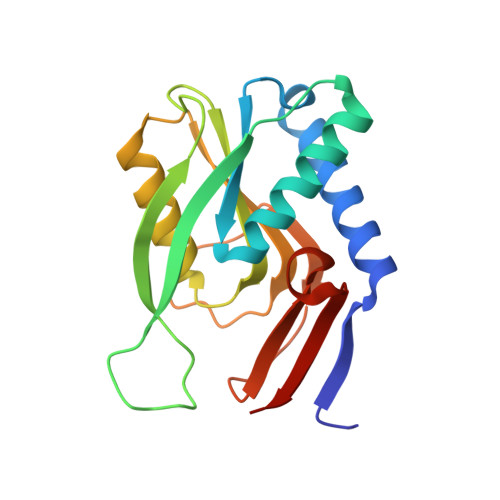
4P82 | pdb_00004p82

Structure of PyrR protein from Bacillus subtilis


Experimental Data Snapshot

  • Method: X-RAY DIFFRACTION
  • Resolution: 1.30 Å
  • R-Value Free: 
    0.206 (Depositor), 0.216 (DCC) 
  • R-Value Work: 
    0.179 (Depositor), 0.188 (DCC) 
  • R-Value Observed: 
    0.180 (Depositor) 

Starting Model: experimental
View more details

wwPDB Validation 3D Report Full Report

Validation slider image for 4P82

This is version 1.2 of the entry. See complete history

Literature

Evolution of oligomeric state through allosteric pathways that mimic ligand binding.

Perica, T.Kondo, Y.Tiwari, S.P.McLaughlin, S.H.Kemplen, K.R.Zhang, X.Steward, A.Reuter, N.Clarke, J.Teichmann, S.A.

(2014) Science 346: 1254346-1254346

  • DOI: https://doi.org/10.1126/science.1254346
  • Primary Citation Related Structures: 
    4P3K, 4P80, 4P81, 4P82, 4P83, 4P84, 4P86

  • PubMed Abstract: 

    Evolution and design of protein complexes are almost always viewed through the lens of amino acid mutations at protein interfaces. We showed previously that residues not involved in the physical interaction between proteins make important contributions to oligomerization by acting indirectly or allosterically. In this work, we sought to investigate the mechanism by which allosteric mutations act, using the example of the PyrR family of pyrimidine operon attenuators. In this family, a perfectly sequence-conserved helix that forms a tetrameric interface is exposed as solvent-accessible surface in dimeric orthologs. This means that mutations must be acting from a distance to destabilize the interface. We identified 11 key mutations controlling oligomeric state, all distant from the interfaces and outside ligand-binding pockets. Finally, we show that the key mutations introduce conformational changes equivalent to the conformational shift between the free versus nucleotide-bound conformations of the proteins.


  • Organizational Affiliation
    • European Bioinformatics Institute, Wellcome Trust Genome Campus, Hinxton, Cambridge CB10 1SD, UK. Medical Research Council (MRC) Laboratory of Molecular Biology, Francis Crick Avenue, Cambridge Biomedical Campus, Cambridge CB2 0QH, UK.

Macromolecule Content 

  • Total Structure Weight: 20.53 kDa 
  • Atom Count: 1,649 
  • Modeled Residue Count: 180 
  • Deposited Residue Count: 183 
  • Unique protein chains: 1

Macromolecules

Find similar proteins by:|  3D Structure
Entity ID: 1
MoleculeChains  Sequence LengthOrganismDetailsImage
Bifunctional protein PyrR183Bacillus subtilis subsp. subtilis str. 168Mutation(s): 0 
Gene Names: pyrRBSU15470
EC: 2.4.2.9
UniProt
Find proteins for P39765 (Bacillus subtilis (strain 168))
Explore P39765 
Go to UniProtKB:  P39765
Entity Groups
Sequence Clusters30% Identity50% Identity70% Identity90% Identity95% Identity100% Identity
UniProt GroupP39765
Sequence Annotations
Expand
Reference Sequence

Small Molecules

Ligands 1 Unique
IDChains Name / Formula / InChI Key2D Diagram3D Interactions
SO4

Query on SO4


Download:Ideal Coordinates CCD File
B [auth A]SULFATE ION
O4 S
QAOWNCQODCNURD-UHFFFAOYSA-L

Experimental Data & Validation

Experimental Data

  • Method: X-RAY DIFFRACTION
  • Resolution: 1.30 Å
  • R-Value Free:  0.206 (Depositor), 0.216 (DCC) 
  • R-Value Work:  0.179 (Depositor), 0.188 (DCC) 
  • R-Value Observed: 0.180 (Depositor) 
Space Group: C 1 2 1
Unit Cell:
Length ( Å )Angle ( ˚ )
a = 76.54α = 90
b = 57.6β = 128.39
c = 54.77γ = 90
Software Package:
Software NamePurpose
REFMACrefinement
XDSdata reduction
XSCALEdata scaling
PHASERphasing

Structure Validation

View Full Validation Report


Entry History 

Deposition Data

Revision History  (Full details and data files)

  • Version 1.0: 2014-12-17
    Type: Initial release
  • Version 1.1: 2014-12-31
    Changes: Database references
  • Version 1.2: 2023-12-20
    Changes: Data collection, Database references, Refinement description