4OYD | pdb_00004oyd

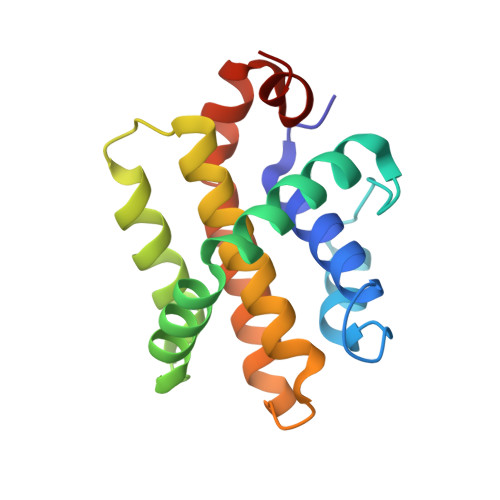
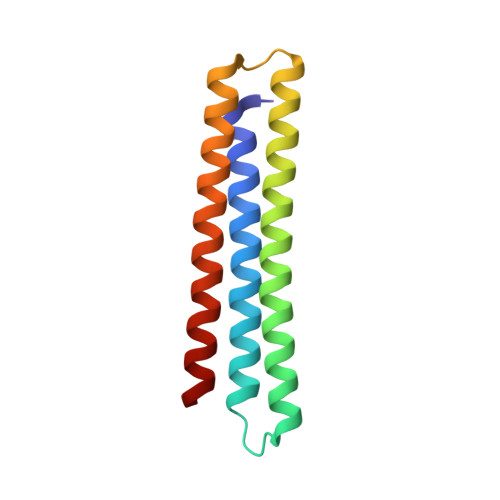
Crystal structure of a computationally designed inhibitor of an Epstein-Barr viral Bcl-2 protein


Experimental Data Snapshot

  • Method: X-RAY DIFFRACTION
  • Resolution: 1.80 Å
  • R-Value Free: 
    0.178 (Depositor), 0.211 (DCC) 
  • R-Value Work: 
    0.145 (Depositor) 
  • R-Value Observed: 
    0.147 (Depositor) 

wwPDB Validation 3D Report Full Report

Validation slider image for 4OYD

This is version 1.3 of the entry. See complete history. 

Literature

A computationally designed inhibitor of an epstein-barr viral bcl-2 protein induces apoptosis in infected cells.

Procko, E., Berguig, G.Y., Shen, B.W., Song, Y., Frayo, S., Convertine, A.J., Margineantu, D., Booth, G., Correia, B.E., Cheng, Y., Schief, W.R., Hockenbery, D.M., Press, O.W., Stoddard, B.L., Stayton, P.S., Baker, D.

(2014) Cell 157: 1644-1656

  • DOI: https://doi.org/10.1016/j.cell.2014.04.034
  • Primary Citation Related Structures: 
    4OYD

  • PubMed Abstract: 

    Because apoptosis of infected cells can limit virus production and spread, some viruses have co-opted prosurvival genes from the host. This includes the Epstein-Barr virus (EBV) gene BHRF1, a homolog of human Bcl-2 proteins that block apoptosis and are associated with cancer. Computational design and experimental optimization were used to generate a novel protein called BINDI that binds BHRF1 with picomolar affinity. BINDI recognizes the hydrophobic cleft of BHRF1 in a manner similar to other Bcl-2 protein interactions but makes many additional contacts to achieve exceptional affinity and specificity. BINDI induces apoptosis in EBV-infected cancer lines, and when delivered with an antibody-targeted intracellular delivery carrier, BINDI suppressed tumor growth and extended survival in a xenograft disease model of EBV-positive human lymphoma. High-specificity-designed proteins that selectively kill target cells may provide an advantage over the toxic compounds used in current generation antibody-drug conjugates.


  • Organizational Affiliation: 
    • Department of Biochemistry, University of Washington, Seattle, WA 98195, USA.

Macromolecule Content 

  • Total Structure Weight: 64.06 kDa 
  • Atom Count: 4,854 
  • Modeled Residue Count: 548 
  • Deposited Residue Count: 550 
  • Unique protein chains: 2

Macromolecules

Find similar proteins by:|  3D Structure
Entity ID: 1
MoleculeChains  Sequence LengthOrganismDetailsImage
Apoptosis regulator BHRF1
A, C
158Epstein-barr virus strain ag876Mutation(s): 0 
Gene Names: BHRF1
UniProt
Find proteins for P0C6Z1 (Epstein-Barr virus (strain AG876))
Explore P0C6Z1 
Go to UniProtKB:  P0C6Z1
Entity Groups
Sequence Clusters30% Identity50% Identity70% Identity90% Identity95% Identity100% Identity
UniProt GroupP0C6Z1
Sequence Annotations
Expand
Reference Sequence
Find similar proteins by:|  3D Structure
Entity ID: 2
MoleculeChains  Sequence LengthOrganismDetailsImage
Computationally designed Inhibitor
B, D
117synthetic constructMutation(s): 0 
Entity Groups
Sequence Clusters30% Identity50% Identity70% Identity90% Identity95% Identity100% Identity
Sequence Annotations
Expand
Reference Sequence

Small Molecules

Ligands 1 Unique
IDChains Name / Formula / InChI Key2D Diagram3D Interactions
EDO

Query on EDO


Download:Ideal Coordinates CCD File
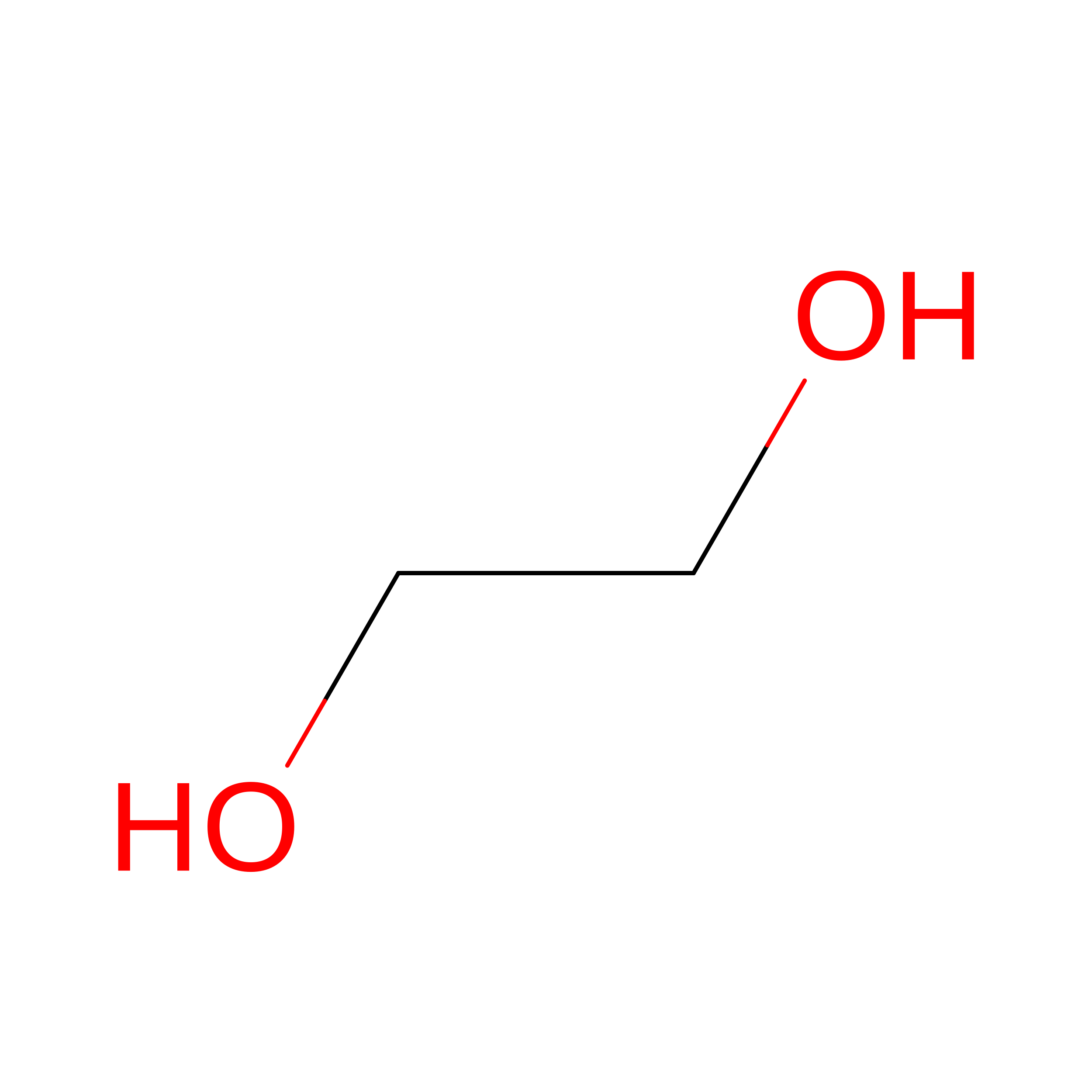
E [auth D]1,2-ETHANEDIOL
C2 H6 O2
LYCAIKOWRPUZTN-UHFFFAOYSA-N

Experimental Data & Validation

Experimental Data

  • Method: X-RAY DIFFRACTION
  • Resolution: 1.80 Å
  • R-Value Free:  0.178 (Depositor), 0.211 (DCC) 
  • R-Value Work:  0.145 (Depositor) 
  • R-Value Observed: 0.147 (Depositor) 
Space Group: P 1 21 1
Unit Cell:
Length ( Å )Angle ( ˚ )
a = 52.103α = 90
b = 113.869β = 90.03
c = 55.67γ = 90
Software Package:
Software NamePurpose
REFMACrefinement

Structure Validation

View Full Validation Report


Entry History 

Deposition Data

Revision History  (Full details and data files)

  • Version 1.0: 2014-07-09
    Type: Initial release
  • Version 1.1: 2015-01-14
    Changes: Database references
  • Version 1.2: 2017-11-01
    Changes: Advisory, Author supporting evidence, Derived calculations, Source and taxonomy
  • Version 1.3: 2023-12-27
    Changes: Data collection, Database references, Refinement description